
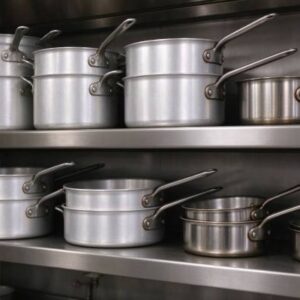
Aluminium sirkel vir kookware | Deep Drawing Discs Factory
| Spesifikasie | Waarde |
| Allooi | 1050 / 1060 / 1100, 3003, 5052 |
| Gemoed | O (annealed for deep drawing) |
| Dikte | 0.6–6 mm (pans 1.5–3 mm; heavy/induction 3–5 mm) |
| Deursnee | 100–500 mm, blanked to tooling |
| Induction | stainless clad base available / specified |
| Voldoening | FDA / Eu 1935/2004 / LFGB food-contact as required |
| QC | alloy-temper certificate, dikte, platheid, draw-sample test |
| Belangrikste produkte | wok, braaipanne, kastrolle, voorraadpotte, milk pans, bakplate |
Aluminium sirkel vir kookware
Bekendstelling
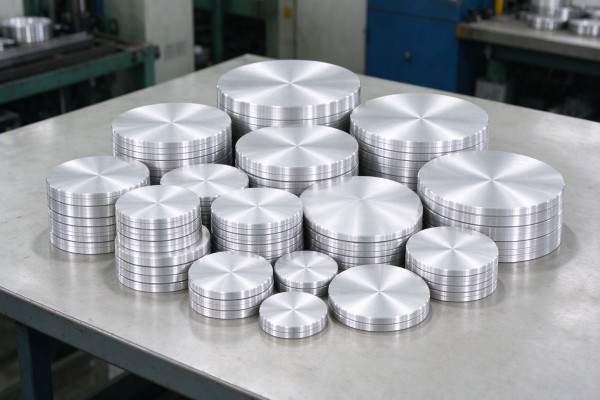
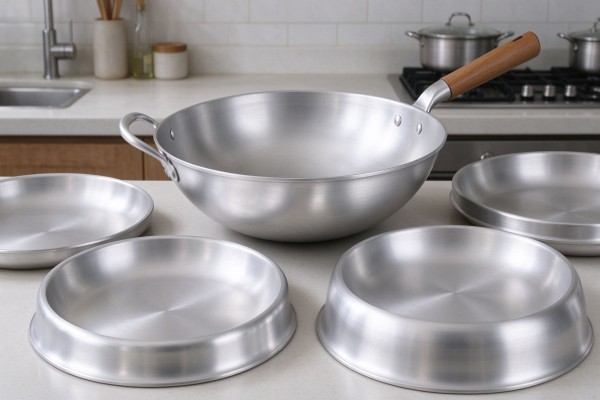
’n Aluminiumsirkel vir kookware is ’n ronde aluminium-blanko wat diep getrek is, in die lyf van 'n wok gespin of gestempel, braaipan, kastrol, voorraad pot, melkpan of bakplaat.
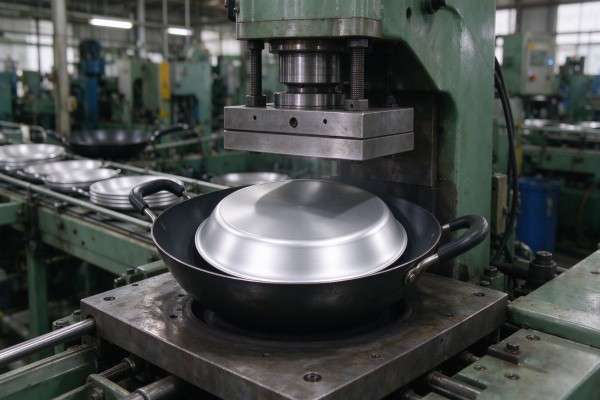
Dit is die beginmateriaal vir byna alle geperste aluminium kookware: 'n plat skyf word op 'n dieptrekpers geplaas en in 'n naatlose koppie gevorm, dan afgewerk, skoongemaak, bedek of geanodiseer, en toegerus met handvatsels.
Die kwaliteit van die sirkel bepaal direk of die pan skoon trek, hou 'n gelyke muur, bly plat op die hitte en neem 'n kleefvrye of geanodiseerde afwerking.
Kookgerei vervaardigers wêreldwyd verkry hierdie skywe van Chinese aluminium meulens omdat die rol, blanking en dieptrek-gereed aanbod is volwasse en koste-mededingend.
Hierdie gids verduidelik watter legerings en humeure in kookware intrek, die tipiese skyfgroottes vir gewone panne, hoe diep tekening werk en wat oorring veroorsaak, lemoenskil of kraak, hoe kleefvrye en geanodiseerde afwerkings en induksiebeklede basisse bygevoeg word, en hoe om konsekwente kookware-sirkels te spesifiseer en bestel.
Dit is geskryf vir panfabrieke, kookware handelsmerke en invoerders.
Wat is 'n aluminium sirkel vir kookware?
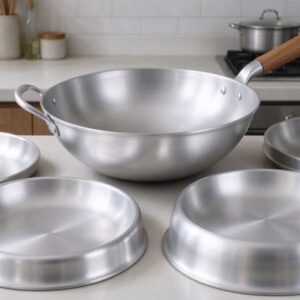
Die sirkel is 'n plat skyf wat uit aluminiumspoel of -plaat gesny is, normaalweg 0,6–6 mm dik en ongeveer 100–500 mm in deursnee, verskaf in die sagte O-temper sodat dit gevorm kan word.
In plaas daarvan om 'n voltooide pan te koop, die kookware fabriek koop die blanko, teken dit in sy eie gereedskap, voeg dan die binnebedekking by, buite-afwerking, handles and packaging.
Supplying the circle rather than the finished body lets each factory control its own designs and branding.
Three properties make a circle good for cookware: it must be soft and ductile enough to deep-draw without cracking, it must have a clean, uniform surface so coatings adhere, and it must have low earing (uneven rim height) so little material is trimmed.
The right alloy, temper and annealing route all contribute, which is why not every aluminum sheet makes a good wok blank.
Die mees algemene kookgerei spasies is sag 1050 aluminium sirkel for pure-aluminum and economy pans, 3003 aluminium sirkel for general non-stick cookware, en 5000-reeks aluminium plaat soos 5052 vir premium hard-geanodiseerde liggame.
Sirkels word teen 'n hoë spoed van die spoel geneste-blank gemaak, daarom is hulle 'n doeltreffende begindeel: die ronde spasies pak styf oor die strook, bietjie afval agterlaat, en die geskeerde rand is skoon vir die pers.
Die verskaffing van 'n vooraf-blanke skyf eerder as 'n reghoekige vel spaar ook die kookwarefabriek om sy eie blankolyn te gebruik, sodat die fabriek op teken kan fokus, coating en montering.
Die meule beheer die uitgloeiing en die breekverdraagsaamheid, terwyl die kookwarefabriek sy eie gereedskap en afwerking beheer.
Waarom kookware van aluminiumsirkels gemaak word
-
- Hoë termiese geleidingsvermoë: aluminium verhit vinnig en versprei hitte oor die basis, warm kolle te verminder.
- Lae digtheid: 'n diepgetrekte aluminiumpan is lig en maklik om te hanteer, anders as gietyster of dik vlekvrye.
- Uitstekende vormbaarheid: sagte O-temper aluminium trek diep in lang wokke en panne in een of paar drukke.
- Oppervlak-versoenbaar: aluminum takes non-stick PTFE/ceramic coatings, hard anodizing and polishing well.
- Affordable: rolled and blanked circle material is low cost compared with cast, forged or stainless cookware.
- Herwinbaar: aluminum cookware is among the most recyclable kitchen products.
The main limitations are that bare aluminum reacts with acidic foods, which is solved by coating or anodizing; and that pure aluminum is not naturally magnetic, so induction cooktops require a bonded stainless steel base (covered in Section 11).
Compared with other cookware materials, aluminum sits between stainless steel and cast iron.
It heats faster and lighter than stainless, is far cheaper and more formable than copper, and does not carry the heavy weight or slow heating of cast iron.
That balance of speed, gewig, formability and cost is why the mass market—from consumer non-stick pans to commercial stockpots—is dominated by pressed aluminum drawn from circles.
A stainless pan is heavier and slower to heat, a cast iron pan is slow and heavy, en 'n koperpan is duur; aluminium uit 'n behoorlik gekose sirkel gee die beste alledaagse kompromie.
Watter aluminiumlegering vir kookgerei?
| Allooi | Eienskappe | Tipiese kookgerei gebruik |
| 1050 / 1060 / 1100 | baie sag, rekbaar, goeie trekking, Lae koste | suiwer aluminium panne, melk potte, ekonomiese ware |
| 3003 (Al-Mn) | matige krag, goeie trekking, robuust | algemene kleefvrye braaipanne en kastrolle |
| 5000 reeks (5052) | sterker, korrosiebestand, hard-anodiseer goed | premium hard-geanodiseerde kookware, swaar basisse |
| 6061 / 6063 | hitte behandelbaar, nie die gewone dieptrek leeg nie | handvatsels, deksels, strukturele dele |
Die meeste geperste kookware gebruik 1050/1060 of 3003 in die O humeur.
Suiwer 1000-reeks aluminium is die sagste en goedkoopste en trek in eenvoudige panne en melkpotte; 3003 adds manganese for a bit more strength and dent resistance, which is why it is the workhorse of non-stick frypans.
5052 is chosen when the pan must be thicker, heavier and hard-anodized, because the 5xxx film anodizes to a hard, durable dark surface. Buyers rarely need a 6xxx alloy for the drawn body; those grades are more often used for handles and lids.
For coated cookware the alloy matters less than the surface and temper, because the non-stick coating covers the aluminum.
For hard-anodized cookware the alloy matters a lot: 5052 spieëlblad en 3003 anodize consistently, while very pure 1xxx gives a softer film.
The supplier should recommend the alloy once the factory says whether the pan will be non-stick, polished or hard-anodized.
Gemoed: Why O Is the Cookware Standard
Cookware circles are almost always supplied in the O (uitgegloei) humeur.
O means the coil has been fully annealed, giving the lowest yield strength and the highest elongation, which is exactly what deep drawing needs: the metal flows into the die without tearing.
A work-hardened H temper circle would crack or wrinkle when drawn into a deep wok, and a half-hard disc would spring back.
So even when the finished pan feels rigid, the blank arrived soft.
The anneal must be correct: too soft and the blank wrinkles or thins unevenly; too hard and it cracks at the corner.
A consistent, low-earing O-temper circle from a hot-rolled, well-annealed coil gives the most stable deep drawing.
For very shallow parts some factories use a light H12/H14 temper, but deep woks, deep saucepans and tall stockpot bodies always use O.
The annealing route also sets the grain size and texture. A coil annealed to a fine, uniform grain draws smoothly and shows little orange peel, while an over-annealed or coarse-grain coil gives a textured surface on the bright pan.
The rolling direction and the subsequent anneal control earing: a well-processed hot-rolled circle draws with almost no lobes, so the trim scrap is low and the press runs cleanly.
This is why cookware buyers ask for the annealing practice, not just the temper letter, when qualifying a new mill.
Typical Dimensions and Pan Sizes
| Parameter | Tipiese reeks | Notas |
| Dikte | 0.6–6 mm | pans 1.5–3 mm; heavy/induction bases 3–5 mm |
| Deursnee | 100–500 mm | sized to the drawn pan and trimming allowance |
| Gemoed | O | annealed for deep drawing |
| Platheid | no buckle or wave | must lie flat in the die |
| Rand | clean bur-free shear | no sharp burr that marks the die |
The circle diameter is larger than the finished pan because deep drawing consumes material around the rim that is later trimmed off.
A 280 mm frying pan typically starts from a blank around 450–550 mm depending on the depth; tall woks and deep stockpots need a much larger blank than a shallow skillet.
The cookware factory calculates the blank size from its draw, and the mill blanks to that exact diameter with a dedicated die.
Tolerances are tight because the blank must nest in the die and draw evenly.
Thickness varies only a few hundredths of a millimeter across the coil, diameter is held to the blanking die, and the disc must be flat and free of waves; a buckled circle wrinkles in the press.
The sheared edge is also clean and deburred so it does not mark the die or create a sharp rim on the finished pan.
These controls are what separate a cookware-grade circle from general aluminum sheet.
A typical illustration: a 280 mm deursnee, 50 mm deep skillet might start from a blank around 480 mm, while a 320 mm wok 100 mm deep may need a 600 mm blank.
The extra diameter is material pulled down the wall and trimmed off the rim, so a deep pan consumes far more blank than a shallow one.
Weight and thickness are checked against the part: a heavy commercial stockpot uses a 4 mm circle, while a light consumer frypan uses a 1.8–2.5 mm circle.
The cookware factory shares its draw, and the mill confirms the blank diameter and thickness before tooling.
How a Circle Becomes a Pan: Diep tekening
Deep drawing places the flat circle over a die cavity, holds it down with a blank holder to control wrinkling, and pushes a punch into the disc so the material flows downward into a cup.
In een slag word die plat spasie 'n naatlose panlyf; langer of dieper dele gebruik veelvuldige trekkings, met 'n tussenuitgloeiing as die werk verhard.
Die leë houer krag, smering en pons/matryspeling is ingestel sodat die muur eweredig verdun en die hoek nie skeur nie.
Die beperkende trekverhouding (LDR) beskryf hoe diep 'n koppie uit 'n gegewe spasie getrek kan word voordat dit skeur: sagte O-temper 1050/3003 trek dieper as hard-temper of hoër-sterkte legerings.
Dun panne word met 'n relatief dik spasie getrek en afgesny; heavy commercial stockpots use a thick circle and sometimes ironing (wall-thinning) after drawing to make a tall, straight-sided pot.
Consistent circle thickness and low earing are what let the press run at high speed without line stops.
Very deep or straight-sided parts are often made in more than one draw: a first shallow cup is redrawn through a smaller die to increase depth, and if the wall must be thinned for a light, tall pot, an ironing step squeezes the wall between punch and die.
Each draw work-hardens the aluminum, so intermediate annealing restores ductility between operations.
A consistent circle—same thickness, same temper, same grain—is essential across these steps, because a variation in the blank changes the draw and can tear at the corner.
Drawing needs three things tuned together: enough blank-holder pressure to stop the flange wrinkling, the right die/punch clearance so the wall thins rather than folds, and press lubrication that lets the aluminum slide over the tool without galling.
Too little hold-down wrinkles the rim; too much cracks the corner. A soft, consistent O-temper circle responds predictably to these settings, which is why a stable blank lets the press run fast with few rejected parts.
Common Drawing Defects and Their Cause
| Defek | Voorkoms | Main cause |
| Oorbelle | wavy lobes on the drawn rim | uneven crystallographic texture / poor anneal |
| Orange peel | rough grainy surface | coarse grain in the blank |
| Strain lines / skeur | cracks or lines at the corner | too hard temper, too deep a draw, poor clearance |
| Wrinkling | waves on the wall or flange | blank holder too light or blank too thin |
| Uneven wall | thin spot that burns through | poor lubrication or uneven thickness |
Earing is the most circle-specific defect: it shows as four or six lobes around the rim after drawing, forcing extra trimming and scrap.
It comes from the way the coil was rolled and annealed, so a low-earing, hot-rolled O-temper circle is essential for high-volume pans.
Orange peel comes from a coarse grain and shows as a textured surface on the finished pan, which is visible on polished or bright surfaces.
Cracks and tearing usually mean the temper is too hard for that draw depth, or the die clearance and lubrication are wrong.
A cookware factory should run a draw trial with the first lot to confirm the circle behaves in its die.
Most of these defects are avoided upstream, not in the press.
Earing and orange peel are set by the coil’s rolling and annealing route, so a low-earing, fine-grain, warmgewalste O-temper sirkel verhoed hulle voor gestempel; krake word voorkom deur die korrekte sagte humeur vir die trekdiepte te verskaf; rimpeling deur die korrekte blankohouerdruk; en bedek vlekke deur skoon te maak, olievrye materiaal.
Dit is hoekom 'n kookwarefabriek 'n meule met 'n trekmonster kwalifiseer eerder as om teen prys alleen te koop, en hoekom herhaal bestellings op dieselfde spoelspesifikasie bly.
Kookgerei gemaak van sirkels
Dieselfde oopmaak- en dieptrekroete produseer die meeste geperste aluminium kookgerei.
Frying pans and skillets are shallow draws from a thin circle; woks are deep draws that need a very ductile O-temper blank; saucepans and stockpots are deeper, straight-sided draws, often with a heavier base; milk pans and baking trays are shallow, simple forms.
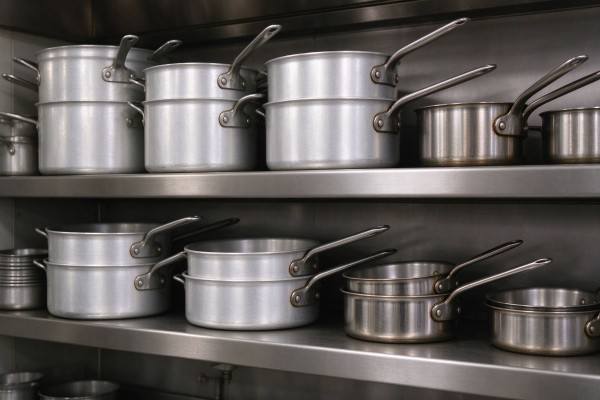
Commercial kitchen stockpots use thick, robust circles, while consumer non-stick pans use thinner, lighter ones.
After drawing, the body is trimmed to a clean rim, the edge is curled or rolled, handle holes are punched, the surface is treated, and the interior is coated or polished.
Handles and lids are then riveted or screwed on. Because the drawn body is seamless, there is no welded corner to leak or trap food, which is why pressed aluminum cookware is easy to clean.
Consumer and commercial cookware differ in the circle they draw.
Household non-stick pans use thin 1.5–2.5 mm O-temper 1050/3003 circles for lightness and low cost; restaurant stockpots and woks use thick 3–5 mm 3003 of 5052 circles that stand up to daily heavy use, denting and alkaline cleaning.
Premium consumer hard-anodized sets sit between the two, using a mid-thick 5052 body that anodizes to a durable dark surface. The same drawing line can serve both markets by changing the alloy, gauge and finish.
Surface and Coating After Drawing
The drawn aluminum body is finished in one of several ways.
Most consumer non-stick pans are degreased, then grit-blasted or chemically etched to give the coating a grip, sprayed with a primer and one or more PTFE (Teflon-type) or ceramic non-stick layers, and cured in an oven.
Premium pans are hard-anodized to a thick, dark, non-reactive oxide layer, sometimes with a non-stick coating over it; economy and commercial pans are left polished or satin.
The cleanliness and grain of the original circle matter here, because any scratch or rolling mark shows through a coating.
Non-stick lines coat dozens of bodies per hour on a conveyor, so the incoming drawn bodies must be consistent in size and surface.
A circle with a dirty or oxidized surface gives poor coating adhesion; a circle with orange peel gives a textured interior.
This is why cookware makers ask their mill for a clean, uitgegloei, low-contamination O-temper disc rather than the cheapest possible scrap-tainted sheet.
The three finishes suit different price points. PTFE non-stick is the most common, durable and affordable, sprayed in multiple primer-and-topcoat layers and cured;
ceramic non-stick is a newer, inorganic option marketed as free of PTFE, with different wear behavior; and hard anodizing builds a thick, dark, non-reactive oxide that can stand alone or carry a non-stick coat.
All three depend on a clean, properly prepared aluminum surface—oily, oxidized or orange-peel material ruins adhesion—so the incoming circle quality is as important as the coating line itself.
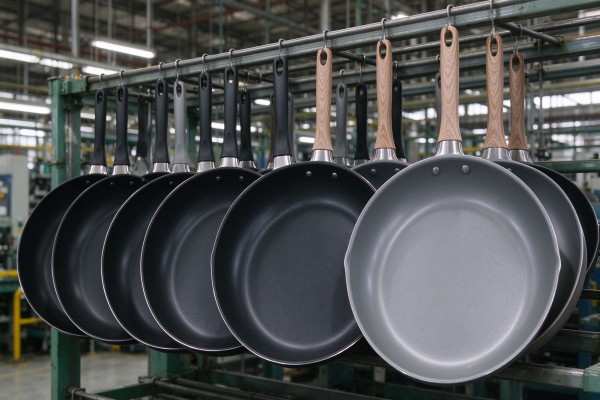
A typical non-stick line degreases and etches the drawn body, applies a primer that bonds to the aluminum, then one or two topcoat layers, and cures each in an oven.
Film bou, cure temperature and cleanliness control how long the coating lasts.
Because the coating is thin, any deep scratch, orange-peel grain or oily residue on the incoming blank shows through, which is why a clean, fine-grain circle is the silent requirement of a good non-stick factory.
Induction and Clad Bases
Aluminum is not magnetic, so a bare aluminum pan will not heat on an induction hob.
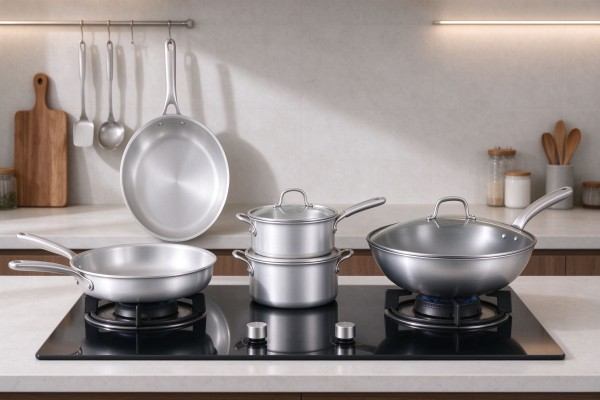
The standard solution is to bond a magnetic stainless steel disc (gewoonlik 430 of 304) to the bottom of the drawn body.
This is done by inserting a stainless sheet between the aluminum circle and a lower aluminum layer before drawing, or by bonding/stir-welding a stainless disc to the finished base and then flattening it.
The result is a clad base: an aluminum core inside for fast, even heat, a stainless layer outside that induction heats, and a flat, stable bottom.
Clad cookware needs a slightly thicker, sturdier circle and a precise bonding operation.
The base must stay perfectly flat after bonding and heating, or the pan rocks on the hob and hot spots form.
For induction lines the cookware factory should specify the base thickness and stainless type, and the mill should supply a circle flat and thick enough to support a clad base without warping.
Two common routes make the clad base.
In the more expensive route a stainless sheet is sandwiched under the aluminum circle before drawing, so the base is bonded through the forming heat; in the common route a stainless disc is bonded or friction-stir welded to the finished pan bottom and then re-flattened.
The bond must be void-free so heat transfers evenly, and the final base must be dead flat or the pan rocks on the glass hob.
A warped base is a frequent complaint, which is why a thick, plat, dimensionally stable circle matters for induction ware.
Voldoening aan voedselkontak
Because cookware touches food, die aluminium en enige deklaag moet aan voedselkontakregulasies in die bestemmingsmark voldoen.
Die algemene maatstawwe is die Amerikaanse FDA-aluminium- en coatingvereistes, die EU-raamwerkregulasie (EC) 1935/2004 en Duitse LFGB, wat migrasietoetse insluit.
Kleefwerende bedekkings moet self voedselveilig wees, en hard-geanodiseerde kookware moet behoorlik verseël wees.
Die verskaffer moet meulsertifikate verskaf en, waar nodig, voedselkontakverklarings vir die legering en die afwerking eerder as 'n generiese eis.
Bare aluminum cookware is suitable for most foods, but acidic foods (tamaties, wine, sitrus) can react, which is why those pans are almost always coated or anodized.
Buyers should ask for the specific migration or food-contact report for the market they sell into, and keep the lot number with the goods so a product can be traced back to the coil.
In die praktyk, the documents a cookware brand should request are: a mill test certificate naming alloy and temper, a food-contact or migration declaration for the aluminum (and for non-stick pans, the coating’s own food-safe approval), and—where the market requires it—LFGB or EU migration results.
A generic statement that the material is “food-grade” without a test report is not enough for a regulated brand.
Hard-anodized cookware must also show that the anodic film is properly sealed, because an unsealed oxide can take up flavor or color.
Quality Control of Cookware Circles
| Kontroleer | Tipiese vereiste | Metode |
| Allooi / humeur | 1050/3003/5052 in O temper | meul sertifikaat, hardness test |
| Dikte | per drawing, tight tolerance | micrometer on samples |
| Deursnee | per blanking die | caliper / sample check |
| Platheid | no buckle or wave | visual and flat-bed inspection |
| Oppervlakte | no oil, skrape, rolmerke | visual before drawing |
| Drawing trial | no crack, lae oorring | first-article draw test |
| Coating adhesie | no peel after cure | cross-hatch / abrasion test |
For a new pan tooling, a first-article draw trial is the most valuable check: a sample lot is drawn in the factory’s press to confirm the circle cracks, ears or thins before a full container is committed.
Once a lot is proven, repeat orders run on the same coil spec, anneal and die, which keeps the draw consistent. Incoming inspection verifies the certificate alloy, humeur, thickness and diameter, and rejects oily or scratched material that would ruin the coating.
Because the circle is soft, handling marks are easy to create and easy to miss.
A qualified lot is sampled across the pallet, not just from the top, because edge dents, corrosion spots and interleaf contamination can hide in the middle of a stack.
For coated lines, a cross-hatch adhesion test after cure quickly reveals whether the incoming surface was clean enough.
Deur die goedgekeurde trekkingmonster en 'n bedekte eerste artikel te hou, kan die fabriek elke herhalende besending visueel vergelyk.
Verpakking en Logistiek
Kringe is plat en krapgevoelig, dus word hulle in skoon kartonne of op berookte palette gestapel, dikwels met tussenbladpapier tussen gesigte om vryf en skrape te voorkom, en randbeskermd.
Want enige krap op die gesig wys deur 'n deklaag, hantering word skoon en droog gehou.
Elke karton is gemerk met legering, humeur, dikte, deursnee, spoel/lot nommer en gewig.
Uitvoerterme is gewoonlik FOB, CFR of CIF met 30% T/T deposito en balans teen die vragbrief, met die meulsertifikaat en voedselkontakdokumente saam met die goedere verskeep.
Materiaal moet droog en plat gestoor word; gestapelde sirkels kan 'n stel of gespe ontwikkel as dit oneweredig gelaai word.
Omdat die spasie sagte O-temper is, duike van rowwe hantering is sigbaar op die voltooide pan, so palette word vasgemaak en randbeskerm vir uitvoer.
Omdat O-temperaluminium sag is, groot stapels moet nie oorverpak of onder ongelyke druk gelaat word nie, of die onderste skywe ontwikkel 'n permanente stel wat nie plat in die dobbelsteen sal lê nie.
Kartonne word gewoonlik geweeg en getel, en die spoel/lotnommer word aan die buitekant gehou sodat die kookwarefabriek 'n getrekte pan kan terugspoor na die presiese spoel as 'n kwaliteitprobleem voorkom.
Interleaving papier keer ook dat die gesigte tydens 'n lang seevaart saam vryf.
Pryse en MOQ
| Koste faktor | Effek op prys |
| Allooi | 1050/1060 laagste; 3003 middel; 5052 hoër |
| Gemoed / roete | lae-oor warmgewalste O-temper trek beter en kos 'n bietjie meer |
| Dikte | dikker swaar-maat sirkels kos meer |
| Deursnee / gereedskap | pasgemaakte deursnee benodig 'n dekvorm (eenmalige) |
| Oppervlakte | skoon, lae-defek materiaal vir coating voeg konsekwentheid |
| Volume | container runs and standard gauges lower the unit cost |
Circle price follows the aluminum ingot base (LME and Shanghai spot) plus rolling, uitgloeiing, blanking and a small premium for cookware-grade consistency.
Custom diameters carry a one-time blanking die, which is amortized over the order; using an existing diameter or a common size removes it.
The lowest-cost scrap or off-temper material is usually a false economy, because a cracked or earing lot stops the coating line.
A small first sample lot is recommended before a full container.
Because the ingot base floats, quotes carry a short validity and are re-confirmed when the order is placed; large metal moves shift the per-disc price noticeably.
Buyers control cost by fixing the alloy and gauge across a product family, choosing an existing blank diameter where possible, vol houers te bestel, and not over-specifying a thicker circle or a higher alloy than the pan needs.
A 5052 circle costs more than 3003, but it is only worth it where hard anodizing or heavy commercial use demands it.
How to Order Cookware Circles
Stuur die pan tekening of die voltooide grootte, diepte en muur sodat die blanko deursnee bereken kan word.
Noem die legering (1050/3003/5052), O humeur, dikte en afwerking (kleefvrye, geanodiseer, gepoleer).
Vir induksie panne, spesifiseer die beklede basisdikte en vlekvrye tipe.
Keur 'n monstertrekking goed, bevestig oorring, oppervlak en bedekking adhesie.
Bevestig prys, die gereedskap, MOQ, verpakking en afleweringsvoorwaardes, voer dan produksie met volledige sertifikate uit.
Vir 'n eerste bestelling, 'n kort monster lot betaal vir homself. Dit bevestig dat die sirkel skoon in jou spesifieke dobbelsteen trek, dat oorring en lemoenskil aanvaarbaar is, and that the coating or anodizing adheres before a full container is committed.
Once approved, the mill holds the blanking die and records the coil spec, anneal and thickness so repeat orders match the approved sample.
Sharing your die draw and any existing problem—tearing, oorbel, coating peel—helps the supplier tune the material rather than guess.
Oor Eco Alum
Eco Alum is 'n aluminiumprodukverskaffer wat in Maart gestig is 2025, georganiseer rondom 'n ryk voorsieningsketting binne China se aluminium rollende industrie.
In plaas daarvan om as 'n eenvoudige handelaar op te tree, we coordinate with qualified rolling, blanking and deep-draw-ready mills to deliver specification-accurate, well-finished material at factory-direct pricing and manage the technical, kwaliteit en uitvoer dokumentasie.
Ons vernaamste produkte is aluminium plate, spoele, foelies, stroke en skywe (sirkels), wat die 1xxx-reeks—1050 dek, 1060, 1070, 1100, 1235 and 1350—along with 3003 and the 5000-series alloys such as 5052.
For cookware we supply O-temper deep-drawing circles in 1050/1060, 3003 en 5052, to your diameter and thickness, with low earing, clean coating-ready surfaces, mill certificates, food-contact documents where required, and scratch-proof packing.
We help calculate the blank size for your pan, recommend the alloy for non-stick, hard-anodized or induction-clad cookware, and support a draw-sample before volume production.
Bereik ons by [email protected] of +86 19924932491.
We support pan factories and cookware brands with blank-size guidance, lae-oor O-temper materiaal, lotspesifieke meule en voedselkontaksertifikate, konsekwente dikte, en skoon, vervlegde verpakking.
Stuur jou pantekening of verlangde deursnee na [email protected] vir 'n boodskap, spesifikasie-gebaseerde kwotasie en trek monsters.
Ons ondersteun die hele verkrygingslus eerder as om net skyfies te stuur: leë-grootte berekening van jou pan tekening, allooi en temper keuse vir kleefvrye,
hard geanodiseerde of induksie gebruik, trek-monster goedkeuring voor volume, lotspesifieke meule en voedselkontakdokumente, and consistent reorders held to the same coil spec.
Because we coordinate with qualified rolling and blanking mills, the circles arrive clean, soft and low-earing, ready for your deep-drawing press.
Gereelde Vrae
V: What aluminum circle is used for cookware?
A: Most pressed cookware uses soft O-temper 1050/1060 of 3003 sirkels; premium hard-anodized pans use 5052.
V: Why must the circle be in the O temper?
A: O is the fully annealed, softest condition, which deep-draws into woks and pans without cracking or springback.
V: How is the blank size calculated?
A: It is larger than the finished pan because deep drawing trims the rim; the cookware factory calculates it from the pan depth, and we blank to that diameter.
V: Why do my drawn pans show wavy edges?
A: That is earing, caused by uneven coil texture. 'n Lae-oor, properly annealed hot-rolled circle reduces it.
V: Can aluminum cookware work on induction?
A: Ja, by bonding a magnetic stainless steel disc (clad base) to the bottom of the drawn aluminum body.
V: Is aluminum cookware food-safe?
A: Ja, when it meets FDA, Eu 1935/2004 or LFGB food-contact rules; acidic foods are best in coated or anodized pans.
V: What thickness circle do frying pans use?
A: Common pan bodies are about 1.5–3 mm; heavy commercial stockpots and induction-clad bases run 3–5 mm.
V: Can you supply draw samples before a full order?
A: Ja. A small sample lot lets the factory trial its die, confirm earing and coating adhesion, and approve the material.
Afsluiting
Kortom: for everyday non-stick consumer pans, sagte O-temper 1050/1060 of 3003 circles are the standard; for hard-anodized premium cookware, gebruik 5052 of 3003; for commercial stockpots and induction-clad bases, use a thicker, sturdier 3003/5052 sirkel.
Specify O temper, lae oorring, clean surface and a flat, tight-tolerance disc, and approve a draw sample before volume.
With the right circle, the press runs cleanly, the coating adheres, and the finished pan is flat, smooth and durable.
The aluminum circle is the heart of pressed cookware. 'n Skoon, sag, lae-oor, O-temper 1050, 3003 of 5052 circle deep-draws into woks, braaipanne, saucepans and stockpots, takes a non-stick or hard-anodized finish, and can be clad for induction.
The specification follows the product: pure aluminum or 3003 for everyday non-stick pans, 5052 vir premium hard-geanodiseerde liggame, thicker blanks for commercial and induction ware, and a low-earing, coating-ready surface for consistent output.
Sourcing from a supplier that understands deep drawing, blank size and food-contact compliance—and that approves a draw sample before volume—gives cookware makers a circle that runs cleanly in the press and finishes to a flat, glad, durable pan.