Cylchoedd Alwminiwm Anodized
| aloi | 1050/1060/1100, 3003, 5052, 6063 (selected by finish and use) |
| Tymher | O / H14 / H24 / H32 as required for forming |
| Trwch | 0.3-6 mm |
| Diamedr | 50–1500 mm, torri i offer |
| Selio | hot-water / nickel-free sealed |
| Safonol | Iso 7599, ASTM B580, Gb/t 8013; salt-spray / food-contact as required |
| QC | eddy-current film thickness, color sample match, selia / salt-spray test |
Cylchoedd Alwminiwm Anodized
Cyflwyniad
Anodized aluminum circles are round aluminum blanks that have been anodized—electrochemically coated with a controlled, hard layer of aluminum oxide—to make the disc corrosion-resistant, gwisgo-gwrthsefyll, electrically insulating, decorative and able to hold a permanent color.
Instead of a bare mill-finish disc, the customer receives a ready-to-use round part in silver, du, aur, siampên, red or blue, or in a bright mirror or satin finish. The circle is then used as a lamp reflector, an anodized cookware body, a decorative or sign disc, a knob, a nameplate or an electronic housing component.
Anodizing is a conversion coating rather than a paint: it grows from the aluminum itself, so it will not peel or chip, and the porous oxide layer can be dyed and sealed.
This makes anodized circles attractive for products that must stay good-looking outdoors, in a kitchen or in a demanding industrial environment.
This guide explains the anodizing process, the common types and finishes, which aluminum alloys anodize best, y prif geisiadau yn fanwl, how film thickness and color are controlled, and how to order consistent anodized discs from a Chinese supplier.
This guide is written for importers, lamp and luminaire makers, cookware factories, sign and nameplate producers, and hardware buyers who need a consistent, factory-direct anodized circle from China.
It explains what to specify—alloy, themprem, anodize type, film thickness, color and standard—and what questions to ask a supplier before a first order.
What Is an Anodized Aluminum Circle?
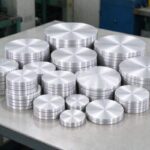
An anodized aluminum circle starts as a normal round blank, usually 0.3–6 mm thick and about 50–1500 mm in diameter, blanked from aluminum coil or sheet.
In anodizing the disc is made the positive electrode (anod) in a bath of dilute sulfuric acid; a controlled current grows a porous aluminum-oxide layer on the surface
After the oxide is grown it can be colored by absorbing dye into the pores and then sealed by closing the pores in hot water or a sealing solution, which locks the color and improves corrosion resistance.
Unlike a painted or plated coating, the anodic layer is integral with the aluminum, grows both outward and into the surface, and is extremely hard and scratch-resistant.
It is also electrically insulating and, because it is oxidized aluminum, it does not peel. A well-sealed anodized disc keeps its color and finish for years outdoors.
The two things buyers actually specify are the type of anodize (decorative or hard), the film thickness, the color and appearance, and the alloy underneath.
The base alloy is chosen from the 5000-taflen alwminiwm cyfres a 1000/3000 teuluoedd; for highly reflective lighting and decorative parts an anodized 5052 taflen drych polish and anodize to a bright finish.
Compared with painting or electroplating, anodizing is part of the metal rather than a separate layer.
Paint can chip and powder coat can be scratched through to the aluminum, tra bod yr ocsid anodig yn tyfu o'r wyneb ei hun; o'i gymharu â chromad neu haenau trawsnewid cemegol eraill, mae'r ffilm anodig yn llawer mwy trwchus, yn galetach ac yn gallu dal lliw.
Y cyfaddawd yw bod anodizing yn broses swp electrocemegol gyda phwyntiau racio sefydlog, ac mae'n llai addas ar gyfer rhannau y mae'n rhaid iddynt aros yn ddargludol yn drydanol ar ôl gorchuddio.
Yn strwythurol, mae gan yr haen anodig ddau barth: haen rwystr denau a thrwchus wrth ymyl yr alwminiwm a haen fandyllog fwy trwchus uwch ei ben.
Y mandyllau yw'r hyn sy'n amsugno llifyn; ar ôl lliwio, mae selio yn hydradu'r alwminiwm ocsid ac yn chwyddo ei gau, dal y lliw a rhwystro cyrydiad.
Y strwythur mandyllog hwn sydd wedi'i selio wedyn yw'r union reswm pam y gall anodizing ddal lliw o gwbl, a pham ansawdd selio yw'r broses unigol bwysicaf ar gyfer lliw oes hir.
Why Anodize Aluminum Circles?
-
- Gwrthiant cyrydiad: the sealed oxide layer protects the disc against atmospheric, humidity and light chemical attack.
- Wear and scratch resistance: the oxide is much harder than bare aluminum; hard anodizing is very durable.
- Decorative color: the porous layer absorbs black, aur, siampên, coched, blue and other dyes, then sealed to lock them in.
- Mirror and satin finishes: polished discs anodize to a bright reflective or a matte satin surface.
- Adhesion and durability: the coating is integral and will not peel, chip or flake like paint.
- Inswleiddiad trydanol: the oxide layer is non-conductive, useful for lighting and electronic parts.
- No plating baths or heavy topcoats: the finish is part of the aluminum itself and is long-lasting.
The main trade-off is that anodizing adds a processing step and cost, that certain alloys color more evenly than others, and that the hanging (rack) points where the discs are held during anodizing remain uncoated.
These points are hidden or placed on non-visible edges in a good design.
Buyers sometimes weigh anodizing against powder coating or electroplating.
Powder coating is a polymer paint available in almost any color, cheap for large outdoor panels, but it can chip and cannot give a true mirror-bright metal look; electroplating adds chrome or nickel for a very hard, shiny surface but relies on heavy chemicals and does not dye to pastel colors.
Anodizing sits between them: an integral, caled, corrosion-resistant layer, a true metallic silver or dyed color, and a mirror that reflects 85%+ o olau, with no peel-prone topcoat.
For small round parts where the metallic look and durability matter, anodizing is usually the right choice; ar gyfer paneli enfawr lle mae angen unrhyw liw a chost isaf, gall cotio powdr fod.
Mathau o Anodize a Gorffeniadau
| Math | Ffilm nodweddiadol | Ymddangosiad | Defnydd nodweddiadol |
| sylffwrig addurniadol | 5–25 µm | harian, lliwiau wedi'u lliwio, satin | caledwedd cyffredinol, arwyddion, trimiff |
| Anodized caled | 25–100+ µm | llwyd i ddu, caled a matte | nghoginio, gwisgo rhannau, sleidiau |
| Disglair / drych anodized | tenau, dros wyneb caboledig | adlewyrchiad drych-llachar | adlewyrchyddion lamp, disgiau addurniadol |
| Chrome / pensaernïol (amgen) | 8–20 µm | gwisg, gwydn | rhannau awyr agored a phensaernïol |
Mae'r rhan fwyaf o gylchoedd anodized lliw ac arian yn anodizing sylffwrig addurniadol yn yr ystod 5–25 µm.
Mae anodizing caled yn defnyddio baddonau oerach a folteddau uwch i adeiladu llawer mwy trwchus, ffilm galetach (25–100 µm neu fwy) mewn llwyd tywyll neu ddu, sef y safon ar gyfer offer coginio anodized premiwm a rhannau sy'n gwrthsefyll traul.
Rhoddir anodizing llachar neu ddrych ar ddisg caboledig i gadw arwyneb arian adlewyrchol uchel ar gyfer adlewyrchyddion. Mae anodizing pensaernïol yn wydn, gorffeniad unffurf ar gyfer paneli awyr agored a disgiau arwyddion.
Mae anodizing caled yn wahanol i anodizing addurniadol yn y bath a'r nod.
Mae anodizing addurniadol yn ffafrio llyfn, gwisg, ffilm derbyn lliw o drwch cymedrol ar dymheredd cynhesach, tra bod anodizing caled yn defnyddio oerach, bath mwy crynodedig a cherrynt uwch i adeiladu trwchus, trwchus, haen sy'n gwrthsefyll traul sy'n naturiol o lwyd tywyll i ddu.
Oherwydd bod y ffilm galed yn drwchus ac yn gymharol garw, fel arfer nid yw wedi'i liwio'n llachar; ei werth yw abrasion a gwrthsefyll cyrydiad, a dyna pam mae offer coginio premiwm a rhannau llithro neu gylchdroi yn ei ddefnyddio.
Dylid nodi trwch ffilm ar y llun, heb ei adael i siawns.
Nid dim ond anodizing dros wyneb caboledig yw anodizing llachar. Cyn anodizing mae'r disg yn cael ei sgleinio'n fecanyddol neu ei loywi'n gemegol i arian lystar uchel, a thenau iawn, yna tyfir haen anodig tryloyw i'w warchod.
Os yw'r ffilm anodig yn rhy drwchus neu os yw'r bath yn anghywir, mae'r wyneb llachar yn troi'n niwlog; dyma pam mae adlewyrchyddion drych yn broses arbenigol yn hytrach nag anodize nwydd, a pham mae prynwyr yn cymharu samplau adlewyrchedd yn hytrach na dibynnu ar lun lliw.
Pa Alloys Anodize Orau?
| aloi | Canlyniad anodizing | Gorau ar gyfer |
| 1050 / 1060 / 1100 | unffurf iawn, meddal, ymgymeriad lliw da | adlewyrchyddion, rhannau bas, disgiau lliw |
| 3003 | dda, ond gall manganîs dywyllu neu frwnt | sosbenni cyffredinol, arwyddion, caledwedd |
| 5052 | dda, gwrthsefyll cyrydiad; amrywiad lliw bach ardal fawr | morol, arwyddion, adlewyrchyddion, trim premiwm |
| 6061 / 6063 | lliw mwyaf unffurf a deniadol (Mg-Si) | trim addurniadol, Platiau Enw, rhannau lliw anodized |
Fel rheol, y purach yw'r alwminiwm, y mwyaf unffurf a deniadol yw'r lliw anodig.
Yn fasnachol pur 1050/1060 mae disgiau'n anodeiddio ac yn lliwio'n gyfartal ac yn gost isel, but the softer surface is less scratch-resistant; 6063 gives the most consistent decorative color and is preferred for colored trim, tra 5052 offers extra corrosion resistance for reflective, coastal or sign discs. 3003 is workable and robust but can show slight greying.
The alloy should be chosen together with the end use, because the anodize cannot hide a poor substrate surface—scratches or roll marks before anodizing show through the coating.
Low-cost colored and reflective blanks often start from a soft 1050 cylch alwminiwm; robust pans and signs commonly use 3003 cylch alwminiwm; and outdoor reflective discs may use corrosion-resistant 5052.
The product form also matters. Rolled and blanked circles give the most uniform anodic surface because the sheet is homogeneous, while extrusions and welded parts can show weld or heat-affect discoloration after anodizing.
6063 is an extrusion alloy known for uniform color on architectural trim; on rolled 5052 cylchoedd, large panels may show slight tone variation because of magnesium distribution, which is why buyers approve a sample.
Welded cookware ends are anodized after forming so the weld blends into the dark hard-anodized body.
The Anodizing Process Flow
A circle goes through a wet-line sequence before it is finished.
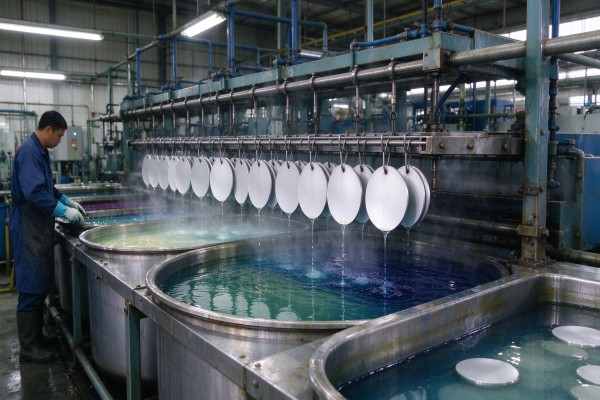
The typical route is degreasing to remove oil and stamping residue, alkaline etching to set a uniform satin texture, acid neutralizing (desmutting) to clean the surface, anodizing in sulfuric acid to grow the oxide film, dyeing in the chosen color, sealing in hot water or a nickel-free sealing bath to close the pores, and finally rinsing and drying.
The discs are racked on tianguis that hold them at points designed to be hidden on the finished part.
The quality of the anodize depends on every stage: an uneven etch gives blotchy color, an unclean surface leaves spots, the bath current and time set the film thickness, the dye concentration and time set the depth of color, and sealing determines whether the color will wash or fade.
Mirror discs are polished and sometimes chemically brightened before anodizing so the reflectivity is preserved, while hard-anodized cookware uses a colder, higher-voltage bath for a thick, hard grey-black film.
The rack (contact) points are a necessary part of the process: each disc must be electrically connected to the rack, so the small contact area cannot be anodized at that instant.
A good anodizer places these points on the edge, the back face or a hidden bore, or machines them off after coating. Mirror discs also need the cleanest pre-treatment, because any rolling mark, scratch or fingerprint before anodizing is sealed forever into the bright surface.
This is why polished reflectors carry peelable film and are handled with gloves.
Lliwiau, Textures and Color Matching
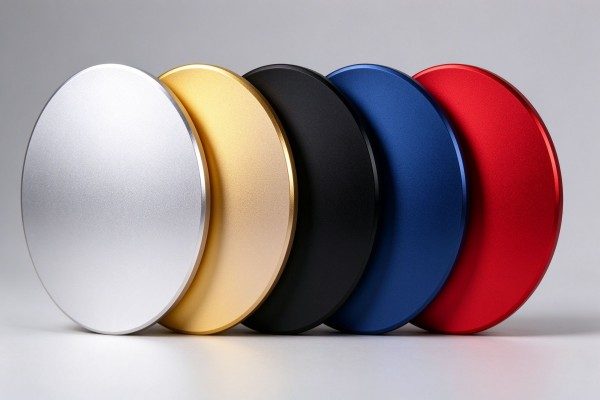
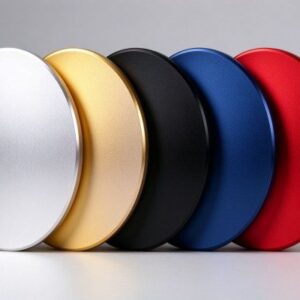
Standard anodized colors include natural silver, du, siampên, efydd, aur, coched, blue and green, with the exact shade controlled by dye choice, concentration and time.
The surface texture can be bright (for reflectors), satin or etched (a fine matte), or mirror (on a polished disc).
Because anodized color is produced from a porous layer, two lots can vary slightly, so buyers approve a physical color sample and specify that all volume for a project comes from a single lot.
Pantone or color samples are matched as closely as possible rather than guaranteed identical to paint.
| Gorffen | Disgrifiadau | Typical product |
| Natural silver / satin | clear anodized, fine matte texture | arwyddion, caledwedd, trimiff |
| Disglair / drych | polished then anodized, adlewyrchedd uchel | adlewyrchyddion lamp, mirror discs |
| Dyed black | du dwfn, decorative or hard | nghoginio, knobs, Platiau Enw |
| Aur / siampên / efydd | warm metallic tones | trimiff, gifts, disgiau addurniadol |
| Coch / glas / gwyrdd | brighter decorative colors | brand parts, Platiau Enw, phaneli |
Color consistency across an order is managed the way paint is—by lot. A physical sample disc is approved and signed, then all discs for the project are anodized in the same lot with the same bath and dye concentration.
Anodized dye cannot be matched to a Pantone printed color exactly, because the metallic aluminum substrate changes the tone; the sample is the contract.
Dylai prynwyr hefyd ddisgwyl gwahaniaeth bach rhwng a 100 mm ac a 600 disg mm, a dylent osgoi cymysgu lliwiau o rediadau cynhyrchu gwahanol ar un cynnyrch.
Cymhwysiad Craidd: Adlewyrchyddion Goleuo
Un o'r defnyddiau mwyaf o gylchoedd anodized yw fel adlewyrchwyr.
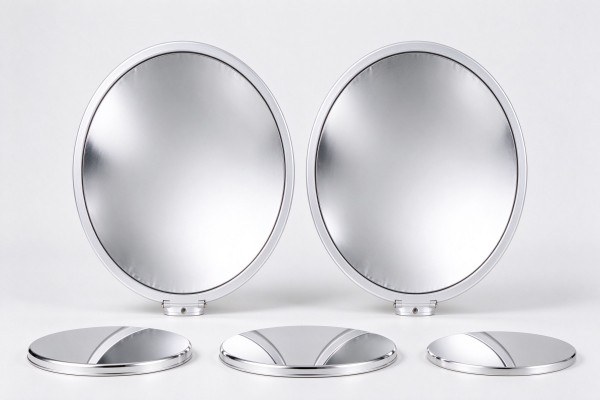
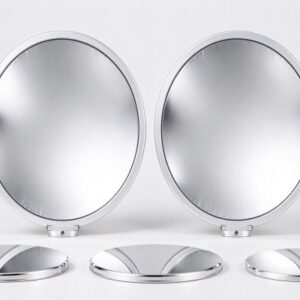
Mae'r disg yn cael ei nyddu neu ei dynnu i mewn i bowlen, caboledig ac anodized i arwyneb arian llachar sy'n adlewyrchu golau yn effeithlon, yn nodweddiadol gydag adlewyrchedd tua 85-95%.
Mae'r disgiau adlewyrchol hyn i'w cael mewn goleuadau i lawr, goleuadau stryd ac ardal, luminaires diwydiannol bae uchel, goleuadau arddangos a phensaernïol ac adlewyrchyddion solar.
Mae'r haen anodized yn amddiffyn yr wyneb caboledig rhag ocsideiddio ac olion bysedd, cadw adlewyrchedd yn sefydlog dros flynyddoedd.
Myfyrdod yw'r paramedr allweddol yma. Mae adlewyrchydd alwminiwm caboledig ac anodized llachar fel arfer yn dychwelyd tua 85-95% o olau gweladwy, far above a painted white surface, and the clear anodic layer keeps the polished silver from dulling.
Downlights and street lights use spun bowls for beam control, while industrial high-bay and solar reflector dishes use larger diameter discs.
The mirror surface is measured by reflectivity and protected until assembly; an edge or back blemish does not matter, but a face scratch destroys the optical performance.
For reflectors the blank must be flat and scratch-free before polishing, because anodizing locks in whatever surface existed underneath.
Pure 1050/1060 discs give the brightest, most uniform mirror; 5052 is used where the reflector also needs corrosion resistance outdoors.
Mirror or bright anodized parts are usually protected with a peelable film through assembly so the reflective face is not marked.
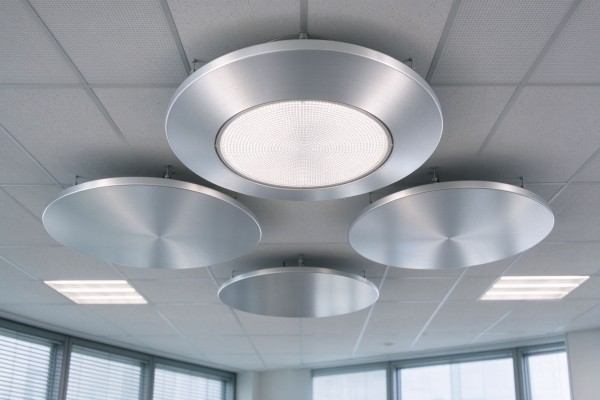
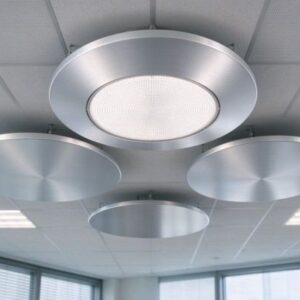
The same round blank can be used as the ceiling diffuser trim and reflector housing in modern round luminaires.
Round luminaires benefit directly from round anodized blanks: the disc is already the right shape for a downlight bezel, a reflector bowl or a suspended ceiling diffuser, so no rectangular sheet needs to be cut and scrap is minimal.
Mirror-anodized versions are used where the light must be efficient, while satin silver anodized versions are chosen where the fixture itself must look clean and modern.
The integral silver oxide reflects without a separate mirror layer, which reduces assembly steps.
Cymhwysiad Craidd: Anodized Cookware
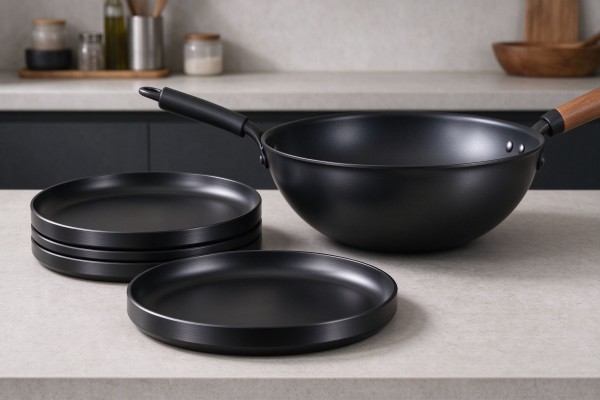
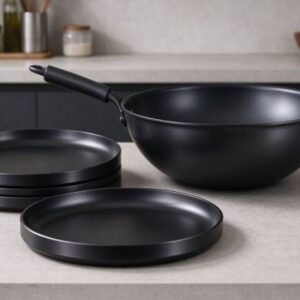
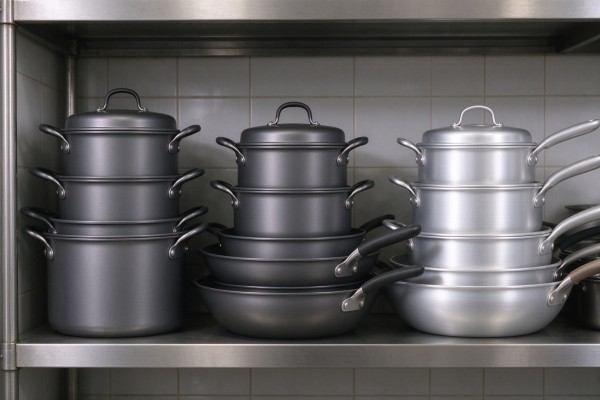
Anodized circles are deep-drawn into premium cookware bodies—woks, padelli ffrio, saucepans and stockpots—then hard-anodized to a dark, caled, non-reactive surface.
Mae anodizing caled yn troi'r corff alwminiwm yn llawer anoddach, crafu- ac arwyneb coginio sy'n gwrthsefyll cyrydiad nad yw'n adweithiol â bwydydd asidig, a dyna pam y caiff ei ddefnyddio'n helaeth ar botiau a sosbenni premiwm.
Mae'r corff anodized du neu lwyd tywyll hefyd yn wydn ac yn hawdd i'w lanhau, ac mae'n paru â gorchudd anffon wedi'i osod dros yr haen anodized.
Mae bylchau offer coginio fel arfer 1050/1060, 3003 neu gylchoedd cyfres 5000 wedi'u tynnu yn y tymer O meddal, yna diseimio a chaled-anodized ar ôl ffurfio yn hytrach nag o'r blaen, oherwydd byddai tynnu disg cyn-anodized yn niweidio'r ffilm.
Mae'r ffilm yn drwchus (25–60 µm neu fwy), tywyll ac unffurf, ac mae'r tyllau ymyl a handlen wedi'u gorffen ar ôl anodizing.
Rhaid i offer coginio cyswllt bwyd ddefnyddio prosesau anodio a selio sy'n ddiogel o ran bwyd, and the supplier should be able to provide the relevant food-contact documents.
Hard-anodized cookware sits between bare aluminum and non-stick coatings.
The anodized body is harder than plain aluminum, non-reactive with tomatoes and wine, and much more scratch-resistant than a soft painted surface; a non-stick PTFE or ceramic coating can then be applied over the anodized layer for easy release.
Because the anodic film is porous before sealing, sealing must be complete for food use—an unsealed film can trap acids or odors—and cookware anodizing must follow food-contact regulations.
The hard dark surface also hides scratches better than bright silver.
The dark hard-anodized surface also spreads heat evenly because it covers a uniform aluminum body, and it resists the alkaline cleaners used in commercial kitchens.
For a wok or frying pan, the circle is drawn before anodizing so the film covers the inside and outside consistently; holes for handles are drilled after anodizing and deburred.
This is why premium anodized pans look and feel more durable than painted aluminum cookware.
Pensaernïol, Decorative and Sign Discs
Anodized circles are used as decorative round panels, ceiling discs, wall and display trims, furniture and kitchen components, and as substrates for nameplates and signs.
The anodized finish does not flake, holds color outdoors and can be screen-printed or laser-marked, so it is preferred for premium interior and exterior trim.
Colored gold, champagne or black anodized discs give a durable metallic look that paint cannot match on small round parts.
Ar gyfer disgiau arwydd a phlatiau enw, mae anodize arian neu ddu yn cymryd dalennau adlewyrchol, argraffu ac ysgythru yn dda; cylchoedd pensaernïol yn anodized i'r safon bensaernïol ar gyfer bywyd awyr agored hir.
Oherwydd bod yr haen anodig yn annatod, mae'r ymylon yn parhau i gael eu hamddiffyn ac nid yw'r disg yn rhydu na sialc yn y tywydd. Mae paru lliwiau i frand neu gynllun mewnol yn cael ei gymeradwyo ar sampl a'i gynhyrchu mewn un swp.
Mae disgiau anodized yn derbyn gorffeniad eilaidd yn dda: gellir eu hysgythru â laser i ddatgelu'r arian o dan haen ddu neu liw - effaith plât enw clasurol - wedi'i argraffu â sgrin, CNC-troi ar ymyl, neu osod pinnau a gludyddion.
Mae disgiau nenfwd pensaernïol wedi'u hanodeiddio i satin arian neu siampên nad yw'n sialc nac yn pylu, ac mae'r ocsid annatod yn golygu bod yr ymyl crwn yn aros yn lân.
Because the anodic surface is slightly textured, it does not show fingerprints as readily as a bare polished disc, which is useful on furniture and hardware.
Small anodized circles are also popular as coasters, capiau, cosmetic and device accessories, and gift or award discs, where a black, gold or silver finish gives a premium look at low cost.
The same blanking and anodizing process serves both large reflectors and these small parts, so a supplier can run a mixed basket of diameters in one color lot.
Caledwedd, Electronics and Automotive Parts
Beyond lighting, cookware and architecture, anodized circles are stamped and turned into control knobs, pan and pot lid components, appliance covers, electronic housings and heat spacers, ventilation and fan discs, ystafell ymolchi a chaledwedd gosod, a trimio modurol a mewnol.
Mae'r haen anodized inswleiddio yn cefnogi rhannau electronig, mae'r arwyneb caled yn gwrthsefyll traul ar nobiau a sleidiau, ac mae'r gorffeniad lliw yn cyd-fynd â dyluniad y cynnyrch.
Rhannau crwn bach mewn du, mae aur neu arian yn addurn cyffredin ac yn elfen reoli mewn cynhyrchion defnyddwyr.
Ar gyfer y rhannau hyn mae'r disg yn aml yn cael ei guddio i faint, ffurfio neu droi yn gyntaf, yna anodized, gyda'r pwyntiau rac wedi'u gosod ar ymylon anweledig; dewisir anodizing caled ar gyfer rhannau sy'n llithro neu'n cylchdroi, tra bod anodizing addurniadol llachar yn cael ei ddefnyddio ar gyfer brand gweladwy ac arwynebau trim.
Mae aloi cyson a swp yn cadw lliw a chaledwch unffurf ar draws teulu cynnyrch.
Mae'r ocsid inswleiddio hefyd yn addas ar gyfer electroneg. Gall cylch llachar-anodized weithredu fel spacer, heat spreader or insulating washer between a powered component and its aluminum housing, combining aluminum thermal conductivity with an electrically non-conductive surface.
Black anodizing further improves emissivity for passive heat dissipation. Automotive and interior trim uses the same colored finish for consistency across knobs, vents and decorative rings, all cut from anodized circles in the same lot.
Trwch Ffilm, Color and Quality Control
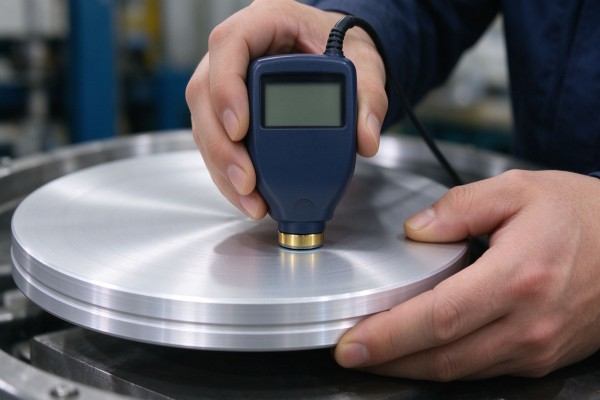
The anodic film is measured with an eddy-current thickness gauge, which reads the non-conductive oxide on the aluminum without damaging the part; buyers specify a minimum and average film thickness (for example 10–15 µm decorative, or 25–50 µm hard).
Color is controlled against an approved sample under standard light, and sealing quality is checked with dye-spot or acid-dissolution tests, because a poorly sealed film will stain or fade.
Salt-spray (neutral salt spray or CASS) is used to verify corrosion resistance for outdoor parts.
| Check | Gofyniad nodweddiadol | Dull |
| Film thickness | 5–25 µm decorative; 25–100 µm hard | eddy-current gauge |
| Lliw | match approved sample | visual under standard light / colorimeter |
| Selio | no stain after dye-spot test | dye spot or acid dissolution |
| Gwrthiant cyrydiad | hours of salt spray per standard | neutral salt spray / CASS |
| Ymddangosiad | no spots, crafiadau, blotchiness | visual inspection |
Common defects—blotchy color, smotiau, rainbow stains, soft film or exposed rack points—trace back to etching, glanhau, bath contamination, under-sealing or the rack design.
A reputable anodizer controls bath chemistry, presennol, temperature and rinsing water, and provides a film-thickness and color inspection report with the lot. For colored parts, keep one approved sample disc as the reference for incoming inspection.
Standards and Compliance
| Safonol | Covers |
| Iso 7599 | anodized aluminum coatings on wrought products (math, thrwch, gwedd) |
| ASTM B580 | anodic coating specifications on aluminum |
| Gb/t 8013 | Chinese anodic oxidation coatings on aluminum and alloys |
| ASTM B117 / CASS | neutral salt spray and copper-accelerated corrosion testing |
| Food-contact regulations | safe anodizing and sealing for cookware |
Buyers should specify the standard and the minimum film thickness, request the anodizing process and thickness report, and—for outdoor or food-contact parts—the salt-spray and food-contact documents.
The certificate should name the alloy, themprem, film thickness and color of the lot rather than a generic statement.
Yn ymarferol, dylai swp cylch anodized gyrraedd gyda thystysgrif prawf melin yn enwi'r aloi a'r tymer, adroddiad anodizing yn nodi trwch y ffilm a'r broses selio, cyfeirnod sampl lliw cymeradwy, ac—ar gyfer rhannau awyr agored neu offer coginio—y prawf chwistrell halen neu gyswllt bwyd.
Dylid cwestiynu datganiadau generig fel “alwminiwm anodedig” heb drwch na safon, oherwydd a 3 µm ffilm addurniadol a 50 µm ffilm galed yn rhannu'r un enw ond yn perfformio'n wahanol iawn.
Cytuno ar y trwch safonol a lleiaf ar y llun a'r gorchymyn.
Pecynnu a Logisteg
Mae disgiau anodized yn sensitif i grafiadau, felly maent yn cael eu hamddiffyn â ffilm croenadwy neu ryngddalennog rhwng yr wynebau caboledig neu liw, ymyl-amddiffyn, ac wedi'u pacio mewn cartonau neu ar baletau wedi'u mygdarthu; mirror and bright reflectors keep their protective film until assembly.
Colored and mirror parts are packed face-to-face or interleaved to avoid rubbing, and each batch is tagged with color, aloi, thrwch, diamedr, film thickness and lot. Dry, clean storage protects the sealed finish.
Mae termau allforio yn gyffredin FOB, CFR or CIF with 30% Blaendal T/T a balans yn erbyn y bil llwytho.
Documents include the bill of lading, anfoneb, rhestr pacio, mill and anodizing certificate, color sample reference, certificate of origin and any salt-spray or food-contact reports.
Sealed anodized discs are stable but should be kept dry and out of direct sun in storage.
Peelable film should be removed only at assembly, because it is the only thing preventing scratches on mirror and colored faces during handling.
If discs arrive with a light white powdery residue it usually wipes off, but heavy powder indicates under-sealing and should be reported. Keeping the protective film on through punching and spinning avoids the most common return reason: face scratches.
Pricing and MOQ
Anodized circles are priced from the base aluminum and blanking cost plus the anodizing processing.
Decorative sulfuric anodizing adds a moderate per-part charge, hard anodizing and bright mirror finishing cost more because of the thicker film or polishing, and custom colors carry a small setup and minimum order because each color must be run separately and matched.
The ingot base follows the daily LME and Shanghai spot quotations, so quotes are valid for a short window and re-confirmed at order.
| Ffactor cost | Effaith ar bris |
| aloi | 1050/1060 isaf; 6063 a 5052 cost more |
| Anodize type | hard and bright/mirror finishes cost more than standard silver |
| Lliw | custom colors add setup and have a minimum order |
| Film thickness | thicker hard-anodized films cost more to grow |
| Surface prep | polishing and brightening add cost for reflectors |
| Cyfrol | large runs and a single color lower the unit cost |
Buyers control cost by using standard colors and stock diameters, ordering all project quantity in one lot for color consistency, and matching the finish to the visible surface rather than over-polishing hidden sides.
A color and film sample is approved before production.
Beyond processing, cost follows the ingot base.
The aluminum content is referenced to the daily LME and Shanghai spot price plus a conversion and processing premium, so sudden metal moves change the quote within its validity.
Tooling for non-standard diameters is a one-time blanking die charge; choosing an existing diameter or a standard color removes both the die and the color-setup cost.
For first orders, a small sample lot pays for itself in avoided color or film-thickness rework on a full container.
How to Order Anodized Circles
Send the drawing or required diameter, thrwch, aloi a thymer, and the end product.
Specify the anodize type (addurniadol, caled, bright/mirror), lliw, film thickness and standard.
Approve a color and film sample; agree the lot, rack-point position and protective film.
Confirm price, tooling if any, MOQ for custom color, packaging and delivery terms.
Talu'r blaendal, run production, inspect color and thickness, and ship with full documents.
For a first order it is worth sending a physical part or a Pantone/color sample even if the drawing dimensions are clear.
Anodized color is hard to describe in words, and seeing a sample—and confirming the rack-point position and peelable film—avoids the most common dispute, which is color. The supplier should hold the sample and the die so repeat orders match.
Am Eco Alum
Mae Eco Alum yn gyflenwr cynnyrch alwminiwm a sefydlwyd ym mis Mawrth 2025, wedi'i drefnu o amgylch cadwyn gyflenwi gyfoethog o fewn diwydiant rholio alwminiwm Tsieina. Yn hytrach na gweithredu fel masnachwr syml, we coordinate with qualified rolling, blanking and anodizing mills to deliver specification-accurate, well-finished material at factory-direct pricing and manage the technical, dogfennaeth ansawdd ac allforio.
Ein prif gynnyrch yw platiau alwminiwm, coiliau, ffoils, stribedi a disgiau (cylchoedd), sy'n cwmpasu'r gyfres 1xxx—1050, 1060, 1070, 1100, 1235 a 1350—ynghyd a 3003 and the 5000-series alloys such as 5052.
For anodized circles we supply custom diameters, gauges, tempers and anodizing finishes—natural silver, satin, mirror/bright, dyed black, aur, champagne and architectural colors, plus hard anodizing for cookware—with color sample approval, eddy-current film-thickness reports, salt-spray and food-contact documents where required, and scratch-proof export packing.
We help you choose the alloy and finish that match the reflector, nghoginio, sign or hardware part rather than selling one grade for everything. Cyrraedd ni yn [email protected] neu +86 19924932491.
Rydym yn cefnogi prynwyr gyda lluniadau a chanllawiau maint gwag, anodizing color samples before a first order, lot-specific mill and anodizing certificates, batch color consistency, and protective peelable film on mirror and polished parts.
Send your drawing, color requirement or sample disc to [email protected] for a prompt, dyfynbris yn seiliedig ar fanyleb.
Cwestiynau Cyffredin
C: What is an anodized aluminum circle?
A: A round aluminum blank that has been electrochemically coated with a hard, integral aluminum-oxide layer, supplied in silver, lliw, mirror or hard finishes.
C: How thick is the anodized film?
A: Decorative sulfuric anodizing is commonly 5–25 µm; hard anodizing for cookware and wear parts is 25–100 µm or more.
C: What colors are available?
A: Natural silver, du, aur, siampên, efydd, red and blue, in bright, satin or mirror finishes, matched to an approved sample.
C: Which alloy anodizes best?
A: Pure 1050/1060 yn rhoi'r lliw mwyaf unffurf a'r drych mwyaf disglair; 6063 yn rhoi'r lliw addurniadol mwyaf cyson; 5052 yn ychwanegu ymwrthedd cyrydiad ar gyfer defnydd awyr agored ac adlewyrchol.
C: A ellir defnyddio cylchoedd anodized ar gyfer offer coginio?
A: Oes - mae cylchoedd wedi'u tynnu'n ddwfn ac wedi'u hanodeiddio'n galed i mewn i woks a sosbenni premiwm ar gyfer caled, anadweithiol, wyneb gwydn.
C: A fydd y lliw yn pylu neu'n pilio?
A: Na. Mae'r haen anodig yn annatod ac wedi'i selio, felly nid yw'n plicio, ac ni fydd llifyn wedi'i selio yn rhwbio i ffwrdd; mae selio priodol yn atal pylu.
C: Pam fod yna smotiau bach heb eu gorchuddio ar yr ymyl?
A: Mae'r rhain yn rac (hongian) pwyntiau o anodizing; mae dyluniad da yn eu gosod ar ymylon cudd neu'n eu gorffen ar ôl eu gorchuddio.
C: Sut mae ansawdd anodize yn cael ei wirio?
A: Mae trwch ffilm yn cael ei fesur gyda mesurydd cerrynt eddy, lliw yn erbyn sampl gymeradwy, a selio a chorydiad trwy brofion smotyn lliw a chwistrell halen.
Casgliad
Yn fyr: choose bright-anodized 1050/1060 for lighting reflectors, caled-anodized 1050/3003 ar gyfer offer coginio, silver or black anodized for signs and nameplates, and dyed 6063 neu 5052 for decorative colored trim.
Specify a minimum film thickness and approve a color sample, control the rack points, and require proper sealing. With those rules, anodized circles deliver a premium, durable metallic finish that outlasts paint and stays good-looking for years.
Anodized aluminum circles turn a plain round blank into a durable, gwrthsefyll cyrydiad, decorative and wear-resistant part.
The oxide layer is integral with the aluminum, holds a permanent color or a high-brightness mirror, protects reflectors and cookware, and outlasts paint in outdoor, kitchen and industrial service.
The specification follows the product: a thin bright film for lamp reflectors, a thick hard film for premium cookware, a dyed silver or black film for signs, platiau enw a trim, a'r aloi a ddewiswyd ar gyfer unffurfiaeth lliw, adlewyrchedd neu ymwrthedd cyrydiad.
Cyrchu gan gyflenwr sy'n rheoli bylchau, Anodizing, selio a chyfateb lliwiau, ac sy'n cymeradwyo adroddiad sampl a ffilm cyn ei gynhyrchu, yn rhoi disgiau anodized cyson i brynwyr o lot i lot.