



Custom 2μm 8011 Hejma Aluminio-Papero: The Ultimate Buyer’s Guide

Custom 2μm 8011 Hejma Aluminio-Papero: The Ultimate Buyer’s Guide
Enkonduko: Why “Custom 2μm 8011 Household Aluminum Foil” Matters
Aluminum foil is one of the most quietly successful packaging materials in the modern kitchen. Every year, millions of tons of thin-gauge aluminum foil are converted into household kitchen rolls, manĝujoj, kovrilo, flexible pouches and catering wraps.
Behind a product that looks simple—a thin silver sheet wound onto a cardboard core—sits a surprisingly precise combination of alloy chemistry, rolling technology, gauge control, surface treatment and custom converting.
When buyers search for “custom 2μm 8011 hejma aluminia folio,” they are usually specifying three decisions at once: the alloy (8011, the dominant food and household foil grade), the gauge (2 mikronoj, ultra-maldika, light-converter thickness), and the fact that the order must be customized to their width, roll format, packaging and private label.
Who this guide is for and how to use it
This guide is written for purchasing managers, posedantoj de marko, packaging converters, importers and distributors who specify aluminum foil rather than simply buy a commodity coil.
If you run a laminating or rewinding line, the sections on gauge, pintruoj, yield and converter formats will be the most relevant. If you market finished kitchen rolls, focus on the thickness landscape, retail SKU planning, private-label customization and food-contact certification.
You can read it end to end as a complete specification manual, or jump to the section that answers the decision in front of you. Each chapter uses the same mill terminology you will encounter on quotations and mill certificates, so it can also serve as a reference when comparing offers from different suppliers.
Aluminia Folio 101: What Household Foil Actually Is
Aluminum foil is aluminum metal rolled into a sheet thinner than 0.2 mm; products below about 0.05 mm are generally called foil, while the thinnest converter and capacitor gauges run down to just a few microns.
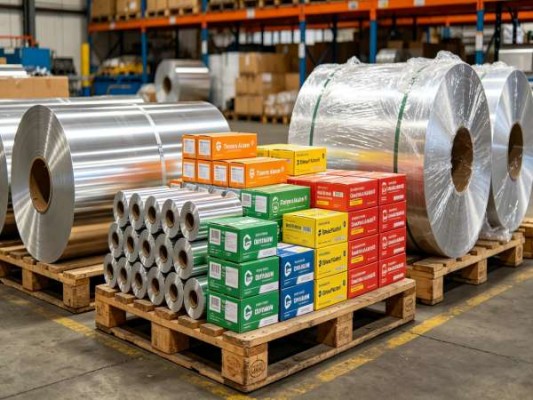
Household aluminum foil is a soft, fully annealed product designed to be folded, wrapped, torn and shaped by hand without tools. It is supplied either as a finished retail roll in a color box with a cutting edge, or as a large “jumbo roll” that converters and packaging factories slit, print, emboss, laminate or rewind into consumer products.
What makes aluminum foil irreplaceable is its barrier behavior. A continuous, pinhole-free aluminum layer is essentially impermeable to light, oksigeno, akvovaporo, aromo, grease and microorganisms.
It also conducts heat rapidly for even cooking and freezing, reflects radiant heat, and can be folded tightly to create a mechanical seal. No single polymer film matches that combination, which is why even very thin aluminum—often just a few microns—remains the barrier layer of choice in laminated food packaging.
Aluminum foil is also fully and repeatedly recyclable without loss of quality, strengthening its sustainability story for brands.
The two ways you will buy household foil
- Finished retail (consumer) rolls – cut to widths such as 290, 300 aŭ 450 mm, wound to a fixed length, packed in a printed color box with a serrated cutter, ready for supermarket shelves.
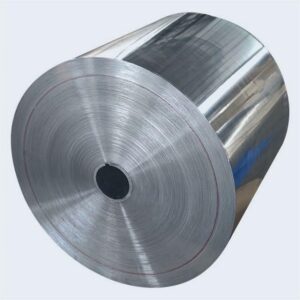
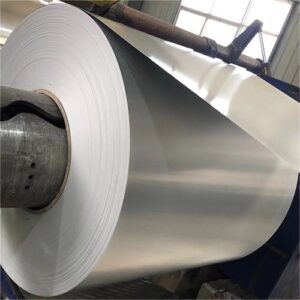
- Jumbo rolls (converter stock) – wide parent rolls (commonly 200–1600 mm) sold to converters, laminators, container makers and rewinders. This is the format in which ultra-thin gauges such as 2μm are normally traded.
Understanding which of these you actually need is the single most important step in buying 2μm foil, and we return to it repeatedly in the gauge section below.
Why aluminum’s barrier is difficult to replace
Packaging engineers describe barrier performance with two key numbers: transdono de oksigeno (OTR) and water-vapor transmission rate (WVTR or MVTR).
A continuous, pinhole-free aluminum layer approaches zero for both—it also blocks 100% de lumo, including UV. Polymer films such as PE and PP are cheap and strong but permeable to gases; EVOH offers good oxygen barrier but is sensitive to moisture and still transmits light.
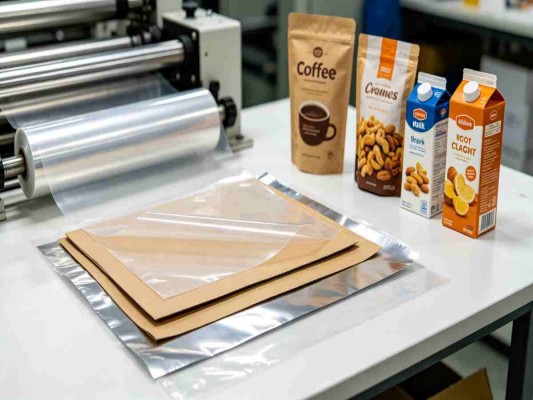
Aluminum foil is the only single material that simultaneously stops oxygen, humideco, light and aroma, which is why even a 2μm layer laminated into a plastic film can transform the shelf life of coffee, dried food, powders and ready meals.
The trade-off is that barrier only exists where the metal is continuous, which is precisely why pinhole control at 2μm is treated so seriously.
Daŭripovo: thin gauge and recyclability
Despite being a metal, aluminum foil has a strong sustainability case. Unue, malpezigo: moving from a 12μm foil to a 6μm converter foil halves the metal used per square meter, and a 2μm lamination layer uses a fraction of that, directly cutting material demand and transport weight.
Due, aluminum is fully and infinitely recyclable without loss of quality, and recycling it uses roughly 95% less energy than producing primary metal.
Most post-consumer foil and foil laminates are recoverable where foil collection or laminate recycling exists. For brands, the combination of a very thin gauge, long product shelf life (which prevents food waste) and recyclability makes light-gauge 8011 foil defensible in life-cycle terms—a point worth reflecting in your own marketing.

Alojo 8011 in Depth: Komponado, Properties and Temper
8011 is an aluminum-iron-silicon (Al-Fe-Si) alloy in the 8xxx series. It was developed specifically for foil and closure stock, and it has become the default household and food-packaging grade worldwide because it rolls cleanly to very thin gauges while retaining enough strength and ductility to wrap and fold without splitting.
Compared with commercially pure 1xxx alloys, the iron and silicon additions in 8011 generate fine intermetallic Al-Fe-Si particles during casting and homogenization; these particles refine the microstructure, strengthen the soft-annealed foil and—crucially at light gauges—reduce sensitivity to pinholing during rolling.
3.1 Kemia komponado (wt. %, por GB/T 3190)
| Elemento | Kaj | Fe | Cu | Mn | Mg | Cr | Zn | De | Al |
| 8011 | 0.50–0.90 | 0.60–1.00 | ≤0,10 | ≤0,20 | ≤0,05 | ≤0,05 | ≤0,10 | ≤0,05 | Ekvilibro |
What each element contributes
- Fero (Fe, 0.60–1.00%) – the main strengthener; forms Al-Fe and Al-Fe-Si dispersoids that improve tensile strength and suppress pinhole formation during thin-gauge rolling.
- Silicio (Kaj, 0.50–0.90%) – works with iron to control cast structure and hot-cracking, improving rollability and the balance of strength and ductility.
- Kupro (Cu, ≤0.10%) – a minor strengthener kept low to preserve corrosion resistance and food-contact safety.
- Mangano (Mn, ≤0.20%) – assists microstructure control without moving the alloy out of the soft, formable window.
- Magnezio, Kromio, zinc and titanium – tightly limited trace elements that keep the alloy clean, stable and suitable for annealing.
3.2 Typical physical properties
| Proprieto | Tipa valoro | Unuo |
| Denso (20°C) | 2.71 | g/cm³ |
| Melting range | ĉ.. 640–655 | °C |
| Coefficient of thermal expansion | 23.5–23.8 | 10⁻⁶/K (20–100°C) |
| Specific heat capacity | ĉ.. 899 | J/(kg·K) |
| Modulo de elasteco | ĉ.. 70 | GPa |
| Termika kondukteco | ĉ.. 220–230 | kun(m·K) |
| Elektra konduktiveco | ĉ.. 58–62 | %IACS (mola) |
3.3 Typical mechanical properties of 8011-O foil
Household foil is supplied in the O (mola, plene recozita) humoro. Exact values vary with thickness and test gauge length; thinner foils show lower measured elongation. The ranges below reflect typical mill data for soft 8011 foil and are useful for specification and comparison rather than as a guarantee for a specific gauge.
| Temperaro | Dikeca gamo | Tensila forto (MPa) | Plilongigo (%) | Karaktero |
| O (mola) | 0.006–0,010 mm | ĉ.. 60–90 | ≥ 1–2 (A100) | Mola, wraps easily |
| O (mola) | 0.010–0,020 mm | ĉ.. 70–100 | ≥ 3–10 | Standard household |
| H22/H24 | on request | pli alta | Malsupra | Pli rigida, semi-hard |
| H18 | on request | highest | lowest | Malfacila, not for hand wrapping |
3.4 Why the O temper is used for household foil
Temper describes how hard or soft the metal is after rolling and heat treatment. Foil comes off the rolling mill work-hardened and stiff; it is then annealed (heated in a controlled furnace) to soften it and restore ductility.
In the O temper the foil is fully soft: it tears cleanly along the dispenser edge, conforms tightly to dishes, folds without spring-back and is easy to handle in the kitchen.
Hard tempers such as H18 are strong but resist folding and are used for industrial and formed products, not for hand wrapping. Unless you have a specific forming reason, custom household and converter foil is ordered as 8011-O.
3.5 Corrosion behavior and food-contact suitability
8011 is not a heat-treatable high-strength alloy; its value lies in a stable oxide surface, good general corrosion resistance and clean, non-toxic chemistry.
On contact with air, aluminum instantly forms a thin, tightly adherent Al₂O₃ film that protects the metal, and food-grade foil relies on this natural passivation rather than on hazardous coatings.
Because copper and other aggressive elements are held to very low limits, 8011 resists the neutral and mildly acidic/alkaline environments encountered in most food contact, and it contains no intentional lead, cadmium or other heavy-metal additives.
For demanding contact—salty, acidic or fatty foods, or high-temperature sterilization —converters add a food-safe lacquer, primer or polymer lamination, which both isolates the food and improves sealability.
Compliance is confirmed through migration testing against the standards of the target market (FDA 21 CFR in the US, Regulation EC 1935/2004 and the relevant EU measures, and the GB 4806 series in China). Specifying these requirements on the order ensures the foil and any coatings are approved together as a finished food-contact material.

8011 vs Other Foil Alloys: Choosing the Right Grade
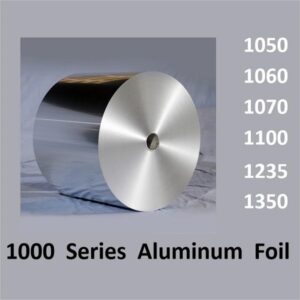
8011 is the best default for household foil, but it is not the only foil alloy. Converters also use 1235, 8079, 8021, 1100, 1060, 1050, 3003 kaj 3004. The right choice depends on gauge, barrier demand, forming method and cost. The table below summarizes how the common grades compare; after it, we explain when each one wins.
| Alojo | Serio | Forto | Thin-gauge / pintrua rezisto | Tipa uzo |
| 8011 | 8xxx Al-Fe-Si | Mez-alta | Tre bone | Domanaro & food foil, kovrilo, containers stock |
| 8079 | 8xxx Al-Fe | Alta | Bonega | Ultra-thin high-barrier & pharma converter foil |
| 8021 | 8xxx Al-Fe | Alta | Bonega | Very thin packaging & blister/lamination foil |
| 1235 | 1xxx pure Al | Low-medium | Modera | Laminado, Kondensilo, cable wrap |
| 1100 | 1xxx pure Al | Meza | Modera | General foil, converter and industrial wrap |
| 1060/1050 | 1xxx pure Al | Low-medium | Modera | Economy foil, kablo, transformer, Stampado |
| 3003 | 3xxx Al-Mn | Alta | Bone | Manĝaĵo ujoj, pletoj, stronger foil |
| 3004 | 3xxx Al-Mn-Mg | Alta | Bone | Container and closure stock, deeper draws |
Alloy selection guidance
- Household kitchen rolls and general food wrap: 8011-O is the standard—best balance of strength, pintrua rezisto, softness and cost.
- Ultra-thin high-barrier converter and pharmaceutical foil: 8079 aŭ 8021 are often preferred at the lightest gauges because their chemistry gives excellent pinhole performance; 8011 remains a strong, lower-cost option for food.
- Lamination and capacitor foil where maximum purity matters: 1235 is common, though it is softer and more pinhole-sensitive at very thin gauges.
- Rigid and semi-rigid food containers and trays: 3003 aŭ 8011/3004 in harder tempers provide the required draw strength.
- Economy industrial, cable and transformer wrap: 1050/1060 pure aluminum is widely used.
For a custom 2μm order, expect the mill to recommend 8011 for food and household conversion, aŭ 8079/8021 if you need the absolute lowest pinhole count for high-end barrier or pharmaceutical lamination. Asking the mill to explain this choice is a useful test of whether they understand ultra-thin foil or simply quote whatever alloy is cheapest.
The Complete Guide to Foil Thickness (Mezurilo)
Thickness is the most important—and most often misunderstood—variable in a foil order. It is quoted in three units: mikronoj (μm), milimetroj (mm) and mils (one-thousandth of an inch, sometimes written as gauge in the US market). Getting the conversion right prevents costly mistakes, because a “2” can mean 2μm, 0.02 mm aŭ 2 mil depending on convention.
5.1 Unit conversion reference
| Mikronoj (μm) | Millimeters (mm) | Mils (thou) | mm rounded |
| 2 | 0.002 | 0.079 | 0.002 |
| 6 | 0.006 | 0.236 | 0.006 |
| 7 | 0.007 | 0.276 | 0.007 |
| 9 | 0.009 | 0.354 | 0.009 |
| 11 | 0.011 | 0.433 | 0.011 |
| 14 | 0.014 | 0.551 | 0.014 |
| 18 | 0.018 | 0.709 | 0.018 |
| 20 | 0.020 | 0.787 | 0.020 |
| 25 | 0.025 | 0.984 | 0.025 |
Quick rules: 1 mm = 1000 μm; 1 mil = 25.4 μm; to convert microns to mils, divide by 25.4. Always confirm the unit in writing on the proforma invoice and mill certificate, especially for ultra-thin orders.
5.2 Household foil thickness landscape
| Mezurilo | Kategorio | Typical end use |
| 2–7μm | Ultra-maldika / converter | Lamination barrier layer, kovrilo, capacitor, specialty light packaging |
| 8–11μm | Ekonomio / standard household | Light kitchen rolls, envolvante, economy retail (KS 2294 starts at 10μm) |
| 12–15μm | Heavy-duty household | Roasting, frostiĝanta, everyday kitchen use |
| 16–20μm | BBQ / manĝoprovizo | Oven and grill, manĝoprovizo, airline trays, kovriloj |
| 21–40μm | Semi-rigid / container | Ujoj, pletoj, fermoj, industriaj |
5.3 What 2μm really means – the “double-zero” frontier
In foil-mill terminology, products below 0.01 mm (10μm) are often called “double-zero” foil because the metric thickness is written with two zeros after the decimal point (Ekzemple 0.006 mm, 0.007 mm).
A 2μm foil at 0.002 mm sits beyond even the thinnest standard double-zero products, which typically bottom out around 0.005–0.006 mm.
At 2μm the web is extraordinarily delicate: it is roughly one-fifth the thickness of the lightest economy kitchen roll and a tiny fraction of a human hair. Rolling it demands exceptional melt cleanliness, precision mills and very tight web tension control.
This leads to the practical reality every buyer should understand: a bare 2μm foil is not rewound into a stand-alone consumer kitchen roll. It is too prone to tearing, wrinkling and pinholing to survive a retail dispenser and normal hand use.
Anstataŭe, 2μm 8011 is produced as a wide jumbo converter foil and is immediately laminated or converted—bonded to paper, PE, PET or other films. The resulting multilayer material is strong enough for pouches, kovriloj, saketoj, wraps and ultra-light food packaging while using the minimum possible amount of aluminum.
If your goal is a private-label kitchen roll, the practical minimum is about 6–9μm; if your goal is a lightweight barrier laminate, 2μm is a legitimate and increasingly popular specification.
5.4 How to decide: bare retail roll vs converter foil
| Your end product | Recommended gauge | Formo |
| Supermarket kitchen roll (normo) | 10–14μm | Finished retail roll |
| Ekonomio / light kitchen roll | 9–11μm | Finished retail roll |
| Heavy-duty / BBQ roll | 15–20μm | Finished retail roll |
| Flexible laminate / pouch / sachet | 2—9μm | Jumbo converter foil |
| Lidding / cup seal / ĉapo stoko | 2–8μm (laminated/coated) | Jumbo converter foil |
| Ujo / pleto | 30–100μm+ | Sheet or coil, harder temper |
5.5 Pezo, coverage and yield: how much foil you get per kilogram
Because foil is sold by the ton but used by area, one of the most useful calculations for a buyer is the coverage (also called yield or “out-turn”) of a given gauge.
It lets you compare quotations, estimate how many retail rolls or laminated square meters a ton produces, and understand why a thinner foil can cover far more packaging despite a higher price per ton.
The arithmetic is straightforward. The weight of one square meter of foil is its volume (1 m² × thickness) multiplied by the density of aluminum, pri 2.71 g/cm³ for 8011:
- Weight per m² (g/m²) = thickness in μm × 2.71
- Square meters per kg = 1000 ÷ (g/m²)
- Square meters per ton = 1,000,000 ÷ (g/m²)
Ekzemple, 2μm foil weighs only about 5.42 g/m², so one ton covers roughly 184,500 m²; a standard 14μm household foil weighs about 37.94 g/m² and covers about 26,400 m² per ton. In other words, a ton of 2μm converter foil yields about seven times the area of a ton of 14μm kitchen foil—the core economic argument for ultra-thin lamination stock.
| Mezurilo (μm) | Pezo (g/m²) | m² per kg | Proks. m² per ton |
| 2 | 5.42 | 184.5 | 184,500 |
| 6 | 16.26 | 61.5 | 61,500 |
| 7 | 18.97 | 52.7 | 52,700 |
| 9 | 24.39 | 41.0 | 41,000 |
| 11 | 29.81 | 33.5 | 33,500 |
| 14 | 37.94 | 26.4 | 26,400 |
| 18 | 48.78 | 20.5 | 20,500 |
| 20 | 54.20 | 18.5 | 18,450 |
These are theoretical values for bare foil; real yield is slightly lower after slitting trim, edge waste, core weight and packaging.
Komparante provizantoj, ask for yield on the same basis and confirm whether the price is per ton of bare foil or includes converting and retail packaging.
Pinholes and Barrier Performance at 2 Mikronoj
A pinhole is a microscopic through-thickness hole in the foil. It is the single most important quality variable in ultra-thin gauge because pinholes are the one defect that breaks aluminum’s otherwise perfect barrier—each hole is a potential path for oxygen, humideco, light or microbes.
Pinholes arise from inclusions, gas porosity, rolling damage, foreign particles or excessive reduction at the finishing passes, and their number rises sharply as gauge decreases.
The relationship between thickness and pinholes is not linear: halving the gauge can multiply pinhole count several times, which is exactly why 2μm foil is so demanding.
A competent mill controls melt cleanliness (filtrado, degasado), roll surface, lubrication and pass reduction, and then measures pinholes on a light table or with automated laser/image scanning rather than relying on visual estimates.
6.1 Reference pinhole limits
Chinese and international standards grade pinholes by foil thickness and quality class. The figures below summarize typical reference limits from GB/T 33143 kaj GB/T 3198 (aluminum and aluminum-alloy foil) kaj ASTM B479; exact contractual limits should be agreed per gauge and application.
| Folio dikeco | Super-high grade | High grade | Standard grade | Typical application |
| ≤ 0.010 mm (incl. double-zero) | ≤15 pcs/m² | ≤20 pcs/m² | ≤30 pcs/m² | Altnivela manĝaĵo, pharma, elektroniko |
| 0.010–0.013 mm | ≤6 pcs/m² | ≤10 pcs/m² | ≤15 pcs/m² | Ĝenerala pakado |
| Pharmaceutical blister foil | ≤5 pcs/m² (pinhole ≤0.3 mm) | — | ≤20–30 pcs/m² | Blister / cold-form |
Standards also control pinhole size: under GB/T 3198-2020, holes of about 20μm and above are counted as controlled defects and holes around 50μm and larger are not permitted; ASTM B479 counts holes around 25μm and rejects those around 60μm and above.
For a 2μm foil, specify both a maximum pinhole count per square meter and a maximum hole diameter, and require a test report.
6.2 Why lamination makes 2μm foil practical
Here is the key engineering point for converters: a 2μm folio that would be too porous and fragile on its own becomes a high-performance barrier once laminated.
The supporting polymer film or paper carries the mechanical load and seals isolated pinholes, while the aluminum layer blocks light and drastically reduces gas and vapor transmission.
The laminate as a whole achieves barrier levels no single ultra-thin layer could. This is why coffee bags, replikaj sakoj, lidding and aseptic cartons can use only a few microns of aluminum and still deliver long shelf life.
For shelf-life-critical products, the finished laminate—not the bare foil—is tested for oxygen and water-vapor transmission under standards such as ASTM D3985 (OTR) and ASTM F1249 (WVTR), and the aluminum gauge is selected together with the sealant and structural films to hit a target shelf life.
This is why sharing your product, fill temperature and required shelf life with the foil supplier matters: the correct 2μm structure is engineered as a system, and a foil specified in isolation may be over- or under-built for the actual barrier target.

Kiel 8011 Foil Is Made: The Full Manufacturing Process
Understanding the production route helps you interpret lead times, price differences and quality claims.
Turning a cast aluminum ingot into a 2μm web involves a sequence of high-precision steps, and the final foil passes are among the tightest tolerances in the metals industry.
7.1 Fandado, casting and homogenization
Production starts with controlled melting of aluminum together with the iron, silicon and other alloying additions that define 8011.
The melt is refined through degassing and filtration to remove hydrogen and non-metallic inclusions—the raw causes of pinholes—before being cast into slabs or strip.
A homogenization heat treatment then evens out the microstructure and distributes the Al-Fe-Si particles that give 8011 its rolling behavior. Cleanliness at this stage largely determines how thin the metal can later be rolled.
7.2 Hot rolling and cold rolling
The slab is hot-rolled into a thick coil, then repeatedly cold-rolled on reversing or tandem mills to reduce thickness and build the work-hardened structure. Between passes the coil may be annealed to restore ductility.
By the time it reaches the foil department, the metal is already only a few hundredths of a millimeter thick.
7.3 Folio ruliĝanta: roughing, intermediate and finishing passes
Foil mills reduce the strip through roughing, intermediate and finishing passes, with roll gaps and tension controlled to the micron.
Below roughly 0.012–0.015 mm, a single web becomes difficult to roll because of roll deflection and the risk of breaks, so mills use double rolling (also called piling or pack rolling): two webs are stacked and rolled together, then separated afterward.
The side of each web that touched the polished work roll comes out bright and reflective, while the two inner faces that rolled against each other come out matte.
This is why household foil has one shiny side and one dull side—it is a manufacturing result, not a performance difference. At the very lightest gauges, single-rolling and specialized mills are also used depending on the target surface.
7.4 Annealing to the O temper
Post ruliĝado, the hard foil is annealed in a furnace to remove rolling oil and to soften it fully into the O temper. Annealing -temperaturo, time and atmosphere are controlled to achieve the required softness, a clean surface and the correct wettability for later printing or lamination, without oil residue or annealing stains.
7.5 Fendado, rewinding and converting
The wide finished coil is slit to customer widths on precision slitting machines, producing either jumbo converter rolls or narrower stock for rewinding.
Converters then print, emboss, koloro, mantelo, laminate or rewind the foil into retail rolls with cores, cutters and color boxes. Rando kvalito, tension and roll hardness are tightly controlled so the web runs without breaks on high-speed packaging lines.
7.6 Why 2μm is harder (and priced accordingly)
- Lower yield and more frequent web breaks at the finishing passes.
- Far stricter melt cleanliness and filtration to limit pinholes.
- Tighter roll geometry, tension and speed windows.
- Higher inspection and rejection rates, and slower throughput.
- More demanding annealing, slitting and handling to avoid wrinkles and tears.
Expect a higher per-ton conversion (prilaborado) charge for 2μm foil than for standard 12–18μm household stock; the metal weight per square meter is lower, but the manufacturing skill and scrap risk are substantially higher.
7.7 From jumbo coil to your private-label product
Many buyers are not converters themselves—they are brands, distributors or importers who want a finished retail product.
In that case the mill or a partner converter takes the jumbo coil through additional steps: printing the brand artwork, embossing or applying a non-stick coating if required, rewinding to the finished width and length on cardboard cores, inserting the serrated cutter, and packing each roll into a color box.
Specifying these steps up front—and approving a pre-production proof and a filled sample box—avoids the most common private-label problems, such as artwork color shift, loose or damaged rolls, cutter misalignment and carton-count errors.
A factory that can supply both the jumbo foil and the finished retail roll under one order simplifies quality responsibility.
Kvalita Kontrolo, Testing and Food-Grade Certification
For food-contact and ultra-thin foil, paperwork and measured data matter as much as the product itself. A professional mill tests every batch and can supply the certificates your customers or customs authority may request. The table below lists the core checks for custom 8011 household and converter foil.
| Testo / document | What it verifies | Typical reference |
| Dikeco & toleremo | Gauge across width and length; usually within about ±4–5% | Micrometer / on-line gauge, ASTM B479, GB/T 3198 |
| Pintruokalkulo & grandeco | Bariera integreco (pcs/m² and max diameter) | Light table / laser scan, GB/T 3198, GB/T 33143, ASTM B479 |
| Streĉita & plilongigo | Strength and wrap/fold performance by temper | Tensilo-testilo, mueleja atestilo |
| Surfaco / wettability | Pureco, neniuj oleaj makuloj, suitability to print/laminate | Wettability grade, visual & contact tests |
| Plateco & randa kvalito | No wrinkles, waves, burrs or cracked slit edges | Visual and dimensional inspection |
| Larĝo / core / OF | Conformance to converter or retail format | Tape measure, gauging |
| Alloy verification | Correct chemistry (8011) kaj humoro (O) | Spectrometer, mueleja atestilo (MTC) |
| Food-contact compliance | Safe migration for direct food contact | FDA 21 CFR, EU 1935/2004, GB 4806 serio |
| Management systems | Konsekvenca, audited production | ISO 9001; SGS/BV/TUV inspection reports |
How the key tests are performed
Thickness is measured with a calibrated hand micrometer and, on modern lines, continuously with on-line X-ray or optical gauging that maps the profile across the strip width; this catches wedge (one side thicker than the other) that would break a converting line.
Pinholes are counted by drawing a sample over a back-lit table in a darkened room—light shining through reveals each hole—or by automated laser/optical scanning, with results reported as the number of holes per square meter and the largest diameter.
Mechanical properties are checked on a tensile tester that records ultimate tensile strength, proof strength and elongation over a defined gauge length. Surface wettability is verified by spreading a test liquid: pura, properly annealed, oil-free surface wets evenly, which predicts whether printing ink or lamination adhesive will bond.
Edges and flatness are inspected visually and against dimensional tolerances after slitting. Asking how these tests are recorded, and at what sampling frequency, quickly distinguishes a systematic quality system from a mill that only checks appearance.
Documents to request before the first bulk order
- Mueleja Testa Atestilo (MTC) showing alloy 8011, temper O, gauge and mechanical results.
- Pinhole inspection report for the specific gauge, expressed as pcs/m² with maximum hole size.
- Food-contact migration / compliance declaration (FDA and/or EU and GB standards as your market needs).
- Sample coils or retail rolls for trial before mass production.
- Third-party inspection option (SGS, BV, TUV) at loading if required.
Be cautious of a supplier who quotes 2μm foil but cannot provide pinhole data or food-contact documents—at that gauge, both are non-negotiable for a sellable product.
Agordaj Ebloj: Building Your Exact Specification
One of the advantages of ordering factory-direct is that every parameter can be matched to your product line and packaging equipment.
The following is the full specification menu for custom 8011 household and converter foil; you only need to specify the items relevant to your order, and we will default the rest to standard export practice.
| Parametro | Available range / opcioj |
| Alojo | 8011 (normo); 8079 / 8021 for ultra-high-barrier; 1235 / 1100 / 1060 / 3003 / 3004 on request |
| Temperaro | O soft (standard household); H14 / H18 / H22 / H24 for special forming |
| Dikeco | 2μm (0.002 mm) to 40μm (0.04 mm) and heavier for containers |
| Jumbo width | 200–1600 mm, slit precisely to your finished width |
| Retail width | 290 / 300 / 450 mm or custom (ekz. 12 en, 18 en) |
| Rullongo / OF | Fixed retail length (ekz. 5—300 m) or maximum jumbo outside diameter |
| Kerna interna diametro | 76 mm (3 en) aŭ 152 mm (6 en); cardboard or steel core |
| Surfaca finaĵo | One bright / one matte; both bright; reliefigita; colored; printed |
| Tegaĵoj / trajtoj | Non-stick silicone coating, hidrofila, lubricated, lakita, corona-treated |
| Retail packaging | Printed color box, private label, shrink wrap, serrated cutter, hang tab |
| Bulk packaging | Moisture-proof bag + fumigation-free wooden pallet/case, export carton |
| Typical MOQ | Around 3 tunoj per specifo; trial/sample orders negotiable |
Popular custom choices for household programs
- Private-label color boxes in your brand design with specified roll length and cutter type.
- Embossed or non-stick surfaces for premium and baking lines.
- Colored foil (oro, nigra, Ruĝa) for specialty and gifting ranges.
- Mixed-thickness assortments (normo + heavy-duty) in a single shipment.
- Converter jumbo rolls slit to the exact width of your lamination or rewinding line to minimize trim waste.
Right-sizing a retail SKU for your market
For supermarket and retail programs, the gauge, width and roll length are chosen together.
The most common retail widths are 300 mm (pri 12 en) kaj 450 mm (pri 18 en), kun 290 mm also common in some markets. Standard economy rolls run 9–11μm and heavy-duty rolls 14–18μm; roll length and net weight are then set to hit a target retail price point and shelf impression.
A useful approach is to define the finished roll by net weight and length, confirm the gauge that delivers it, and then design the color box and carton count around pallet and container dimensions to minimize freight.
Converters buying jumbo stock instead optimize the parent width so that slitting to their finished width leaves the least possible trim scrap—a few millimeters of trim planning per jumbo roll can mean a meaningful material saving across a full container.
Sharing your packaging line width, core size and target carton/pallet layout with the mill at the quotation stage prevents rework and unlocks the best yield.
Aplikoj: Where Custom 8011 Foil Is Used
Ĉar 8011 combines barrier, heat conductivity and formability with food safety, it appears across household, food-service and industrial packaging. The ultra-thin gauges feed converter products, while 9–20μm foils appear directly in the kitchen and catering chain.
10.1 Household and kitchen
- Wrapping and storing food, covering bowls and plates, keeping meals fresh in the fridge or freezer.
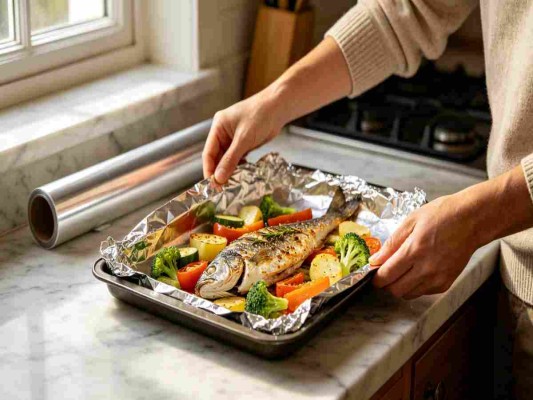
- Lining baking trays, roasting meat and vegetables, oven and grill cooking (use recommended gauges).
- BBQ and outdoor cooking with heavy-duty foil packets and grids.
- Steam-table and catering pans, airline meal service and hotel kitchens.
10.2 Flexible and converter packaging (the home of 2μm foil)
- Barrier layer in laminated films for coffee, teo, etmanĝaĵoj, sukeraĵejo, powdered drinks and pet food.
- Retort and vacuum pouches, sachets and stand-up bags requiring long shelf life.
- Lidding for yogurt cups, desserts and ready meals; heat-seal and peelable webs.
- Aseptic and liquid carton board (the thin aluminum layer in beverage cartons).
- Bottle cap and closure stock, yogurt lids and milk/cosmetic cap membranes.
10.3 Containers and specialty uses
- Disposable foil containers, trays and baking cups (kutime 3003/8011 in heavier gauges).
- Food-service takeaway and airline containers with matching lids.
- Lumo-ŝirmado, izolado, cable wrap and electronic shielding in adjacent product lines.
10.4 Food-contact safety and correct kitchen use
Manĝ-kvalita 8011 foil is safe for normal wrapping, stokado, freezing and oven cooking when used as directed. A few practical points are worth passing on to end customers and are useful for product-page content. Aluminum foil conducts heat well and tolerates conventional oven and barbecue temperatures, but it should not be used in a microwave oven unless the appliance and packaging are explicitly rated for foil use, because metal can cause arcing.
There is no meaningful difference in safety between the bright and matte sides; either side may contact food. Common guidance to place the matte side outward or inward relates more to tradition and slightly different heat reflection than to contamination risk.
Export Packaging, Shipping and Logistics
Foil is easily damaged by moisture, crushing and rough handling, so export packaging is part of quality, not an afterthought. Proper packing prevents oxidation (white spots), edge bruising, core collapse and contamination during a multi-week sea voyage.
Typical export packing for jumbo rolls
- Each roll wrapped in moisture-proof plastic / VCI film, sometimes with desiccant.
- Rolls mounted vertically or on protected pallets to avoid core and edge damage.
- Fumigation-free wooden pallets or plywood cases to satisfy import rules (ISPM 15).
- Strapping and corner protection; eye-to-wall or eye-to-sky loading agreed in advance.
Retail and container loading
- Retail rolls packed in printed color boxes, grouped in export cartons with fixed quantities.
- Cartons stacked on pallets and stretch-wrapped; weight balanced for safe container loading.
- 20ft and 40ft HQ containers; loading quantity depends on roll OD, pallet count and carton dimensions.
- Terms commonly quoted FOB, CIF or CFR; confirm Incoterms, port and whether insurance is included.
Ask for packing photos and a loading plan before shipment, and specify markings, labels and any pallet requirements your warehouse or retailer mandates.
Storage and handling after delivery
- Store jumbo and retail rolls indoors in dry, ventilated conditions, away from moisture, chemicals and direct sunlight; keep the original moisture-proof wrapping intact until use.
- Avoid stacking heavy items on rolls, which can crush cores, bruise edges or cause telescoping.
- Handle jumbo rolls with appropriate forklift or lifting equipment and never roll them across rough floors.
- Use converted foil on a first-in, first-out basis; prolonged storage in humid conditions can cause oxidation (white spots) even on food-grade material.
- Condition cold foil to room temperature before opening sealed packaging to prevent condensation.
-
How to Choose a Reliable Custom Foil Supplier
At ultra-thin gauges the difference between a capable foil mill and a trader reselling generic stock is significant. Use the following checklist to evaluate suppliers before committing a deposit.
| Evaluation area | What good looks like | Red flag |
| Foil capability | Own foil rolling mills; documented double-zero / thin-gauge capacity | Only trader photos, no mill or gauge data |
| Pintruo & QC data | Pinhole report per m², MTC, on-line gauging and light-table inspection | Promises “zero defects” with no report |
| Food compliance | FDA / EU / GB documents and migration test reports | Vague or refused certification |
| Personigo | Fendado, presado, reliefado, color boxes, private label | Only fixed stock sizes |
| Samples | Sample rolls for machine trial before bulk | Demands full payment before any sample |
| Communication | Clear gauge guidance, honest “2μm is converter foil” advice | Agrees to any spec without questioning fit |
| Eksporti sperton | Regular export packing, reliable documentation and references | No export paperwork or loading photos |
A trustworthy supplier will sometimes talk you out of a specification—for example, recommending 9μm instead of 2μm for a bare retail roll. That honesty is a strong positive signal: it means they are optimizing for a product that actually works, not just accepting the order.
Validating with samples before committing
Never approve a thin-gauge program from a photo and a price alone. Request a representative sample from the actual production gauge and, for converter orders, run it on your lamination, slitting or rewinding equipment at normal speed to check web handling, edge quality and break frequency.
For retail programs, assemble a filled sample color box and test the cutter, roll tension and unwinding by hand.
Inspect the sample against a light source for pinholes, measure thickness at several points across the width, and confirm the surface finish and any printing match your proof.
A pre-production sample that you have tested and signed off becomes the quality standard against which the bulk shipment is inspected—and gives you a clear basis for a claim if the delivered goods differ. This small step prevents the majority of thin-gauge disputes.
Pricing and Cost Drivers for Custom 2μm 8011 Folio
Foil is commonly priced as the aluminum metal base (linked to the prevailing aluminum ingot or LME price) plus a conversion/processing fee that covers rolling, recocido, fendo, packaging and mill margin. Understanding the components lets you compare quotations fairly and avoid comparing a high-barrier thin gauge with a commodity thick foil.
Main factors that move the price
- Gauge – thinner foil uses less metal per square meter but carries a higher conversion fee, lower yield and higher scrap, especially at 2μm; price per ton can therefore be higher even though coverage per ton is greater.
- Alloy – 8079/8021 ultra-high-barrier grades and specialty tempers may cost more than standard 8011.
- Width and format – custom slitting, narrow widths and finished retail rolls add converting cost.
- Surface and packaging – printing, reliefado, color coating, non-stick treatment and branded color boxes increase unit cost versus plain jumbo rolls.
- Order quantity – larger tonnage per specification spreads setup cost and lowers the unit price; small trial orders carry a premium.
- Certification and inspection – third-party SGS/BV inspection and special test reports add modest fees.
- Logistics and currency – freight, Incoterms, destination port and exchange-rate movement affect the landed cost.
Why comparing by square meter matters for thin foil
Because foil is sold by weight but used by area, thinner gauges cover more square meters per ton.
When evaluating 2μm against a 9μm product, compare the cost per thousand square meters (or per finished retail roll) for the actual packaging function, not just the price per ton. A higher price per ton for 2μm converter foil can still deliver a lower cost per finished laminated package.
Payment terms, Incoterms and comparing quotes fairly
Standard export practice for custom foil is a deposit (komune 30%) to confirm production with the balance paid against the copy of the bill of lading before release; irrevocable letters of credit are also used for larger orders, and new buyers may start with a smaller trial shipment.
Quotations should state the Incoterm clearly—FOB (the named Chinese port), CFR/CIF (ŝarĝon, and with CIF insurance, al via haveno), or DDP where available—because a price that looks low ex-works can look different once ocean freight, insurance and destination charges are added.
When comparing two suppliers, line up the quotes on an identical basis: same alloy and temper, same gauge and tolerance, same width and roll format, same packaging, same Incoterm and same included certificates.
A spreadsheet that normalizes each offer to cost per ton and cost per thousand square meters will usually reveal that the most expensive-looking quote is sometimes the cheapest delivered package, kaj inverse.
How to Place a Custom Order, Step by Step
A complete specification at the inquiry stage produces an accurate quote on the first pass and protects you against receiving the wrong gauge or format. Provide the following where possible.
- Alojo kaj temperamento (for example 8011-O).
- Thickness in microns/mm and acceptable tolerance.
- Width in mm (jumbo converting width or finished retail width).
- Roll format: jumbo roll for conversion, or finished retail roll length and outside diameter.
- Kerna interna diametro (76 mm / 3 in or 152 mm / 6 en) and core material.
- Surface and treatment (bright/matte, reliefigita, printed, colored, tegita).
- Pakado (bulk pallet/export case or printed retail color box, private-label artwork).
- Quantity in tons, destination port, Incoterms and required certifications.
Standard order workflow
Inquiry → specification confirmation → formal quotation → sample/trial approval → contract and deposit → production and in-process QC → final inspection with test report → balance payment → export packing and shipping → after-sales support. Lead time varies with gauge, printing and packaging; share your delivery deadline early so production can be scheduled.
Troubleshooting Common Thin-Gauge Foil Issues
| Temo | Verŝajna kaŭzo | Antaŭzorgo / action |
| Troaj pintruoj / poor barrier | Inkluzivecoj, too-thin gauge, dirty melt, over-reduction | Raise gauge slightly, require pinhole report, Uzu 8079/8021 aŭ lamenaĵo |
| Web breaks on converting line | Gauge too light, edge cracks, tension mismatch | Match gauge to line speed/tension, inspect slit edges, use proper core |
| Tears on retail dispenser | Bare foil too thin for consumer roll | Use 9–20μm for kitchen rolls; reserve 2μm for lamination |
| Sulkoj / malriĉa plateco | Tension or winding problems, humideco | Check roll hardness, handling and dry storage; request flatness QC |
| Oil stains / malbona presado | Incomplete degreasing/annealing | Specify wettability grade and clean surface; approve samples |
| White oxidation spots | Moisture ingress in transit | Moisture-proof packing, sekigilo, dry container and storage |
| Color/brightness variation | Rolling surface or batch differences | Order by lot, agree surface standard, keep reference samples |
Glossary of Key Terms
- Jumbo roll – a large parent roll of foil supplied to converters for slitting, printing or lamination.
- Converter foil – thin-gauge jumbo foil intended to be laminated, coated or rewound rather than sold directly to consumers; the typical form of 2μm foil.
- Double-zero foil – foil thinner than 0.01 mm, written with two leading zeros (T.e., 0.006 mm).
- Temper – the hardness/softness condition; O is fully soft (kovrita), H designations are work-hardened.
- O temper – fully annealed, soft foil used for household wrapping and food contact.
- Pinhole – a microscopic through-thickness hole that compromises barrier; counted per square meter.
- Double rolling (pack rolling) – rolling two webs together, producing one bright and one matte side.
- Wettability – a measure of surface cleanliness/energy that determines printing and laminating quality.
- Slitting – cutting a wide jumbo coil into narrower customer widths.
- Lamination – bonding foil to paper or plastic films to build a strong multilayer packaging material.
- Mil / gauge – imperial thickness units; 1 mil = 25.4 μm.
- MTC – mill test certificate documenting alloy, humoro, gauge and tested properties.
Oftaj Demandoj
Q: What exactly is custom 2μm 8011 hejma aluminia folio?
A: It is an ultra-thin, mola (O-tempero) 8011-alloy aluminum foil produced to your specified width, roll format and packaging. Ĉe 0.002 mm it is a light converter gauge, normally supplied as jumbo rolls for lamination rather than as bare consumer kitchen rolls.
Q: Is 2μm aluminum foil food-safe?
A: Jes. 8011-O is a standard food-contact alloy, and when produced with FDA/EU/GB compliance and used in a proper packaging structure, 2μm foil is safe for food packaging. Request the migration/compliance documents for your market.
Q: Can I sell 2μm foil directly as a kitchen roll?
A: It is not recommended; a bare 2μm web tears and wrinkles too easily for a retail dispenser. Use 9–20μm for stand-alone kitchen rolls, or convert 2μm foil into laminates and lidding.
Q: What is the thinnest gauge for a retail household foil roll?
A: Most economy kitchen rolls start around 9–11μm, with some ultra-light lines at 6–8μm. Below that, converter/lamination use is standard.
Q: 8011 vs 8079 vs 1235 – which should I choose at 2μm?
A: 8011 is the cost-effective, food-grade default with good pinhole resistance; 8079 aŭ 8021 offer the best ultra-thin pinhole performance for high-end barrier and pharmaceutical laminates; 1235 is softer and more common for lamination and capacitor stock.
Q: How are pinholes specified and checked?
A: Pinholes are counted per square meter on a back-lit table or by laser/image scanning, with a maximum hole diameter also defined. Reference standards include GB/T 3198, GB/T 33143 kaj ASTM B479; require a batch report for light gauges.
Q: Why does household foil have one shiny and one dull side?
A: In double rolling, two webs are rolled together; the faces touching the polished rolls become bright, while the inner faces in contact with each other become matte. There is no meaningful food-safety difference between the two sides.
Q: Kio estas la MOQ kaj plumbotempo?
A: A typical minimum is about 3 tunoj per specifo, with trial orders negotiable. Lead time depends on gauge, printing and packaging; provide your target quantity and delivery date for an exact schedule.
Q: How is the foil packed for export?
A: Jumbo rolls are wrapped in moisture-proof film and secured on fumigation-free pallets or in wooden cases; retail rolls go in printed color boxes grouped into export cartons. Loading photos and a packing list are provided before shipment.
Q: How do I get an accurate quotation?
A: Send alloy/temper, dikeco, larĝo, roll format, kerna ID, surface/packaging requirements, kvanto, destination port and certifications. Complete specifications avoid revisions and speed up pricing.
Q: Which side of the foil should touch the food?
A: Either side is safe; household foil has one bright and one matte side from double rolling, with no meaningful food-safety difference. Use either side for wrapping and cooking.
Q: Can household aluminum foil go in the oven or microwave?
A: It is suitable for conventional ovens, grills and freezers. It should not be used in a microwave unless the appliance and package are specifically approved for foil, to avoid electrical arcing.
Q: Do you support OEM and private-label retail programs?
A: Jes. Custom thickness, larĝo, roll length, embossed or non-stick surfaces, printed color boxes, cutter type, carton quantities and branded markings can all be supplied, with pre-production proofs and sample retail rolls for approval.
Q: Are samples available before a bulk order?
A: Sample jumbo strips or retail rolls can be provided for machine and market trials before mass production; sample terms depend on specification and freight, and trial-size production orders are negotiable for new customers.
- Konkludo
Custom 2μm 8011 household aluminum foil is a specialized product that rewards buyers who understand the difference between converter foil and a finished kitchen roll.
The 8011-O alloy supplies an outstanding balance of strength, moleco, food-contact safety and pinhole resistance at light gauges, while the 2μm thickness delivers maximum coverage and minimum metal weight for laminated flexible packaging, lidding and barrier structures.
For a conventional consumer kitchen roll, specify 9–20μm; for lamination and ultra-light barrier packaging, 2μm 8011—or 8079/8021 for the strictest pinhole requirements—is an excellent, economical choice when produced by a mill that controls pinholes, supplies full food-grade documentation and customizes width, core, surface and packaging to your line.
The cheapest quote is not always the lowest landed cost: gauge accuracy, pinhole performance, clean annealed surfaces and export-grade packing determine whether your converting line runs smoothly and your finished product performs on the shelf.
Define the real end use, require measured data and samples, and build the specification around the packaging function rather than a single number.