Anodized Aluminum Circles
| મિશ્રધાતુ | 1050/1060/1100, 3003, 5052, 6063 (selected by finish and use) |
| ટેમ્પર | ઓ / H14 / H24 / H32 as required for forming |
| જાડાઈ | 0.3-6 મીમી |
| વ્યાસ | 50–1500 mm, cut to tooling |
| મહોર | hot-water / nickel-free sealed |
| ધોરણ | ISO 7599, ASTM B580, જીબી/ટી 8013; salt-spray / food-contact as required |
| QC | eddy-current film thickness, color sample match, મહોર / salt-spray test |
Anodized Aluminum Circles
રજૂઆત
Anodized aluminum circles are round aluminum blanks that have been anodized—electrochemically coated with a controlled, hard layer of aluminum oxide—to make the disc corrosion-resistant, વસ્ત્રો-પ્રતિરોધક, electrically insulating, decorative and able to hold a permanent color.
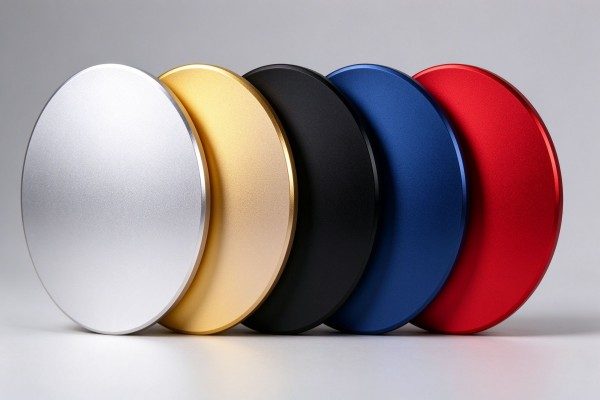
Instead of a bare mill-finish disc, the customer receives a ready-to-use round part in silver, કાળો, સોનું, શેમ્પેઈન, red or blue, or in a bright mirror or satin finish. The circle is then used as a lamp reflector, an anodized cookware body, a decorative or sign disc, a knob, a nameplate or an electronic housing component.
Anodizing is a conversion coating rather than a paint: it grows from the aluminum itself, so it will not peel or chip, and the porous oxide layer can be dyed and sealed.
This makes anodized circles attractive for products that must stay good-looking outdoors, in a kitchen or in a demanding industrial environment.
This guide explains the anodizing process, the common types and finishes, which aluminum alloys anodize best, the main applications in detail, how film thickness and color are controlled, and how to order consistent anodized discs from a Chinese supplier.
This guide is written for importers, lamp and luminaire makers, cookware factories, sign and nameplate producers, and hardware buyers who need a consistent, factory-direct anodized circle from China.
It explains what to specify—alloy, ગુસ્સો, anodize type, film thickness, color and standard—and what questions to ask a supplier before a first order.
What Is an Anodized Aluminum Circle?
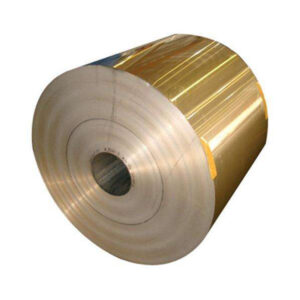
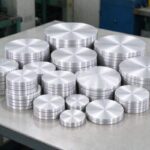
An anodized aluminum circle starts as a normal round blank, usually 0.3–6 mm thick and about 50–1500 mm in diameter, blanked from aluminum coil or sheet.
In anodizing the disc is made the positive electrode (એનોડ) in a bath of dilute sulfuric acid; a controlled current grows a porous aluminum-oxide layer on the surface
After the oxide is grown it can be colored by absorbing dye into the pores and then sealed by closing the pores in hot water or a sealing solution, which locks the color and improves corrosion resistance.
Unlike a painted or plated coating, the anodic layer is integral with the aluminum, grows both outward and into the surface, and is extremely hard and scratch-resistant.
It is also electrically insulating and, because it is oxidized aluminum, it does not peel. A well-sealed anodized disc keeps its color and finish for years outdoors.
The two things buyers actually specify are the type of anodize (decorative or hard), the film thickness, the color and appearance, and the alloy underneath.
The base alloy is chosen from the 5000-શ્રેણીની એલ્યુમિનિયમ શીટ અને 1000/3000 પરિવારો; for highly reflective lighting and decorative parts an anodized 5052 મિરર શીટ polish and anodize to a bright finish.
Compared with painting or electroplating, anodizing is part of the metal rather than a separate layer.
Paint can chip and powder coat can be scratched through to the aluminum, while the anodic oxide grows from the surface itself; compared with chromate or other chemical conversion coatings, the anodic film is much thicker, harder and able to hold dye.
The trade-off is that anodizing is an electrochemical batch process with fixed racking points, and it is less suitable for parts that must remain electrically conductive after coating.
Structurally, the anodic layer has two zones: a thin dense barrier layer next to the aluminum and a thicker porous layer above it.
The pores are what absorb dye; after dyeing, sealing hydrates the aluminum oxide and swells it shut, trapping the color and blocking corrosion.
This porous-then-sealed structure is exactly why anodizing can hold color at all, and why sealing quality is the single most important process for long-life color.
Why Anodize Aluminum Circles?
-
- કાટ પ્રતિકાર: the sealed oxide layer protects the disc against atmospheric, humidity and light chemical attack.
- Wear and scratch resistance: the oxide is much harder than bare aluminum; hard anodizing is very durable.
- Decorative color: the porous layer absorbs black, સોનું, શેમ્પેઈન, લાલ, blue and other dyes, then sealed to lock them in.
- Mirror and satin finishes: polished discs anodize to a bright reflective or a matte satin surface.
- Adhesion and durability: the coating is integral and will not peel, chip or flake like paint.
- ઇલેક્ટ્રિકલ ઇન્સ્યુલેશન: the oxide layer is non-conductive, useful for lighting and electronic parts.
- No plating baths or heavy topcoats: the finish is part of the aluminum itself and is long-lasting.
The main trade-off is that anodizing adds a processing step and cost, that certain alloys color more evenly than others, and that the hanging (rack) points where the discs are held during anodizing remain uncoated.
These points are hidden or placed on non-visible edges in a good design.
Buyers sometimes weigh anodizing against powder coating or electroplating.
Powder coating is a polymer paint available in almost any color, cheap for large outdoor panels, but it can chip and cannot give a true mirror-bright metal look; electroplating adds chrome or nickel for a very hard, shiny surface but relies on heavy chemicals and does not dye to pastel colors.
Anodizing sits between them: an integral, સખત, corrosion-resistant layer, a true metallic silver or dyed color, and a mirror that reflects 85%+ પ્રકાશનું, with no peel-prone topcoat.
For small round parts where the metallic look and durability matter, anodizing is usually the right choice; for huge panels where any color and lowest cost are required, powder coating can be.
Types of Anodize and Finishes
| પ્રકાર | Typical film | દેખાવ | લાક્ષણિક ઉપયોગ |
| Decorative sulfuric | 5-25 µm | ચાંદી, dyed colors, satin | સામાન્ય હાર્ડવેર, ચિહ્નો, ટ્રિમ |
| Hard anodized | 25–100+ µm | grey to black, hard and matte | રસોઇર, wear parts, slides |
| તેજસ્વી / મિરર એનોડાઇઝ્ડ | પાતળું, over polished surface | mirror-bright reflective | લેમ્પ રિફ્લેક્ટર, decorative discs |
| Chrome / સ્થાપત્ય (alternative) | 8–20 µm | યુનિફોર્મ, ટકાઉ | outdoor and architectural parts |
Most colored and silver anodized circles are decorative sulfuric anodizing in the 5–25 µm range.
Hard anodizing uses colder baths and higher voltages to build a much thicker, harder film (25–100 µm or more) in dark grey or black, which is the standard for premium anodized cookware and wear-resistant parts.
Bright or mirror anodizing is applied to a polished disc to preserve a high-reflectivity silver surface for reflectors. Architectural anodizing is a durable, uniform finish for outdoor panels and sign discs.
Hard anodizing differs from decorative anodizing in the bath and the goal.
Decorative anodizing favors a smooth, યુનિફોર્મ, dye-accepting film of moderate thickness at warmer temperatures, while hard anodizing uses a colder, more concentrated bath and higher current to build a thick, ગાઢ, wear-resistant layer that is naturally dark grey to black.
Because the hard film is thick and relatively rough, it is usually not bright-dyed; its value is abrasion and corrosion resistance, which is why premium cookware and sliding or rotating parts use it.
Film thickness should be specified on the drawing, not left to chance.
Bright anodizing is not simply anodizing over a polished face. Before anodizing the disc is mechanically polished or chemically brightened to a high-luster silver, and a very thin, transparent anodic layer is then grown to protect it.
If the anodic film is too thick or the bath is wrong, the bright surface turns hazy; this is why mirror reflectors are a specialized process rather than a commodity anodize, and why buyers compare reflectivity samples rather than rely on a color photo.
Which Alloys Anodize Best?
| મિશ્રધાતુ | Anodizing result | માટે શ્રેષ્ઠ |
| 1050 / 1060 / 1100 | very uniform, નરમ, good dye uptake | પરાવર્તક, shallow parts, colored discs |
| 3003 | સારું, but manganese can darken or mottle | general pans, ચિહ્નો, હાર્ડવેર |
| 5052 | સારું, કાટ-પ્રતિરોધક; slight large-area color variation | દરિયાઈ, ચિહ્નો, પરાવર્તક, premium trim |
| 6061 / 6063 | most uniform and attractive color (Mg-Si) | સુશોભન ટ્રીમ, નેમપ્લેટ્સ, anodized color parts |
As a rule, the purer the aluminum, the more uniform and attractive the anodic color.
Commercially pure 1050/1060 discs anodize and dye evenly and are low cost, but the softer surface is less scratch-resistant; 6063 gives the most consistent decorative color and is preferred for colored trim, જ્યારે 5052 offers extra corrosion resistance for reflective, coastal or sign discs. 3003 is workable and robust but can show slight greying.
The alloy should be chosen together with the end use, because the anodize cannot hide a poor substrate surface—scratches or roll marks before anodizing show through the coating.
Low-cost colored and reflective blanks often start from a soft 1050 એલ્યુમિનિયમ વર્તુળ; robust pans and signs commonly use 3003 એલ્યુમિનિયમ વર્તુળ; and outdoor reflective discs may use corrosion-resistant 5052.
The product form also matters. Rolled and blanked circles give the most uniform anodic surface because the sheet is homogeneous, while extrusions and welded parts can show weld or heat-affect discoloration after anodizing.
6063 is an extrusion alloy known for uniform color on architectural trim; on rolled 5052 circles, large panels may show slight tone variation because of magnesium distribution, which is why buyers approve a sample.
Welded cookware ends are anodized after forming so the weld blends into the dark hard-anodized body.
The Anodizing Process Flow
A circle goes through a wet-line sequence before it is finished.
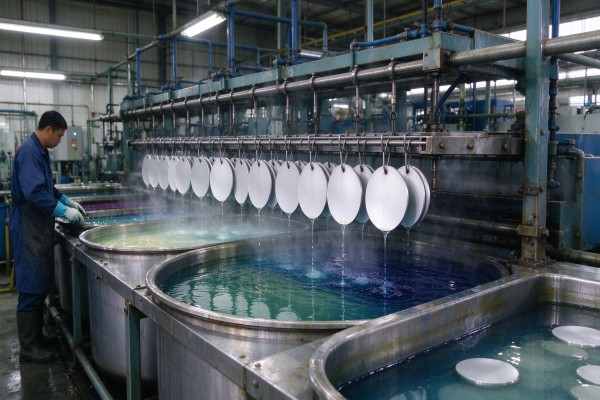
The typical route is degreasing to remove oil and stamping residue, alkaline etching to set a uniform satin texture, acid neutralizing (desmutting) to clean the surface, anodizing in sulfuric acid to grow the oxide film, dyeing in the chosen color, sealing in hot water or a nickel-free sealing bath to close the pores, and finally rinsing and drying.
The discs are racked on tianguis that hold them at points designed to be hidden on the finished part.
The quality of the anodize depends on every stage: an uneven etch gives blotchy color, an unclean surface leaves spots, the bath current and time set the film thickness, the dye concentration and time set the depth of color, and sealing determines whether the color will wash or fade.
Mirror discs are polished and sometimes chemically brightened before anodizing so the reflectivity is preserved, while hard-anodized cookware uses a colder, higher-voltage bath for a thick, hard grey-black film.
The rack (contact) points are a necessary part of the process: each disc must be electrically connected to the rack, so the small contact area cannot be anodized at that instant.
A good anodizer places these points on the edge, the back face or a hidden bore, or machines them off after coating. Mirror discs also need the cleanest pre-treatment, because any rolling mark, scratch or fingerprint before anodizing is sealed forever into the bright surface.
This is why polished reflectors carry peelable film and are handled with gloves.
રંગો, Textures and Color Matching
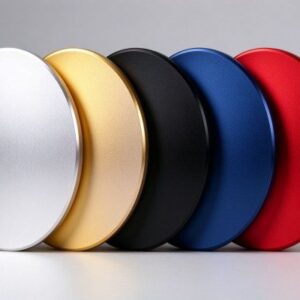
Standard anodized colors include natural silver, કાળો, શેમ્પેઈન, કાંસ્ય, સોનું, લાલ, blue and green, with the exact shade controlled by dye choice, concentration and time.
The surface texture can be bright (for reflectors), satin or etched (a fine matte), or mirror (on a polished disc).
Because anodized color is produced from a porous layer, two lots can vary slightly, so buyers approve a physical color sample and specify that all volume for a project comes from a single lot.
Pantone or color samples are matched as closely as possible rather than guaranteed identical to paint.
| સમાપ્ત કરો | વર્ણન | Typical product |
| Natural silver / satin | clear anodized, fine matte texture | ચિહ્નો, હાર્ડવેર, ટ્રિમ |
| તેજસ્વી / અરીસો | polished then anodized, ઉચ્ચ પ્રતિબિંબિતતા | લેમ્પ રિફ્લેક્ટર, mirror discs |
| Dyed black | ઊંડો કાળો, decorative or hard | રસોઇર, knobs, નેમપ્લેટ્સ |
| સોનું / શેમ્પેઈન / કાંસ્ય | warm metallic tones | ટ્રિમ, gifts, decorative discs |
| લાલ / વાદળી / લીલો | brighter decorative colors | brand parts, નેમપ્લેટ્સ, પે panીઓ |
Color consistency across an order is managed the way paint is—by lot. A physical sample disc is approved and signed, then all discs for the project are anodized in the same lot with the same bath and dye concentration.
Anodized dye cannot be matched to a Pantone printed color exactly, because the metallic aluminum substrate changes the tone; the sample is the contract.
Buyers should also expect a small difference between a 100 mm and a 600 mm disc, and should avoid mixing colors from different production runs on one product.
કોર એપ્લિકેશન: Lighting Reflectors
One of the largest uses of anodized circles is as reflectors.
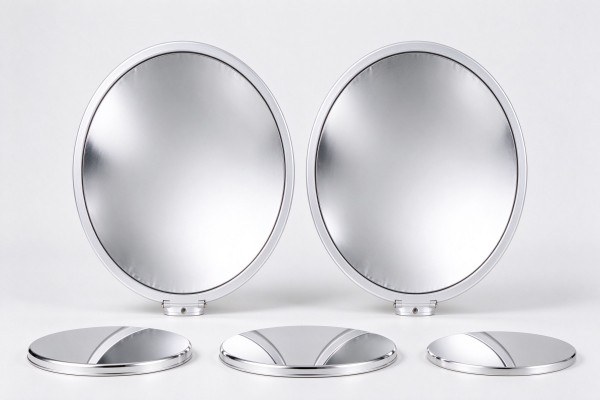
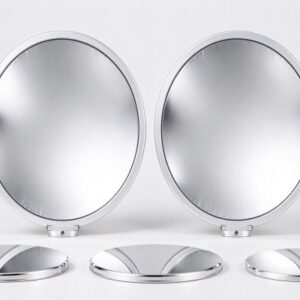
The disc is spun or drawn into a bowl, polished and anodized to a bright silver surface that reflects light efficiently, typically with reflectivity around 85–95%.
These reflector discs are found in downlights, street and area lights, industrial high-bay luminaires, display and architectural lighting and solar reflectors.
The anodized layer protects the polished surface from oxidation and fingerprinting, keeping reflectivity stable over years.
Reflectivity is the key parameter here. A polished and bright-anodized aluminum reflector typically returns around 85–95% of visible light, far above a painted white surface, and the clear anodic layer keeps the polished silver from dulling.
Downlights and street lights use spun bowls for beam control, while industrial high-bay and solar reflector dishes use larger diameter discs.
The mirror surface is measured by reflectivity and protected until assembly; an edge or back blemish does not matter, but a face scratch destroys the optical performance.
For reflectors the blank must be flat and scratch-free before polishing, because anodizing locks in whatever surface existed underneath.
Pure 1050/1060 discs give the brightest, most uniform mirror; 5052 is used where the reflector also needs corrosion resistance outdoors.
Mirror or bright anodized parts are usually protected with a peelable film through assembly so the reflective face is not marked.
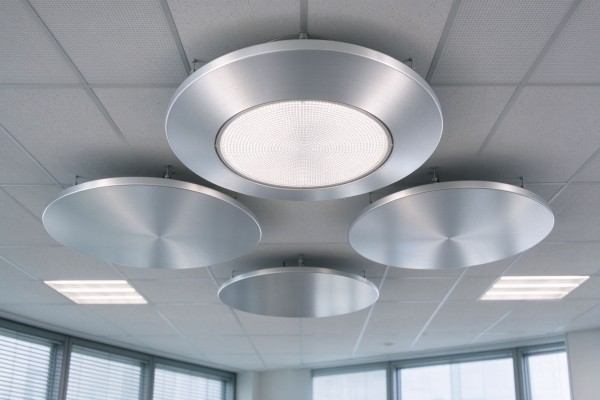
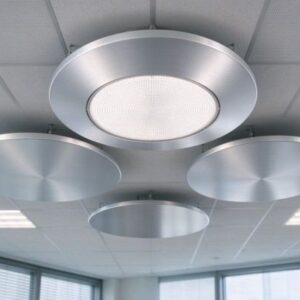
The same round blank can be used as the ceiling diffuser trim and reflector housing in modern round luminaires.
Round luminaires benefit directly from round anodized blanks: the disc is already the right shape for a downlight bezel, a reflector bowl or a suspended ceiling diffuser, so no rectangular sheet needs to be cut and scrap is minimal.
Mirror-anodized versions are used where the light must be efficient, while satin silver anodized versions are chosen where the fixture itself must look clean and modern.
The integral silver oxide reflects without a separate mirror layer, which reduces assembly steps.
કોર એપ્લિકેશન: Anodized Cookware
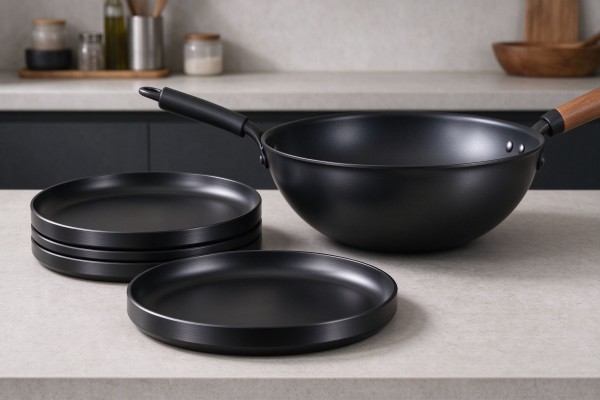
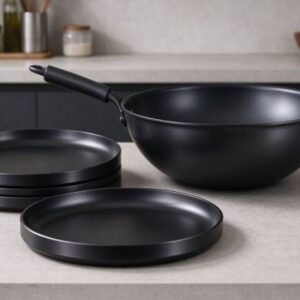
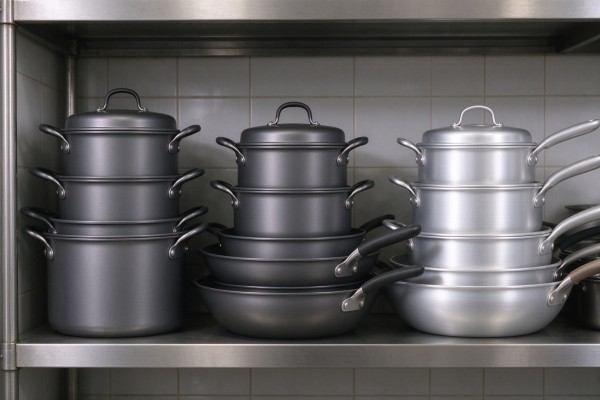
Anodized circles are deep-drawn into premium cookware bodies—woks, frying pans, saucepans and stockpots—then hard-anodized to a dark, સખત, non-reactive surface.
Hard anodizing turns the aluminum body into a much harder, સ્ક્રેચ- and corrosion-resistant cooking surface that is non-reactive with acidic foods, which is why it is widely used on premium pots and pans.
The anodized black or dark-grey body is also durable and easy to clean, and it pairs with a non-stick coating applied over the anodized layer.
Cookware blanks are usually 1050/1060, 3003 or 5000-series circles drawn in the soft O temper, then degreased and hard-anodized after forming rather than before, because drawing a pre-anodized disc would damage the film.
The film is thick (25–60 µm or more), dark and uniform, and the edge and handle holes are finished after anodizing.
Food-contact cookware must use food-safe anodizing and sealing processes, and the supplier should be able to provide the relevant food-contact documents.
Hard-anodized cookware sits between bare aluminum and non-stick coatings.
The anodized body is harder than plain aluminum, non-reactive with tomatoes and wine, and much more scratch-resistant than a soft painted surface; a non-stick PTFE or ceramic coating can then be applied over the anodized layer for easy release.
Because the anodic film is porous before sealing, sealing must be complete for food use—an unsealed film can trap acids or odors—and cookware anodizing must follow food-contact regulations.
The hard dark surface also hides scratches better than bright silver.
The dark hard-anodized surface also spreads heat evenly because it covers a uniform aluminum body, and it resists the alkaline cleaners used in commercial kitchens.
For a wok or frying pan, the circle is drawn before anodizing so the film covers the inside and outside consistently; holes for handles are drilled after anodizing and deburred.
This is why premium anodized pans look and feel more durable than painted aluminum cookware.
આર્કિટેક્ચરલ, Decorative and Sign Discs
Anodized circles are used as decorative round panels, ceiling discs, wall and display trims, furniture and kitchen components, and as substrates for nameplates and signs.
The anodized finish does not flake, holds color outdoors and can be screen-printed or laser-marked, so it is preferred for premium interior and exterior trim.
Colored gold, champagne or black anodized discs give a durable metallic look that paint cannot match on small round parts.
For sign and nameplate discs, silver or black anodize takes reflective sheeting, printing and engraving well; architectural circles are anodized to the architectural standard for long outdoor life.
Because the anodic layer is integral, the edges remain protected and the disc does not rust or chalk in weather. Color matching to a brand or interior scheme is approved on a sample and produced in a single batch.
Anodized discs accept secondary finishing well: they can be laser-engraved to expose the silver under a black or colored layer—a classic nameplate effect—screen-printed, CNC-turned on the edge, or fitted with pins and adhesives.
Architectural ceiling discs are anodized to a satin silver or champagne that does not chalk or fade, and the integral oxide means the round edge stays clean.
Because the anodic surface is slightly textured, it does not show fingerprints as readily as a bare polished disc, which is useful on furniture and hardware.
Small anodized circles are also popular as coasters, ટોપીઓ, cosmetic and device accessories, and gift or award discs, where a black, gold or silver finish gives a premium look at low cost.
The same blanking and anodizing process serves both large reflectors and these small parts, so a supplier can run a mixed basket of diameters in one color lot.
Hardware, Electronics and Automotive Parts
Beyond lighting, cookware and architecture, anodized circles are stamped and turned into control knobs, pan and pot lid components, appliance covers, electronic housings and heat spacers, ventilation and fan discs, bathroom and fitting hardware, and automotive and interior trim.
The insulating anodized layer supports electronic parts, the hard surface resists wear on knobs and slides, and the colored finish matches product design.
Small round parts in black, gold or silver are a common decor and control element in consumer products.
For these parts the disc is often blanked to size, formed or turned first, then anodized, with the rack points placed on non-visible edges; hard anodizing is chosen for parts that slide or rotate, while bright decorative anodizing is used for visible brand and trim surfaces.
A consistent alloy and batch keeps color and hardness uniform across a product family.
The insulating oxide also suits electronics. A bright-anodized circle can act as a spacer, heat spreader or insulating washer between a powered component and its aluminum housing, combining aluminum thermal conductivity with an electrically non-conductive surface.
Black anodizing further improves emissivity for passive heat dissipation. Automotive and interior trim uses the same colored finish for consistency across knobs, vents and decorative rings, all cut from anodized circles in the same lot.
ફિલ્મ જાડાઈ, Color and Quality Control
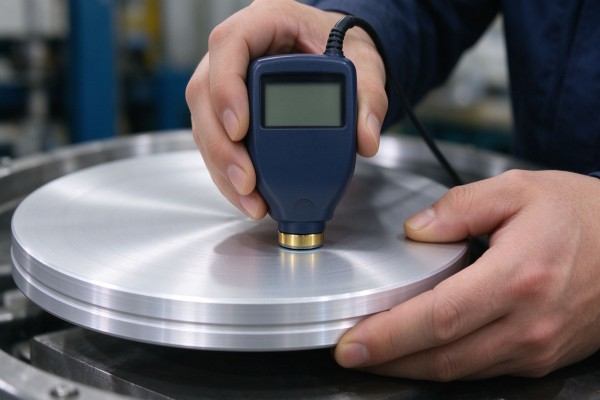
The anodic film is measured with an eddy-current thickness gauge, which reads the non-conductive oxide on the aluminum without damaging the part; buyers specify a minimum and average film thickness (for example 10–15 µm decorative, or 25–50 µm hard).
Color is controlled against an approved sample under standard light, and sealing quality is checked with dye-spot or acid-dissolution tests, because a poorly sealed film will stain or fade.
Salt-spray (neutral salt spray or CASS) is used to verify corrosion resistance for outdoor parts.
| Check | લાક્ષણિક જરૂરિયાત | પદ્ધતિ |
| Film thickness | 5–25 µm decorative; 25–100 µm hard | eddy-current gauge |
| રંગ | match approved sample | visual under standard light / colorimeter |
| મહોર | no stain after dye-spot test | dye spot or acid dissolution |
| કાટ પ્રતિકાર | hours of salt spray per standard | neutral salt spray / CASS |
| દેખાવ | no spots, ખંજવાળ, blotchiness | visual inspection |
Common defects—blotchy color, ફોલ્લીઓ, rainbow stains, soft film or exposed rack points—trace back to etching, સફાઈ, bath contamination, under-sealing or the rack design.
A reputable anodizer controls bath chemistry, વર્તમાન, temperature and rinsing water, and provides a film-thickness and color inspection report with the lot. For colored parts, keep one approved sample disc as the reference for incoming inspection.
Standards and Compliance
| ધોરણ | Covers |
| ISO 7599 | anodized aluminum coatings on wrought products (પ્રકાર, જાડાઈ, દેખાવ) |
| ASTM B580 | anodic coating specifications on aluminum |
| જીબી/ટી 8013 | Chinese anodic oxidation coatings on aluminum and alloys |
| ASTM B117 / CASS | neutral salt spray and copper-accelerated corrosion testing |
| Food-contact regulations | safe anodizing and sealing for cookware |
Buyers should specify the standard and the minimum film thickness, request the anodizing process and thickness report, and—for outdoor or food-contact parts—the salt-spray and food-contact documents.
The certificate should name the alloy, ગુસ્સો, film thickness and color of the lot rather than a generic statement.
વ્યવહારમાં, an anodized circle batch should arrive with a mill test certificate naming the alloy and temper, an anodizing report stating the film thickness and sealing process, the approved color sample reference, and—for outdoor or cookware parts—the salt-spray or food-contact test.
Generic statements such as “anodized aluminum” without thickness or standard should be questioned, because a 3 µm decorative film and a 50 µm hard film share the same name but perform very differently.
Agree the standard and minimum thickness on the drawing and the order.
Packaging and Logistics
Anodized discs are scratch-sensitive, so they are protected with peelable or interleaving film between the polished or colored faces, edge-protected, and packed in cartons or on fumigated pallets; mirror and bright reflectors keep their protective film until assembly.
Colored and mirror parts are packed face-to-face or interleaved to avoid rubbing, and each batch is tagged with color, એલોય, જાડાઈ, વ્યાસ, film thickness and lot. Dry, clean storage protects the sealed finish.
Export terms are commonly FOB, CFR or CIF with 30% T/T deposit and balance against the bill of lading.
Documents include the bill of lading, invoice, પેકિંગ યાદી, mill and anodizing certificate, color sample reference, certificate of origin and any salt-spray or food-contact reports.
Sealed anodized discs are stable but should be kept dry and out of direct sun in storage.
Peelable film should be removed only at assembly, because it is the only thing preventing scratches on mirror and colored faces during handling.
If discs arrive with a light white powdery residue it usually wipes off, but heavy powder indicates under-sealing and should be reported. Keeping the protective film on through punching and spinning avoids the most common return reason: face scratches.
Pricing and MOQ
Anodized circles are priced from the base aluminum and blanking cost plus the anodizing processing.
Decorative sulfuric anodizing adds a moderate per-part charge, hard anodizing and bright mirror finishing cost more because of the thicker film or polishing, and custom colors carry a small setup and minimum order because each color must be run separately and matched.
The ingot base follows the daily LME and Shanghai spot quotations, so quotes are valid for a short window and re-confirmed at order.
| Cost factor | Effect on price |
| મિશ્રધાતુ | 1050/1060 સૌથી નીચું; 6063 અને 5052 cost more |
| Anodize type | hard and bright/mirror finishes cost more than standard silver |
| રંગ | custom colors add setup and have a minimum order |
| Film thickness | thicker hard-anodized films cost more to grow |
| Surface prep | polishing and brightening add cost for reflectors |
| વોલ્યુમ | large runs and a single color lower the unit cost |
Buyers control cost by using standard colors and stock diameters, ordering all project quantity in one lot for color consistency, and matching the finish to the visible surface rather than over-polishing hidden sides.
A color and film sample is approved before production.
Beyond processing, cost follows the ingot base.
The aluminum content is referenced to the daily LME and Shanghai spot price plus a conversion and processing premium, so sudden metal moves change the quote within its validity.
Tooling for non-standard diameters is a one-time blanking die charge; choosing an existing diameter or a standard color removes both the die and the color-setup cost.
For first orders, a small sample lot pays for itself in avoided color or film-thickness rework on a full container.
How to Order Anodized Circles
Send the drawing or required diameter, જાડાઈ, એલોય અને સ્વભાવ, and the end product.
Specify the anodize type (સુશોભન, સખત, bright/mirror), રંગ, film thickness and standard.
Approve a color and film sample; agree the lot, rack-point position and protective film.
Confirm price, tooling if any, MOQ for custom color, packaging and delivery terms.
Pay the deposit, run production, inspect color and thickness, and ship with full documents.
For a first order it is worth sending a physical part or a Pantone/color sample even if the drawing dimensions are clear.
Anodized color is hard to describe in words, and seeing a sample—and confirming the rack-point position and peelable film—avoids the most common dispute, which is color. The supplier should hold the sample and the die so repeat orders match.
ઇકો ફટકડી વિશે
Eco Alum is an aluminum product supplier established in March 2025, organized around a rich supply chain within China’s aluminum rolling industry. Instead of acting as a simple trader, we coordinate with qualified rolling, blanking and anodizing mills to deliver specification-accurate, well-finished material at factory-direct pricing and manage the technical, quality and export documentation.
Our main products are aluminum plates, કોઇલ, વરખ, strips and discs (circles), covering the 1xxx series—1050, 1060, 1070, 1100, 1235 and 1350—along with 3003 and the 5000-series alloys such as 5052.
For anodized circles we supply custom diameters, gauges, tempers and anodizing finishes—natural silver, satin, mirror/bright, dyed black, સોનું, champagne and architectural colors, plus hard anodizing for cookware—with color sample approval, eddy-current film-thickness reports, salt-spray and food-contact documents where required, and scratch-proof export packing.
We help you choose the alloy and finish that match the reflector, રસોઇર, sign or hardware part rather than selling one grade for everything. Reach us at [email protected] or +86 19924932491.
We support buyers with drawings and blank-size guidance, anodizing color samples before a first order, lot-specific mill and anodizing certificates, batch color consistency, and protective peelable film on mirror and polished parts.
Send your drawing, color requirement or sample disc to [email protected] for a prompt, specification-based quotation.
વારંવાર પૂછાતા પ્રશ્નો
પ્ર: What is an anodized aluminum circle?
એ: A round aluminum blank that has been electrochemically coated with a hard, integral aluminum-oxide layer, supplied in silver, રંગીન, mirror or hard finishes.
પ્ર: How thick is the anodized film?
એ: Decorative sulfuric anodizing is commonly 5–25 µm; hard anodizing for cookware and wear parts is 25–100 µm or more.
પ્ર: What colors are available?
એ: Natural silver, કાળો, સોનું, શેમ્પેઈન, કાંસ્ય, red and blue, in bright, satin or mirror finishes, matched to an approved sample.
પ્ર: Which alloy anodizes best?
એ: Pure 1050/1060 gives the most uniform color and the brightest mirror; 6063 gives the most consistent decorative color; 5052 adds corrosion resistance for outdoor and reflective use.
પ્ર: Can anodized circles be used for cookware?
એ: Yes—circles are deep-drawn and hard-anodized into premium woks and pans for a hard, non-reactive, durable surface.
પ્ર: Will the color fade or peel?
એ: કોઈ. The anodic layer is integral and sealed, so it does not peel, and sealed dye will not rub off; proper sealing prevents fading.
પ્ર: Why are there small uncoated spots on the edge?
એ: These are rack (hanging) points from anodizing; a good design places them on hidden edges or finishes them after coating.
પ્ર: How is the anodize quality checked?
એ: Film thickness is measured with an eddy-current gauge, color against an approved sample, and sealing and corrosion by dye-spot and salt-spray tests.
નિષ્કર્ષ
ટૂંકમાં: choose bright-anodized 1050/1060 for lighting reflectors, hard-anodized 1050/3003 for cookware, silver or black anodized for signs and nameplates, and dyed 6063 અથવા 5052 for decorative colored trim.
Specify a minimum film thickness and approve a color sample, control the rack points, and require proper sealing. With those rules, anodized circles deliver a premium, durable metallic finish that outlasts paint and stays good-looking for years.
Anodized aluminum circles turn a plain round blank into a durable, કાટ-પ્રતિરોધક, decorative and wear-resistant part.
The oxide layer is integral with the aluminum, holds a permanent color or a high-brightness mirror, protects reflectors and cookware, and outlasts paint in outdoor, kitchen and industrial service.
The specification follows the product: a thin bright film for lamp reflectors, a thick hard film for premium cookware, a dyed silver or black film for signs, nameplates and trim, and the alloy chosen for color uniformity, reflectivity or corrosion resistance.
Sourcing from a supplier that controls blanking, એનોડાઇઝિંગ, sealing and color matching, and that approves a sample and film report before production, gives buyers consistent anodized discs from lot to lot.