


china 5052 aluminum circle factory

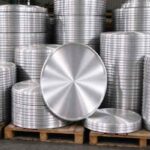
china 5052 aluminum circle factory
Pambuka
A 5052 aluminum circle is a flat, round aluminum blank stamped or blanked from 5052 sheet or coil and delivered ready for deep drawing, Spinning, stamping, welding or machining.
Also called an aluminum disc or round blank, it is the standard starting form for round metal products because a circle uses the material efficiently when it is pressed or spun into a hollow part.
5052 is an aluminum-magnesium, non-heat-treatable alloy that is stronger than the 1000 lan 3000 series cookware alloys, with excellent atmospheric and salt-water corrosion resistance, which is why a China 5052 aluminum circle factory serves cookware, traffic sign, Laut, lighting and hardware converters.
Buyers choose 5052 circles when a part needs more strength or corrosion resistance than 1050, 1060 utawa 3003 can offer—for example a deep wok drawn in one stroke, a coastal traffic sign, a boat deck fitting or a polished lamp reflector.
The decisions that matter are the temper (O for deep drawing, H32 or H34 for strength), the casting route, the blank diameter and tolerance, edge quality and the surface finish.
This guide explains the alloy, its specifications and tempers, how circles are blanked, aplikasi utama ing rinci, quality and packaging, and how to order from a Chinese factory.
Apa iku a 5052 Lingkaran Aluminium?
An aluminum circle is produced by cutting a round disk from rolled sheet or coil, normally with a circular blanking die.
Unlike a laser-cut plate, a blanked circle is a high-volume, consistent part with a sheared edge that can be deburred; the factory nests the circles to maximize material yield and supplies them stacked, interleaved and palletized.
Circles are ordered by diameter and thickness rather than by length and width, and they are priced per tonne or per piece according to the blank size and volume.
5052 is the most widely used of the 5000-series rust-resistant aluminum alloys.
It is non-heat-treatable, so it is strengthened by cold work and stabilized by the H3 tempers, and its magnesium content gives it medium strength, good fatigue performance and very good corrosion resistance, especially in marine and humid environments.
It welds well by conventional methods, anodizes to a durable finish and polishes to a bright, near-mirror surface.
In the annealed O temper it is ductile enough for deep drawing, while H32 and H34 give stiffer, stronger blanks for stamping and structural parts.
5052 is part of the wider 5000-sheet aluminium seri kulawarga; for a highly reflective lighting or decorative finish, the corresponding 5052 lembaran pangilon can be blanked into circles.
Komposisi Kimia lan Sifat Mekanik
| unsur | Mg | Cr | Fe | lan | Cu | Mn | Zn | Al |
| 5052 kisaran (%) | 2.2–2.8 | 0.15–0.35 | ≤0.40 | ≤0.25 | ≤0.10 | ≤0.10 | ≤0.10 | Balance |
Magnesium is the principal strengthening element and chromium improves resistance to stress-corrosion cracking, while the low copper and manganese levels keep the alloy rust-resistant and weldable.
The density is about 2.68 g/cm³. Because the alloy is not heat-treatable, its properties are set by the temper and the amount of cold work after the final anneal.
| Temper | Kekuwatan tensile khas (MPa) | Formability | Panggunaan khas |
| O (Anneeled) | about 190–195 | paling dhuwur; deep draw and spin | Woks, deep pots, complex draws |
| H32 | Babagan 228 | moderate; good stiffness | Tandha, marine parts, hardware |
| H34 | Babagan 262 | ngisor; kekuatan dhuwur | stamped and load-bearing parts |
| H111 | between O and H32 | apik | general forming and fabrication |
Values are typical and vary with thickness and mill; the annealed O temper offers the highest elongation and the lowest forming force, while H32 and H34 are stabilized for reduced spring-in and greater rigidity.
The mill certificate should be treated as the authoritative values for each lot.
Napa 5052: 5052 vs 1050, 1060, 3003 lan 6061
| Paduan | Seri / main element | kekuwatan | tahan korosi | Common circle use |
| 1050 / 1060 | commercially pure Al | low | very good | general lamps, bagean cethek, low-cost ware |
| 3003 | Al-Mn | medium | very good | panci non-stick, kompor tekanan, CAPS |
| 5052 | Al-mg (2.5%) | medium-high | excellent incl. salt water | deep woks, Tandha, Laut, lampu |
| 6061 | Al-Mg-Si (bisa nambani panas) | high | apik | machined structural parts, anodized components |
5052 is roughly 30% luwih kuat tinimbang 3003 in matching tempers and clearly outperforms the 1000 series in strength and in salty or acidic environments.
It is more formable and corrosion-resistant than 6061, and it welds and polishes better, but it is not heat-treatable and is a little less easy to machine; it is also priced above the pure-aluminum and 3000 series because of the magnesium addition.
Aturane prasaja: Gunakake 1050/1060 for easy, low-cost forming, 3003 for balanced cookware, lan 5052 for strength, salt-water exposure, deep drawing and premium finishes.
For low-cost lamp and reflector blanks a soft 1050 bunder aluminium is often enough, while pressure cookers and general pans commonly use 3003 bunder aluminium; 5052 is selected when the part must survive salt, deep forming or higher stress.
Tempers and Forming Behavior
Most 5052 circles are supplied in O, H32 or H34. The O (Anneeled) temper is the default for deep drawing and metal spinning: iku alus, ductile and can be drawn into a tall wok or pot, often in a single stroke, without intermediate annealing.
H32 is work-hardened and then stabilized, giving a firmer blank that resists denting and is widely used for signs, marine fittings and stamped hardware; H34 is harder again for load-bearing components.
H111 is a lightly hardened temper between O and H32 for general fabrication.
The harder H32 and H34 tempers show noticeable springback and are difficult to bend by hand, so press and spinning tools must be designed with the correct bend allowance and the die must hold the part with enough force.
O-temper stock has the lowest springback and forming load for a given draw depth, but a finished part that needs rigidity can be supplied in H32 or, in a heat-treatable design, switched to 6061.
Sharing the draw depth and tooling with the factory is the reliable way to select the temper.
The temper designation carries useful information: H1x is work-hardened only, H2x is work-hardened and partially annealed, and H3x—the usual choice for 5052—is work-hardened and stabilized, which limits the tendency to soften at room temperature and gives a stable, formable product.
The second digit grades the hardness, from Hx2 (quarter-hard) through Hx4 (setengah hard) to Hx8 (full-hard).
For most circle buyers the decision is simply O for deep draws, H32 for a balanced stiff blank and H34 for the strongest stamped parts, with the mill confirming the choice from a forming sample.
Spesifikasi, Diameters and Tolerances
| Parameter | Kisaran khas kanggo 5052 bunderan |
| Paduan / Tempper | 5052; O, H32, H34, H111 |
| kekandelan | 0.2-6 mm (piranti masak umume 0,5-4 mm) |
| Dhiameter | about 50–1600 mm, cut to tooling and draw size |
| Toleransi kekandelan | about ±0.02 mm (standard gauge tolerances apply) |
| Diameter tolerance | about ±1.0 mm (agreed with the die) |
| Pinggir | blanked and deburred, no sharp burr, ovality controlled |
| lumahing | gilingan, polesan, Pangilon, disikat, anodized; lenga-free |
| Rute casting | DC hot-rolled (kuping kurang) utawa cast kembar-rol |
| Standar | GB / t 3880, Astm B209, Ing 485 (En aw-5052), HE |
The blank diameter is calculated from the finished part geometry and the draw ratio: the circle must be large enough to form the wall and leave a trim allowance, but not so large that it wastes metal or overloads the press.
Very large or very thick blanks are produced from sheet rather than continuous coil, and tight-diameter or flatness requirements are agreed when the die is opened.
For each part the factory should confirm the blank size, gauge and temper with a forming sample before production.
Carane 5052 Aluminum Circles Are Made
The metal begins as direct-chill (DC) cast ingot that is hot-rolled and then cold-rolled to gauge, or as a twin-roll continuously cast strip, which is shorter and lower in cost but more prone to earing.
Circles are then produced in two ways. Continuous high-speed coil blanking feeds a long coil into a progressive press that stamps nested circles in a staggered layout, producing a faint wavy edge and very high material yield at low unit cost; this is typical for thin to medium cookware and lamp blanks.
Single-sheet blanking cuts circles from cut sheets on a simpler press, which suits thicker gauges, large diameters and smaller batches.
After blanking, the discs are deburred and leveled, degreased, inspected and stacked with interleaving paper where the surface must be protected.
For deep-drawn cookware, DC hot-rolled stock is preferred because its texture gives low earing—the uneven rim height that otherwise creates waste after trimming.
The same lot can then be polished, disikat, anodized or coated depending on the product. Consistent casting route, gauge and annealing are what keep a circle batch stable across high-speed forming lines.

The casting route directly affects deep-drawing yield. DC hot-rolled 5052 has a symmetric recrystallization texture that produces low earing—the lobes that appear on the rim after drawing—so a tall cup or wok needs little trimming and uses the blank efficiently.
Twin-roll cast material is shorter and cheaper and adequate for shallow parts, signs and hardware, but it can show higher earing and a coarser surface. For high-volume cookware, the small premium for hot-rolled low-earing circles is usually recovered in lower trim scrap and fewer line stops.
Aplikasi: Cookware and Deep Drawing
Cookware is the largest use of 5052 bunderan. The discs are deep-drawn in a hydraulic or mechanical press into woks, wajan, panci, stockpots, kettles and rice-cooker inner pots, often with a further spinning or trimming step.
5052-O is valued for high-wall products because it can be drawn into a deep wok or pot in a single stroke without intermediate annealing, and it holds up to salty, acidic and oily cooking better than 3003 or the pure alloys, resisting pitting over a long service life.
The formed body is then polished, anodized, hard-coat treated or coated with non-stick layers.
The blank specification follows the pan: a deep, heavy wok needs a soft O-temper, kurang kuping, hot-rolled disc with a slightly larger diameter, while a shallow pan or a rigid griddle body can use H32.
Cookware makers audit the blank for gauge variation, surface roll marks and edge burrs, because any of these will show through the non-stick coating or cause an uneven draw.
DC hot-rolled 5052 circles are the usual choice for tall cookware, while twin-roll cast stock suits shallow, price-sensitive parts.
In a typical cookware line the 5052 blank is degreased and, for non-stick products, the drawn body is sandblasted or grit-blasted, hard-anodized or chemically treated, then sprayed with primer and PTFE or ceramic non-stick coatings and cured; for induction products the disc is bonded or brazed to a magnetic stainless or steel layer for a clad base.
5052 is often used for the body where thermal conductivity and corrosion resistance are the priority, nalika 3003 remains common for simple non-stick pans and pure aluminum for very thin, low-cost ware.
The chosen blank must hold an even wall so the coating thickness is uniform and the base stays flat on the heat source.
Aplikasi: Metal Spinning
Metal spinning forms a flat 5052 circle against a rotating mandrel with a roller, turning the disc into a hollow, rotationally symmetric part such as a conical reflector, a funnel, a dished end, a bowl, a lampshade or a ventilation component.
Spinning is economical for medium volumes and large diameters because it needs simple tooling, and it can produce parts that would be hard to draw in a press.
Soft O-temper circles are easiest to spin; the operator makes several passes to reduce the wall and close the diameter.
For spinning, the blank must be flat and stress-free, with a clean surface and a center point that locates on the mandrel; an out-of-flat or high-burr disc will run eccentrically and wrinkle.
5052 is preferred for spun parts that need strength or corrosion resistance, such as outdoor lamp housings, food-bowl components and marine covers, while the pure alloys are used for simple, low-cost reflectors.
The factory can advise on the extra blank diameter needed for the spinning allowance and the tail of the part.
Spinning is governed by the mandrel geometry and the number of passes: the roller progressively presses the rotating disc over the mandrel, thinning the wall and raising the rim, while the blank edge is kept under control to avoid wrinkling or tearing.
Mandrel spinning suits one-off to medium runs and large diameters, and it can be combined with deep drawing, where a pre-drawn cup is spun to its final profile.
Typical defects are thinning at the corner, wrinkling at the rim, eccentricity and surface scores, which trace back to a non-flat blank, too large a reduction per pass or an incorrect roller feed.
Lembut O-temper 5052 with a clean, even face gives the most stable spin.
Aplikasi: Traffic Sign and Round Sign Blanks
Round and shaped aluminum sign blanks are made from circles in 5052 H32, the temper that gives a flat, rigid panel with good dent resistance and weathering life.
These blanks are the substrate for reflective sheeting (meeting standards such as ASTM D4956) on stop signs, mandatory and warning discs, municipal and parking signs, and heavy-duty or coastal installations.
5052 is specified instead of pure aluminum for large or exposed signs because it stays flat under wind, temperature cycling and salt exposure, and it can be anodized or coated for a long outdoor life.
Sign blanks need a very flat, oil-free surface so reflective sheeting and screen or digital graphics bond without bubbles, and the blanked edge must be smooth for safety and for channel or extrusion mounting.
Diameters are commonly cut to the regional sign standard, and the same 5052 coil is used for rectangular and specialty panels.
A flatness specification and a clean, dry surface are more important for sign blanks than deep-drawing ductility, so H32 is the default rather than O.
On the production side the sign blank is first checked for flatness, then cleaned and primed or anodized, after which the reflective sheeting—engineer-grade, high-intensity or prismatic—is applied with an approved adhesive and the graphic printed or applied.
Round signs are hemmed or fitted with channel rails and brackets for mounting, and the panel must remain flat so the retroreflective material performs at night.
5052 H32 is the standard substrate for long-life outdoor signage because it resists corrosion at the cut edge and does not warp through freeze-thaw and sun exposure; the supplier can match the blank diameter to regional sign standards.
Aplikasi: Marine and Shipbuilding
5052 is recognized as a marine-grade aluminum because it withstands salt spray and high-humidity, salt-water service without pitting; it is commonly accepted for marine fabrication and performs well in salt-spray testing such as ASTM B117.
As circles it is formed into boat and deck fittings, hatch and inspection covers, tank and fuel-tank ends, buoy and flotation components, marine cookware, vent and equipment housings and flanges.
These parts combine a round form with the need for corrosion resistance, weldability and weight saving.
For marine service the O or H111 temper is used when the disc is to be deep-formed or welded, and H32 or H34 for rigid fittings and covers.
Dibandhingake karo baja, an aluminum deck fitting is far lighter (up to roughly 40% lighter than steel), which improves vessel performance and fuel economy, and it does not need constant painting.
The mill should supply the correct marine grade and traceability, and welding should use a matching 5xxx filler so the joint retains corrosion resistance.

Marine fabricators weld 5052 circles with a matching 5xxx filler such as 5356, and for classed vessels the material and certificates may need to satisfy the relevant classification society.
Fuel and water tank ends are spun or pressed from O or H111 discs and welded to a 5052 shell, while hatch covers, deck plates and equipment housings use H32 or H34 for rigidity.
Amarga 5052 keeps its strength and appearance after years of salt spray without painting, the parts reduce maintenance, and the alloy’s low density lowers the top weight of small craft.
The factory should supply marine-grade, fully traceable discs and avoid mixing in non-marine temper or alloy.
Aplikasi: Lighting Reflectors and Stamped Hardware
Polished or anodized 5052 circles are used as lamp and reflector blanks, lamp bases, down-light housings and decorative trim, where the alloy polishes to a bright, near-mirror surface with reflectivity of roughly 85–95% depending on the finish, and keeps its shape at the temperatures of lighting fixtures.
The discs are spun or drawn into reflectors and then anodized or coated. 5052 is chosen over the pure alloys where the reflector also needs strength or outdoor corrosion resistance.
Beyond lighting and cookware, 5052 circles are stamped into general hardware and industrial parts:
appliance and electronic housings, filter and pump end caps, pressure components, furniture and kitchen fittings, automotive and equipment trim, and welded cylinders or tank ends.
The same properties—medium-high strength, resistance karat, weldability and a clean, anodizable surface—make the alloy a versatile round-blank material for these jobs.
For LED and high-output luminaires the reflector blank is often paired with an anodized or spun housing, and 5052’s thermal conductivity and dimensional stability help it act as a heat-spreading reflector rather than a purely optical part.
The mirror surface is specified by reflectivity percentage and protected through spinning with a peelable film.
This combination of reflectivity, strength and corrosion resistance is why the same alloy serves indoor decorative lighting, outdoor architectural luminaires and solar reflector blanks.
Surface Finishes and Anodizing
5052 circles are supplied mill-finished for direct forming, or polished to a bright or mirror finish, brushed for a satin look, or anodized for a hard, decorative and corrosion-resistant skin.
5052 anodizes well and is widely used for anodized cookware, lighting and trim; very large flat areas can show slight color variation, so where color matching is critical the finish and batch should be agreed and produced from a single coil lot.
For food-contact cookware the coating and anodizing processes must use food-safe materials, and the blank surface must be free of oil and roll marks.
| Rampung | Penampilan | Panggunaan khas |
| Mill rampung | matte silver, resik | mbentuk, then coating |
| Dipoles / padhang | mulus, shiny | panci, Trim, Reflektor |
| Pangilon | 85–95% reflectivity | reflektor lampu, Bagéan Dekorasi |
| Disikat | satin directional grain | appliance and cookware bodies |
| Anodisasi | hard colored film | hard-wearing cookware, Laut, Tandha |
Anodizing converts the aluminum surface into a hard, porous oxide layer that is sealed and can be dyed, improving wear and corrosion resistance for cookware, marine parts and trim; hard anodizing gives a darker, very hard layer popular for premium cookware.
Polished mirror circles, Beda, are protected by a clear coat or a peelable film to guard the reflective face during forming.
Amarga 5052 ngandhut magnesium, it takes the anodic layer well but can show slight tone variation across a large disc, so reflective and anodized blanks should be produced from a single coil and inspected for color and reflectivity.
Quality Control and Incoming Inspection
For a round blank the quality risks are easy to define: the wrong diameter or thickness, a burr or a wavy edge, an out-of-flat disc, a roll mark or scratch on the face, inconsistent temper and, kanggo piranti masak, high earing and coarse grain.
The factory checks gauge with calibrated micrometers, diameter and ovality with gauges, edge condition and flatness, and surface quality under controlled light, and it pulls tensile and elongation coupons for each lot.
Surface reflectivity is measured for mirror and reflector blanks.
| Cacat | Effect on the part | Kontrol |
| Gauge variation | uneven draw wall, coating shows through | calibrated coil and gauge checks |
| Earing dhuwur | scalloped rim, extra trimming waste | DC hot-rolled, low-earing stock |
| Burr / wavy edge | feeds poorly, safety and weld issues | sharp die, deburring, nested blanks |
| Out-of-flat disc | wrinkles in draw, eccentric spinning | leveling and flatness inspection |
| Roll mark / ngeruk | visible after polish or coating | clean rolls, interleaving, oil-free face |
| Wrong temper | Springback, cracks or soft parts | anneal control and lot MTC |
At incoming inspection buyers verify the packing mark and certificate against the goods, measure diameter and thickness on a sample, and run a forming trial before committing a container, especially for a new die or a deep part. The lot number on the coil, tag and certificate should match so a forming or quality issue can be traced.
For deep-drawn cookware the lot is assessed not only on dimensions but on forming metrics:
the limiting draw ratio (how deep a cup can be made from the blank), the earing percentage (the height difference between the peaks and valleys of the drawn rim), grain size and the orange-peel or strain-line tendency of the surface.
A coarse grain shows as a rough orange-peel face after drawing, while a hard or unevenly annealed blank may strain-line or crack.
A mill that supplies cookware routinely checks these and tunes the anneal and texture so the formed pan is smooth, round and uniform before coating.

Packaging lan Logistik
Circles are stacked with interleaving paper or film between the polished or sensitive faces, protected by edge protectors and wrapped in moisture-proof film, then placed on fumigated wooden pallets or in wooden cases; small or thin discs are packed in bags or cartons to prevent rubbing.
Pallet dimensions and weights are arranged for container loading, and each pallet is tagged with alloy, Tempper, ketebalan, diameteripun, lot and net weight. Dry storage is required, especially for mirror and anodized surfaces.
Istilah ekspor biasane FOB, CFR utawa CIF, with payment by 30% T / T simpenan lan imbangan marang Bill of lading (L / C ing ngarsane kanggo pesenan gedhe).
Set dokumen kalebu tagihan muatan, invoice komersial, daftar packing, sertifikat pabrik (often EN 10204 3.1), certificate of origin and any food-contact, RoHS or salt-spray reports.
Full containers are the most economical for repeated cookware, sign or hardware production.
pricing, Tooling and MOQ
Circles are priced per tonne or per piece from the aluminum ingot price plus a processing charge for rolling, blanking, the surface finish and packaging.
5052 carries a small premium over the pure-aluminum and 3003 alloys because of its magnesium content, and polished, mirror or anodized discs and low-earing hot-rolled stock cost more than mill-finish, twin-roll cast material.
The ingot base follows LME and the Shanghai futures and spot quotations, so quotations are valid for a few days and re-confirmed at deposit.
| Faktor biaya | Effect on the circle price |
| Paduan | 5052 costs more than 1050/1060/3003 due to magnesium |
| Rute casting | DC hot-rolled low-earing stock costs more than cast-rolled |
| Blank layout | nested high-yield layouts reduce cost; odd sizes add scrap |
| Temper | hardened H32/H34 and special anneals add processing |
| lumahing | polesan, mirror and anodized finishes add cost |
| Volume / perkakas | large runs and shared dies lower unit cost; custom die is a one-time fee |
A custom diameter requires a blanking die, which is normally a one-time tooling charge amortized over the order; using a standard or existing blank size removes this cost.
A trial lot is common for a new part, followed by container shipments once the sample is approved. Buyers lower cost by fixing the blank size, ordering full containers and not over-specifying the finish.
Lead time is driven mainly by the die, the casting route and whether the surface is a standard mill finish or a polished or anodized one.
A standard blank in a common gauge can ship quickly, while a custom diameter needs a die made and approved, and low-earing hot-rolled or mirror-finished stock adds processing time.
A first order usually includes a tooling lead and a short forming-sample approval; after that, repeat orders run on the held die and fixed standard, keeping the blank diameter and edge quality identical from lot to lot.
Using one or two standard blank diameters across a product family also reduces the number of dies and the inventory a converter has to hold.
Choosing a China Factory and How to Order
For circles the key distinction is a supplier that works with rolling and blanking mills and controls the full process versus a trader reselling generic discs.
A capable factory selects the casting route, opens the blanking die to the exact diameter, controls earing and temper and supplies lot-specific certificates.
China’s aluminum industry is concentrated in Henan, Shandong and the Yangtze and Pearl River deltas.
Buyers should verify the alloy and temper, the casting route for cookware, sample approval and food-contact documents, and always run a forming trial on the actual tooling.
During incoming inspection converters confirm the tag against the paperwork, measure diameter, thickness and flatness, and coupon-test tensile and elongation before a long run.
A reliable supplier supports stable lead times, repeatable lots and responsive technical support, and it adjusts the die, anneal or stock when a converter reports a forming issue.
- Send the drawing or sample, paduan, Tempper, ketebalan, diameteripun, Rampung lumahing, jumlah lan tujuan.
- Confirm the blank size, rute casting, earing requirement, tolerance and die cost.
- Approve a forming sample on your press or spinning machine and sign the standard.
- Mbayar simpenan, schedule production, and arrange inspection, packing and export documents.
Babagan Eco Alum
Eco Alum minangka pemasok produk aluminium sing diadegake ing wulan Maret 2025, diatur watara chain sumber sugih ing industri rolling aluminium China. Tinimbang tumindak minangka pedagang prasaja, kita koordinasi karo pabrik rolling lan blanking qualified kanggo ngirim materi specification-akurat ing rega pabrik-langsung lan ngatur technical, kualitas lan dokumentasi ekspor.
Produk utama kita yaiku piring aluminium, kumparan, Foil, ngudani lan disk (bunderan), ngliputi seri 1xxx—1050, 1060, 1070, 1100, 1235 lan 1350-bebarengan karo 3003 and the 5000-series rust-resistant alloys such as 5052.
Kanggo 5052 bunderan kita nyedhiyakake pengukur khusus, diameteripun, tempers lan lumahing kanggo cookware, Spinning, Tandha lalu lintas, Laut, lighting and hardware converters, with hot-rolled low-earing stock, deburred and leveled blanks, sertifikat uji pabrik, persetujuan sampel, packing ekspor tahan kelembapan lan dokumen pengiriman lengkap.
Kita mbantu sampeyan milih antarane 5052, 3003 lan 1050/1060 kanggo bagean tartamtu tinimbang ngedol siji alloy kanggo saben aplikasi. Tekan kita ing [email protected] utawa +86 19924932491.
Kita ndhukung para panuku kanthi gambar lan tuntunan ukuran kosong, produksi-gauge mbentuk conto sadurunge urutan pisanan, sertifikat pabrik khusus lan dokumen kepatuhan, lan pengepakan ekspor tahan lembab kanthi dokumen pabean lengkap.
For cookware converters we advise on hot-rolled versus cast-rolled stock, the correct O temper for the draw depth and the surface finish that matches your coating or anodizing line. Kirim gambar utawa sampel disk kanggo [email protected] kanggo pituduh, kutipan adhedhasar spesifikasi.
Pitakonan sing Sering Ditakoni
Q: What is a 5052 bunder aluminium?
A: A round aluminum blank (disc) stamped from 5052 Al-Mg sheet or coil, supplied ready for deep drawing, Spinning, stamping or welding into round products.
Q: What sizes and tempers are available?
A: Typically 0.2–6 mm thick and 50–1600 mm in diameter, in O, H32, H34 and H111, with mill, polesan, Pangilon, brushed or anodized surfaces.
Q: Apa milih 5052 tinimbang 3003 utawa 1060?
A: 5052 is stronger and far more resistant to salt water and acids, welds and polishes well, and is preferred for deep woks, coastal signs, marine parts and reflectors.
Q: Tempera apa sing paling apik kanggo nggambar jero?
A: The annealed O temper is the softest and most ductile for deep woks and pots; H32 or H34 are used for rigid signs, hardware and load-bearing parts.
Q: Are 5052 circles suitable for marine use?
A: Ya. 5052 is a marine-grade alloy that performs well in salt-spray service and is used for boat fittings, hatch covers and fuel-tank ends.
Q: What is the difference between coil and sheet blanking?
A: Continuous coil blanking is fast and high-yield for thin/medium standard discs; single-sheet blanking suits thicker, larger or small-batch circles.
Q: Do you provide hot-rolled low-earing stock?
A: Ya. DC hot-rolled 5052 circles with low earing are recommended for tall cookware to reduce the scalloped rim and trimming waste.
Q: How are the circles packed and priced?
A: Interleaved, moisture-proof and palletized; priced per tonne or piece as ingot plus processing, with a one-time die charge for custom diameters.
Kesimpulan
Ing 5052 aluminum circle is the round blank of choice when a part needs medium-high strength, salt-water corrosion resistance, weldability and a clean, polishable surface in addition to good formability.
Its O temper draws deep woks and spins reflectors, while H32 and H34 give flat sign blanks, marine fittings and stamped hardware.
The specification follows the application: the blank diameter and gauge from the draw, the temper from the forming method, hot-rolled low-earing stock for tall cookware, and a mill, polesan, mirror or anodized surface for the end product.
Sourcing from a factory that controls rolling, blanking, earing and temper, and that approves a forming sample on the real tooling, gives converters repeatable parts and the lowest landed cost.


