


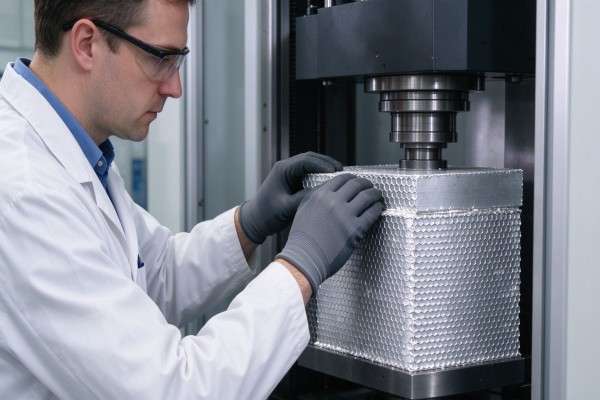


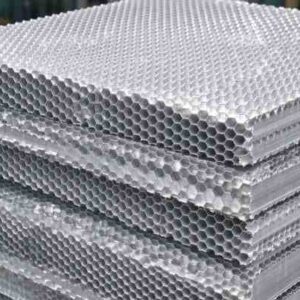


5052 Fojl tal-Aluminju H18 għall-qalba tax-xehda: Qawwa, Sizes and Standards

5052 Fojl tal-Aluminju H18 għall-qalba tax-xehda: Qawwa, Sizes and Standards
Introduzzjoni
When an aluminum honeycomb panel must carry real load, survive outdoor or marine service and stay flat for decades, the core is usually built from 5052 H18 aluminum foil rather than the softer, irħas 3003.
5052 is an aluminum-magnesium alloy with far higher strength and excellent corrosion resistance, and the full-hard H18 temper gives the thin cell walls the rigidity needed for high compression and shear performance.
This guide explains why 5052 H18 foil is used for honeycomb cores, its composition and mechanical properties, how the foil is converted into a core, the cell sizes, densities and strength values to specify, the relevant aerospace and ASTM test standards, kif 5052 compares with 3003 u 5056, and how to order factory-direct.
X'inhu 5052 H18 Foil?
5052 is a non-heat-treatable 5xxx-series alloy containing about 2.2–2.8% magnesium plus a small chromium addition; it is strengthened by cold work.
The H18 temper means the foil has been strain hardened to its full-hard condition without subsequent annealing, so it is at its stiffest. Hard foil is ideal for a core because:
- A honeycomb core carries compression and shear rather than being deep-drawn, so it needs high yield strength to stop the thin cell walls from buckling.
- The foil is only printed with node adhesive, stacked, sliced and expanded—it is not severely formed after rolling, so the low elongation of H18 is not a problem.
- Hard H18 walls keep the hexagonal cells uniform during expansion and panel pressing and raise the finished core’s stabilized compression and shear strength.
H19 (iebsa żejda) is sometimes specified for very thin, high-strength foil, while H38 is a stabilized equivalent; H18 remains the most common commercial full-hard honeycomb temper.
Kompożizzjoni Kimika u Proprjetajiet Mekkaniċi
| Element | Mg | Cr | Fe | U | Cu | Mn | Zn | Al |
| 5052 | 2.2–2.8 | 0.15–0.35 | ≤0.40 | ≤0.25 | ≤0.10 | ≤0.10 | ≤0.10 | bilanċ |
Magnesium provides the strength, chromium controls grain structure and corrosion behavior, and iron and silicon are kept low for toughness.
Typical foil properties by temper (values rise in thin, fully hard gauges; some mills measure about 319 MPa tensile on 5052 H18 core foil):
| Temper | Tensili (MPa) | Rendiment (MPa) | Titwil |
| O (Anzjan) | appross. 130–170 | appross. 50–90 | 18–25% |
| H14 | appross. 195–230 | appross. 140–170 | 7–12% |
| H18 (sħiħ iebes) | appross. 250–320 | appross. 215–305 | about 2–7% |
Density is about 2.68 g/ċm³. Always confirm the tensile, yield and elongation range on the mill certificate for the exact gauge.
Minn Foil għall-Qalba tax-xehda
Converter production prints parallel lines of node adhesive onto the foil, stacks many sheets, cures the block, slices it to core thickness and expands it into hexagonal cells.
Foil for 5052 cores typically runs about 0.03–0.13 mm (30–130 μm, commonly 0.04–0.06 mm); the foil is often chromated or otherwise conversion-coated to strengthen the adhesive node bonds and improve corrosion resistance.
| Parametru | Typical range |
| Ħxuna tal-fojl | about 0.03–0.13 mm (komunement 0.04 / 0.05 / 0.06 mm) |
| Cell size | 1/4″ (6.4), 3/8″ (9.5), 1/2″ (12.7), 3/4″ (19), 1″ (25 mm) |
| Core thickness | about 5–200 mm (deeper on request) |
| Supply form | unexpanded block/strip or expanded slice; perforated or solid; slotted |
| Maximum sheet | commonly up to roughly 1200–2000 mm wide by 2000–3000 mm long |
Core Density, Strength and Test Standards
Smaller cells and thicker foil raise density and strength. Indicative expanded-core values (exact figures depend on alloy, foil gauge and supplier):
| Cell size | Densità (kg/m³) | Flatwise compression (MPa) | Crush strength (MPa) |
| 1/4″ | madwar 81 | appross. 0.47 | appross. 0.19 |
| 3/8″ | madwar 54 | appross. 0.26 | appross. 0.08 |
| 1/2″ | madwar 38 | appross. 0.14 | appross. 0.05 |
| 3/4″ | madwar 30 | appross. 0.09 | appross. 0.03 |
| 1″ | madwar 31 | appross. 0.05 | appross. 0.02 |
5052 cores deliver higher shear (both ribbon L and transverse W directions), fatigue and impact performance than 3003 at the same density.
Aerospace cores are qualified to AMS-C-7438 (formerly MIL-C-7438); node-bond strength is tested per ASTM C363, plate shear per ASTM C273, flatwise compression per ASTM C365 and facing adhesion per ASTM C297.
Specify the standard and whether typical or minimum values are required.
Applikazzjonijiet Tipiċi
- Architectural curtain-wall and facade honeycomb panels that must stay flat and weather outdoors.
- Rail and transit wall, floor and ceiling panels for high-speed trains and metros (ħafifa, stiff, compatible with fire requirements).
- Aerospace floors, interiors and control surfaces, plus marine bulkheads and furniture where salt resistance matters.
- Equipment cabinets, clean-room and elevator panels, għamara, acoustic structures, wind and automotive lightweight parts.
5052 vs 3003 u 5056
| Liga / temperament | Foil tensile | Qawwa | Korrużjoni | Best fit |
| 3003 H18 | appross. 165–200 MPa | Medju | Tajjeb | Economical architectural and decorative cores |
| 5052 H18/H19 | appross. 250–320 MPa | Għoli | Eċċellenti | Outdoor, tal-baħar, transit and structural cores |
| 5056 H18 | higher again | Għolja ħafna | Eċċellenti | Premium aerospace cores at maximum strength |
Agħżel 3003 for cost in mild indoor or general cladding, 5052 when strength, fatigue and corrosion drive the design, u 5056 only where the highest aerospace performance justifies the price.
5052 forms slightly less easily than 3003, but this is irrelevant once the foil is expanded into a core.
Speċifikazzjonijiet, Yield and Ordering
At about 2.68 g/ċm³, g/m² = thickness (μm) × 2.68, so foil area per ton is easy to estimate for material planning:
| Foil gauge | g/m² | Appross. m² per ton |
| 30 μm | 80 | 12,400 |
| 40 μm | 107 | 9,330 |
| 50 μm | 134 | 7,460 |
| 60 μm | 161 | 6,220 |
| 100 μm | 268 | 3,730 |
Quality control covers gauge and width tolerances, kwalità tal-wiċċ, tensile/yield by temper, chemistry on the MTC and, for finished cores, densità, node bond and shear/compression values, with ISO 9001 and SGS/BV inspection available.
To order foil, send alloy and temper (5052 H18), gauge, width and roll dimensions, ID tal-qalba, chromate/coating needs and quantity; for finished cores add cell size, core thickness, densità, standard and expanded or block form.
Common terms are 30% deposit with the balance against the bill of lading, FOB/CFR/CIF.
Mistoqsijiet Frekwenti
Q: Why use 5052 H18 foil instead of 3003 for honeycomb?
A: 5052 H18 is substantially stronger with better fatigue and corrosion (inkluż il-baħar) prestazzjoni, so the core gives higher compression and shear for outdoor, transit, marine and structural panels; 3003 is chosen mainly for lower cost in general cladding.
Q: Why the full-hard H18 temper?
A: A core needs stiff, high-yield cell walls and is not deep-drawn after rolling, so full-hard foil maximizes compression and shear while keeping cells uniform during expansion.
Q: What foil thickness and cell size are standard?
A: Core foil commonly runs 0.03–0.13 mm (often 0.04–0.06 mm) with cells of 1/4″, 3/8″, 1/2″, 3/4″ or 1″; smaller cells and thicker foil give denser, stronger cores.
Q: Which standards apply?
A: Aerospace cores use AMS-C-7438; node bond is ASTM C363, shear ASTM C273, compression ASTM C365 and facing adhesion ASTM C297, with mill and core test certificates.
Q: Do you supply foil only or finished cores?
A: Both—5052 H18 foil in jumbo or slit rolls for converters, and expanded or unexpanded finished honeycomb cores cut to cell size, density and thickness.
Q: X'inhu l-MOQ u l-ħin taċ-ċomb?
A: Foil MOQ is commonly several tons per specification and finished cores depend on size and volume, with samples and trial orders available; lead time varies with gauge, quantity and coating.
Konklużjoni
5052 H18 is the high-strength, corrosion-resistant foil behind premium aluminum honeycomb cores for architecture, rail, aerospace and marine use.
Its full-hard walls deliver the compression, shear and fatigue that 3003 cannot, while staying lighter and stiffer than almost any alternative.
Specify foil gauge, daqs taċ-ċellula, core density and the test standard, and buy on certificates and approved samples rather than price alone.


