


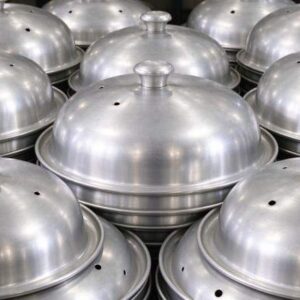

Aluminum Disc for Cookware Lids

| Pagtutukoy | Halaga |
| Product name | Aluminum Disc for Cookware Lids |
| Haluang metal | 1050 / 1060 / 1100 (soft forming); 3003 (stiffer rims) |
| init ng ulo | O (domed lids) / H14-H24 (rigid glass rims) |
| Nabubuo | spun or deep-drawn dome, rolled edge, knob hole |
| Ibabaw | Tapos na ang Mill; polish, brush, anodize or coat downstream |
| Flat / gilid | patag, burr-free, consistent diameter |
| Tolerance | diameter ±0.3–0.5 mm, thickness per spec |
| Mga Aplikasyon | pot/pan lids, domed covers, glass-lid rims, casseroles |
Aluminum Disc for Cookware Lids
Panimula
An aluminum disc for cookware lids is a round blank of aluminum that a cookware maker spins, deep-draws or presses into the lid of a pot, pan, casserole or Dutch oven.
The lid is the most visible and hand-touched part of a cookware set: it must seal well, stay light in the hand, look premium after polishing or coating, and take the repeated heat, washing and thermal shock of a kitchen.
The aluminum disc is the starting material for every formed aluminum lid, whether plain, anodized, nonstick-coated or paired with a glass panel.
Aluminum is the classic lid material because it is light, cheap, easy to form into the domed shape that lets condensation drip back into the pot, and accepts every finish from bright polish to hard-anodized black.
This guide explains which discs are used for cookware lids, why pure and 3xxx alloys dominate, the tempers and sizes, how blanks are formed into domed lids, glass-lid rims, mga pagtatapos sa ibabaw, oven and dishwasher compatibility, kontrol sa kalidad, pricing and ordering, and a core specification table.
What Is an Aluminum Disc for Cookware Lids?
A cookware-lid disc is a round blank cut from aluminum coil, typically 0.6–3 mm thick and 120–400 mm in diameter, matched to the pot it will cover.
Unlike a flat tray blank, a lid disc is formed into a shallow dome or curve: the center rises to make headroom, and the edge is rolled over (knocked-down) to a smooth rim that rests on the pot and can carry a knob or handle.
The disc may be the whole lid, or the aluminum rim around a glass center.
The disc is specified by alloy, Tempre, gauge and diameter. For formed lids the alloy must be soft enough to deep-draw the dome and roll the edge without cracking, yet stiff enough not to dent in use.
Most cookware lids use 1050/1060/1100 pure aluminum or 3003; 5052 is reserved for heavier structural rims and premium hardware.
The standard formed-lid blank is the 1050 bilog na aluminyo; stiffer rims and premium lids often use 3003 bilog na aluminyo.
The disc is the raw material, not the finished lid: the cookware maker forms it, rolls the edge, pierces the knob hole, finishes the surface, and assembles the knob or handle. This is why spec precision matters.
A disc that is too thin dents in the hand; one in the wrong temper cracks on the dome; a cupped or burred disc will not sit on the pot.
Buyers send the pot drawing or finished lid, and the blank supplier calculates the right diameter, gauge and temper for the forming process.
Why Aluminum for Cookware Lids?
Banayad na timbang: a lid should lift easily; aluminum is about a third the weight of steel.
Easy to spin and deep-draw into domed, drip-friendly shapes.
Good heat distribution across the lid surface.
Accepts every finish: polish, brush, anodize, nonstick coat.
Naturally corrosion-resistant and easy to clean.
Low cost compared with stainless steel or copper lids.
Recyclable and compatible with mass cookware production.
Glass lids are popular because you can see the food, but the aluminum rim and knob are still aluminum.
Solid aluminum lids stay lighter and cheaper, and they can be anodized or coated to match the pot body.
Stainless lids are heavier and harder to form; copper is premium but expensive. Aluminum sits in the mass-market sweet spot—which is why most formed cookware lids start as an aluminum disc.
Compare the alternatives. A stainless lid is heavier and harder to deep-draw, so it is often a flat sheet with a pressed rim rather than a spun dome; a pure glass lid is fragile and needs the aluminum or steel rim anyway; a copper lid is premium and expensive.
Aluminum gives the dome, the rolled edge and the finish at a mass-market price, and it competes well on weight—a 28 cm aluminum lid lifts with one hand, while the same stainless lid feels tiring over a long cooking session.
For everyday and commercial cookware that balance is hard to beat.
Which Alloy? Formability vs Stiffness
| Haluang metal | karakter | Use for cookware lids |
| 1050 / 1060 / 1100 | puro, napakalambot, easy deep draw, bright after polish | domed formed lids, rolled edges, polished lids |
| 3003 | Mn alloy, stiffer, more rust-resistant | stiffer lids, heavy pots, rims that hold shape |
| 5052 | Mg alloy, malakas, lumalaban sa kaagnasan | premium structural rims, humahawak, hardware |
For the dome and rolled edge, soft pure 1050/1060/1100 O-temper is easiest to form and gives the brightest polish.
For a lid that must keep its shape on a heavy stockpot or that carries a glass panel, 3003 adds stiffness and rust resistance without losing too much formability.
5052 is overkill for a standard lid but is used for premium rims and handle brackets.
The choice is driven by how deep the draw is, how stiff the rim must be, and whether the lid will be polished or coated.
Reflective inner surfaces and mirror finishes may use a bright 5052 high-reflectivity mirror sheet sheet; general structural hardware can come from the 5000 serye ng aluminyo sheet saklaw.
In practice most cookware programs run on two blanks: 1050/1060 O for spun domed aluminum lids, at 3003 O or H for glass-lid rims and heavy pots.
Mixing alloys across a set can create color mismatch after polishing, so premium matched sets keep the same alloy across body and lid.
The blank supplier can guide the choice from the dome depth, the rim profile and the finish, and should supply sample discs to prove the formability before the die is cut.
init ng ulo: Soft O for Forming, H for Rigid Rims
Formed lids are almost always O temper (Annealed, malambot). A soft disc deep-draws into the dome and rolls over into a smooth rim without cracking or springing back.
Half-hard H14/H24 is used only for flat or shallow lids and for glass-lid rims that must hold a precise diameter and rigidity rather than be deeply drawn.
As with any spun part, the temper is matched to the forming step.
A common defect is forming an H-temper disc into a domed lid: it cracks at the dome transition because it will not flow.
Conversely an O disc used for a precision glass-lid rim is too soft and diameter drifts.
The cookware maker therefore asks the disc supplier for the exact temper—usually O for spun domed lids, H for rigid rims—and trials a blank before volume.
Over-annealing and under-annealing both show up in forming. A disc that is too soft wrinkles and ears when the edge rolls over; one that still carries work-hardening from rolling cracks at the dome shoulder.
Because temper is set at the mill and cannot be fixed by the cookware maker, incoming hardness or a simple cup-deepening trial on the press is the cheapest insurance. It is a small step that avoids the much larger cost of scrapped lids mid-run.
Mga Karaniwang Pagtutukoy
| Parameter | Karaniwang saklaw |
| Haluang metal / Tempre | 1050 / 1060 / 1100 O, o 3003 O / H14 |
| kapal | 0.6–3 mm; domed lids ~0.8–1.5 mm, glass rims ~1.5–2.5 mm |
| diameter | 120–400 mm, matched to pot (16–32 cm standard) |
| Flat / gilid | flat disc, burr-free, clean cut edge |
| Ibabaw | Tapos na ang Mill; makintab, brushed, anodized or coated downstream |
| Tolerance | diameter ±0.3–0.5 mm, thickness per spec |
| Knob hole | punched or pierced after forming, to size |
Lid diameter is matched to the pot’s top rim, so discs are cut in standard cookware sizes (16, 18, 20, 22, 24, 26, 28, 30, 32 cm). Gauge depends on lid size and finish: small frying-pan lids are thin, heavy stockpot lids are stiffer and heavier.
The blank diameter is calculated from the dome depth and rolled rim so the finished lid has the right headroom and edge.
Blank-size calculation is the hidden engineering step. As the disc spins into a dome, it thins toward the shoulder, and the rolled rim consumes material around the perimeter.
A blank that is too small leaves a short rim that does not cover the pot; one too large creates excess trim and wrinkles during rolling.
Experienced lid makers work from the finished lid cross-section, estimate the surface-area change through the draw, and confirm with a sample rather than guess. This is why the disc supplier prefers a lid drawing over a single diameter number.
From Coil to Disc: How Lid Blanks Are Made
Lid blanks start from cold-rolled aluminum coil in the chosen alloy and temper.
The coil is uncoiled, leveled, and blanked on a circle-cutting or blanking line into round discs of the target diameter.
Because a lid must look good when polished or coated, the disc surface is controlled for rolling lines, scratches and edge burr—a defect that shows on a finished lid.
The critical quality points are flatness (a cupped disc will not sit on the pot), edge burr (which cracks when rolled over), gauge consistency, and surface cleanliness.
Polished lids amplify every rolling mark, so their blanks are supplied with a finer, uniform surface; coated lids are more forgiving but still need a clean, oil-free blank for adhesion.
Nesting efficiency on the blanking line affects price. Circles cut from coil leave trim between discs, so a diameter that nests well on a standard coil width reduces scrap and lowers the per-piece cost.
For common cookware sizes the mills already run optimized nest patterns, which is why standard diameters are cheaper than odd custom sizes.
Surface class is also graded: makintab- and anodize-grade blanks carry a premium over plain mill finish because they require lighter rolling tension, finer inspection and interleaved packing to avoid scratches.
Nabubuo: Spinning and Deep-Drawing the Dome
Two main processes turn a flat disc into a lid. Spinning clamps the disc over a mandrel on a lathe and rollers form the shallow dome and rolled edge—cheap tooling, fast for medium and large lids, and the standard process for domed aluminum cookware.
Deep drawing presses the disc in a die into the dome, used for high-volume, tighter-tolerance lids and shallow pan covers.
Matapos mabuo, the edge is rolled over (knocked-down) to create a smooth, safe rim, and a knob hole is pierced in the center.
The rolled edge is what makes the lid safe to handle and what seals loosely on the pot.
A soft O-temper 1050/1060 disc flows under the spinning roller to make a clean dome and a tight rolled edge without splitting.
Tooling choice splits by volume and size.
Spinning uses a cheap wooden or metal mandrel and a roller, so it suits one-off designs, large lids and medium runs; deep drawing uses a matched die set with higher upfront cost but faster, more repeatable parts for high-volume pan covers.
The two also leave different surfaces: spun lids carry concentric roller marks that polishing removes, while drawn lids are smoother as formed.
For a polished premium lid, spinning followed by polishing is standard; for a coated mass lid, drawing keeps cost down at high volume.
Lid Designs: Domed, patag, Rolled Edge, Knob
The classic cookware lid is shallow-domed: the center rises so condensation drips to the sides and back into the pot, rather than pooling in the middle.
The edge is rolled over to a smooth rim that rests on the pot flange. A knob or handle hole is centered for the lid knob; some lids have a vent hole to release pressure.
The dome depth and rolled profile are set by the mold and the blank size.
Lids range from shallow pan covers (almost flat) to deep casserole and Dutch-oven domes that give headroom for steaming.
The rolled edge must be uniform and burr-free; a loose or uneven rim rattles on the pot and looks cheap.
The knob hole is punched after forming and deburred so the knob screws or rivets on cleanly. These features all start from a round, patag, well-cut disc.
Vent holes and knob styles add detail. Many lids pierce a small steam vent so pressure does not build and condensation does not drip unpredictably; the vent is punched after forming and deburred so it is safe and clean.
Knobs are riveted, screwed or bayonet-fit, and the centered hole must align so the knob sits straight. These features look small, but they are the parts the consumer touches every time, so their edge quality and alignment distinguish a premium lid from a cheap one.
Glass Lids with Aluminum Rims
Most modern lids pair a clear glass center with an aluminum rim.
The glass lets the cook see the food; the aluminum rim holds the glass, rolls over to a safe edge, and carries the knob.
Here the aluminum disc is not the whole lid—it is the rim blank, formed and rolled around the glass.
These rims are often 1.5–2.5 mm and in 3003 or H-temper for stiffness and a precise diameter that clamps the glass.
Glass-lid rims must be dimensionally accurate so the glass sits without stress, and the rolled edge must be smooth so it does not chip the glass or cut the user.
The rim is often polished or anodized to match the cookware. Because the glass is brittle, the aluminum rim’s edge quality and flatness are critical—a bent or sharp rim rejects the glass in assembly.
Glass-lid production is a precision assembly: the glass disc is cut, tempered and placed inside the aluminum rim, which is then rolled over to capture it.
The rim blank must hold a consistent inner diameter so the glass is neither loose nor stressed. Stressed glass can fail later in thermal shock, so rim tolerance and edge smoothness are safety-related, not cosmetic.
This is why glass-lid rims lean on 3003 or H-temper material that stays dimensionally stable through the forming and rolling cycle.
Natapos ang ibabaw: Pinakintab, Anodized, Nonstick
Aluminum lids take every cookware finish. Bright polishing gives the shiny, reflective lid seen on classic aluminum sets; brushing gives a satin, modernong hitsura.
Hard anodizing grows a durable, scratch-resistant oxide layer (commonly black) that resists stains and is easy to clean, matching anodized cookware. Nonstick coating is applied to the inside of some lids to make grease wiping easy.
The blank surface determines how good the finish looks.
Polishing amplifies rolling marks and dents, so polished-lid discs need a fine, uniporme, walang scratch na ibabaw; anodizing follows the same rule—black anodizing hides less than you would think, and any scratch shows.
Nonstick coating needs a clean, chemically prepared surface for adhesion. Specify the downstream finish to the disc supplier so the blank is prepared for it.
Polishing is often the make-or-break finish. A bright polished lid shows the quality of the whole disc: rolling lines, roller marks from spinning, dents and handling scratches all glow after polishing.
Suppliers serving polished cookware therefore supply a finer-mill blank, spin with clean tools, and pack with interleaving so the lid reaches the polisher undamaged.
Brushed lids are more forgiving, and anodized lids follow the underlying finish—black anodizing, sa partikular, hides very little. Telling the blank supplier the final finish is the single easiest way to avoid a cosmetic reject rate.

Pagiging tugma: Oven, Dishwasher, Heat and Cleaning
Aluminum lids handle oven temperatures, stovetop heat and dishwasher cleaning well, though the finish dictates the details.
Hard-anodized lids are oven-safe and dishwasher-friendly; nonstick-coated lids are usually hand-wash recommended and not broiler-safe; polished aluminum cleans easily but can discolor over high heat.
The knob/handle material—often bakelite, stainless or silicone—sets the actual oven rating, more than the aluminum disc itself.
Thermal shock matters: a cold lid put into a hot oven, or a hot lid cooled under cold water, can warp a thin disc.
Heavier gauges and stiffer alloys (3003) resist warping better than very thin pure-foil lids.
For commercial and oven-heavy use, lid gauge and temper are chosen to stay flat on the pot through repeated heating and cooling.
Food contact is another practical question. Cookware-grade aluminum (1xxx and 3xxx) is widely accepted for kitchen contact, and coatings or anodizing further separate the metal from acidic foods.
Buyers supplying regulated markets should request the appropriate food-contact documentation and confirm the alloy and coating system.
Because the lid sits above the food rather than in it, contact exposure is lower than the pot body, but export customers still expect consistent, documented material—which is why mill certificates and clear alloy records matter for a lid as much as for the pan.
Quality Control of Lid Discs
| Check | Kinakailangan |
| Haluang metal / Tempre | sertipiko ng gilingan 1050/1060/1100 O or 3003 |
| diameter | matches pot size ±tolerance |
| Flat | disc lies flat, no cupping or wave |
| gilid | burr-free, clean cut, no laminations |
| Ibabaw | Malinis, uniporme, scratch-free for polish/anodize |
| Forming trial | sample spins/deep-draws without cracks or split |
| Finished lid | sits flat on pot, rolled edge smooth, knob hole clean |
The cookware maker trials a sample disc on its own spinning or stamping line: if the dome cracks, the rim wrinkles or the lid does not sit flat, ang haluang metal, temper or blank diameter is off.
Incoming checks of diameter, pagiging patag, edge burr and surface catch most problems; polishing or anodizing in-house further reveals surface defects that were invisible on the bare disc.
A stable supplier relationship reduces QC cost. Once a disc spec is approved, reorders are held to the same flatness, gilid, surface and lot so the cookware line does not re-tune the spinning press every shipment.
First-article samples, mill certificates and a written spec sheet (haluang metal, Tempre, panukat, Diameter, pagpaparaya, ibabaw, packaging) are the standard controls.
They are cheap relative to the cost of a run of lids that crack, dimple or will not sit on the pot.
Custom Sizes and Standard Pot Diameters
Cookware lids use standard pot sizes, so discs are commonly cut to 16, 18, 20, 22, 24, 26, 28, 30 at 32 cm diameters, plus custom sizes for specialty cookware.
The blank diameter is calculated from the finished dome depth and rolled rim: a deeper dome needs a larger blank, and the rolled edge consumes extra material.
Because circle cutting is low-cost, custom diameters and gauges are flexible; tight tolerance matters so lids match their pots.
For new cookware designs, buyers send the pot drawing or the finished lid and ask for a calculated blank size plus sample discs.
The maker spins the sample, checks the dome headroom, rolled edge and knob hole, and adjusts the blank diameter before releasing volume. Interleaved, scratch-free packing keeps polished-grade blanks clean until they are formed and finished.
Standardization simplifies reordering. A cookware line that buys 20, 24 at 28 cm lids repeatedly benefits from discs cut to the same diameter tolerance and surface grade every time.
Mixed or one-off sizes are available, but they carry a small setup and nesting cost.
For a product line with a fixed size set, locking the disc sizes to the pot flange early—and buying in container quantities—keeps both price and quality consistent across production runs.

Pricing and MOQ
Lid discs are priced on the aluminum base (LME-linked) plus blanking and processing.
Pure 1050/1060 blanks cost a little more than 3003, but they polish and form best for lids. Gauge, Diameter, pagpaparaya, kalidad ng ibabaw (polish-grade vs mill) and cut accuracy move price; thin large discs and tight-tolerance glass rims cost more.
MOQ is typically a few hundred kg or a pallet per size; standard cookware diameters are quicker.
Buyers control cost by matching the alloy to the lid job—not over-specifying 5052 kailan 1050 O is better—and by ordering standard sizes in container quantities.
Total cost includes forming yield: a flat, burr-free, Malinis 1050 disc with high spin yield beats a cheap disc that cracks on the dome or shows scratches after polishing.
Aluminum pricing follows the LME, so quotations carry a short validity and freight and packaging matter at container scale.
Discs are dense and stackable, which helps freight, but polished-grade packing (interleaved paper, banded pallets, nakabalot) adds a small cost that prevents far larger cosmetic rejects.
Ask for the price breakdown—alloy base, blanking, surface grade, packaging and freight—so you can see whether a higher blank price is actually saving you forming and finishing waste.
How to Order Cookware Lid Discs
State the alloy (1050/1060/1100 o 3003), Tempre (O for domes, H for glass rims) at kapal.
Give the pot/lid size (Diameter) or the finished lid drawing.
Specify whether the blank will be polished, brushed, anodized or nonstick-coated.
Require flatness, burr-free edge, and a polish-/anodize-ready surface.
Approve a forming sample before volume, and request mill certificates.
A well-run inquiry speeds up. The buyer who sends the finished lid drawing (or the blank size already calculated), the target gauge and temper, the downstream process (umiikot, deep drawing or glass-rim rolling), and whether the discs will be polished, brushed, anodized or coated gets a quotation matched to the job rather than a generic per-kg price.
It also avoids the most common returns—discs that are the wrong temper for spinning, or that show scratches under polishing.
For ongoing production, agree on a written spec sheet and reorder against it so every shipment matches the approved sample.
Tungkol sa eco alum
Eco Alum is an aluminum supply specialist established in March 2025, coordinating a qualified Chinese aluminum rolling and blanking supply chain for customers worldwide.
We focus on plates, mga coils, mga foil, strips and circles across the 1000 serye (1050, 1060, 1070, 1100, 1235 at 1350), together with 3003 and 5000-series such as 5052.
Rather than a single-mill trader, we match the right mill, haluang metal, temper and cut to each customer’s application and manage quality, certificates and export packing.
For cookware and lid manufacturers, supply namin 1050, 1060, 1100 at 3003 aluminum discs and circles in O or H temper, cut to domed-lid and glass-rim diameters, with flat, burr-free, polish-/anodize-ready blanks and mill certificates.
We also supply 5052 for premium rims and reflective mirror sheet where needed. Contact [email protected] or call +86 19924932491 with your lid drawing or blank size for a factory-coordinated quotation and forming samples.
We support cookware makers through the whole lid-disc loop: blank-size calculation from your finished lid drawing, alloy and temper selection for spinning or deep drawing, sample discs before volume, lot mill certificates, polish- and anodize-ready surface handling, and consistent reorders held to the same spec. Rather than reselling,
we coordinate qualified rolling and blanking mills so the discs arrive flat, burr-free and form-ready—reducing the cracked domes, wrinkled rims and polishing rejects that come from inconsistent or mis-specified stock.
Madalas na nagtanong
Q: What aluminum disc is used for cookware lids?
A: Most domed lids use 1050/1060/1100 in O temper; stiffer glass-lid rims and heavy pots often use 3003.
Q: Why O temper for lids?
A: A soft O disc deep-draws the dome and rolls over the rim without cracking or springing back.
Q: What diameter discs are used?
A: Standard cookware sizes from 16 sa 32 cm, plus custom diameters matched to the pot.
Q: Can aluminum lids be polished or anodized?
A: Yes—polished, brushed, hard-anodized or nonstick; the blank surface must be clean and scratch-free for the finish.
Q: What is the aluminum part of a glass lid?
A: The rolled rim, kadalasan 3003 or H-temper for stiffness, formed and rolled around the glass center.
Q: Are aluminum lids oven and dishwasher safe?
A: Anodized lids generally are; the knob/handle often sets the oven rating. Thin lids can warp under thermal shock.
Q: How is the blank diameter calculated?
A: From the finished dome depth and rolled-edge consumption, then validated with a forming sample.
Q: Can custom sizes be cut?
A: Yes—circle cutting is low-tooling, so custom diameters and gauges are cut to your lid drawing.
Konklusyon
The aluminum disc is the starting point of every formed cookware lid. Malambot 1050/1060/1100 in O temper deep-draws into the domed, drip-friendly shape and rolls over into a safe rim; stiffer 3003 and H-temper blanks serve glass-lid rims and heavy pots.
The buying points are the right alloy and temper, a flat burr-free blank cut to the calculated diameter, a polish-/anodize-ready surface, and a forming sample before volume.
Sourcing discs from a coordinated supply chain that controls alloy, Tempre, blanking and surface gives cookware makers lids that spin cleanly, sit flat on the pot, finish beautifully and stand up to daily kitchen use.


