
Aluminum honeycomb cores are widely used in industries requiring lightweight yet strong materials, such as aerospace, marine, and architecture. Understanding the manufacturing process and material choices is essential for selecting the right product that meets performance and durability standards.

Aluminum Honeycomb structure
What It Is & Why It’s Chosen
An aluminum honeycomb core is a bonded foil structure expanded into a hexagonal cell pattern. This geometry delivers an exceptional stiffness-to-weight ratio, making it ideal for aerospace cabins, building façades, marine components, and even rail interiors. Compared with foam or balsa cores, it offers better compressive strength, corrosion resistance, and fire performance.
Step-by-Step Manufacturing Process
- Foil preparation – High-quality aluminum alloy foil is precision cut and surface treated for adhesion.
- Adhesive application – Thin adhesive lines are printed to form node bonds.
- Stacking & curing – Foils are stacked into blocks and cured under heat and pressure.
- Expansion – The block is pulled apart to form the honeycomb cells.
- Stabilizing & cutting – Expanded cores are trimmed to size and stabilized before panel assembly.
- Panel production – Cores are bonded between skins (aluminum, FRP, HPL) to create lightweight sandwich panels.
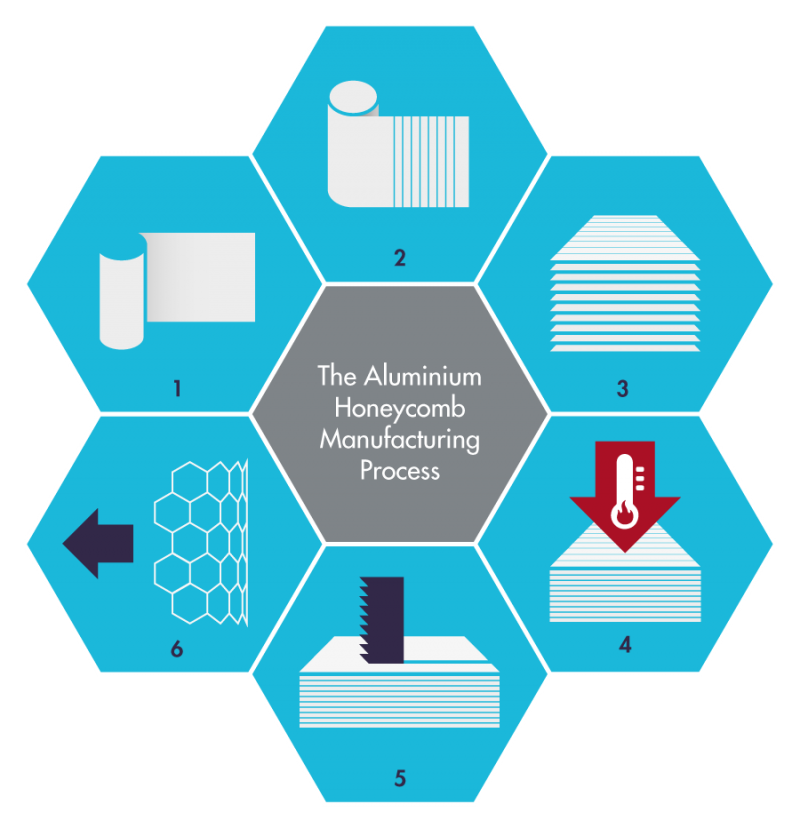
Manufacturing Process
Material Choices: Common Alloy Comparison 3003/3004/3104 vs. 5052
| Alloy | Strength | Corrosion / Formability | Typical Use |
|---|---|---|---|
| 3003/3004/3104 | Medium, good formability | Good corrosion resistance | Cost-effective cores, formable panels |
| 5052 | Higher yield, fatigue resistance | Excellent, marine-grade | Exterior panels, marine structures |
Quality Control & Testing
Reputable manufacturers follow ASTM standards such as C365 (flatwise compression) and C273 (shear). Testing ensures dimens
ional accuracy, cell bond strength, and resistance to fire and corrosion. For critical industries like aerospace or marine, third-party certification is a must.
Recommendations for Alloy Selection and Supplier Evaluation
For exterior or marine environments, 5052 alloy cores offer superior corrosion resistance. For interior architectural projects, 3003 provides excellent value and formability. Confirm the supplier’s bonding expertise and quality certifications to ensure product performance and longevity.
Founded in March 2025, Eco-Alum brings together over 21 years of industry expertise in aluminum honeycomb solutions. Our commitment to quality, innovation, and customer satisfaction makes us a trusted partner for B2B buyers seeking reliable, high-performance materials tailored to their project needs. Choose Eco-Alum for proven experience and cutting-edge manufacturing that delivers durable, lightweight, and cost-effective aluminum honeycomb products.