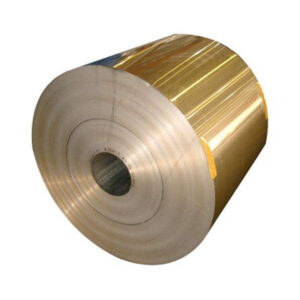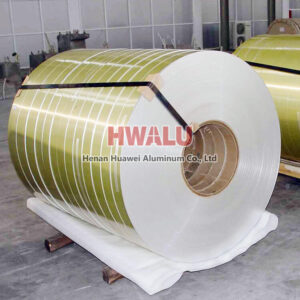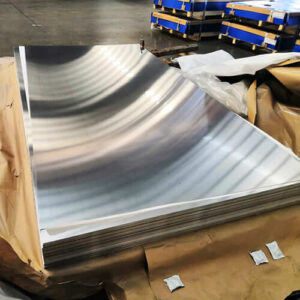
5052 H32 Aluminum Sheet for Truck Fender

| Aliatge | 5052 |
| Tremp | H32 |
| Gruix | 1.5–4.0 mm |
| Tractament superficial | Pintura, Recobriment en pols, Anoditzat, Brushing |
| Normes | ASTM B209/B209M, EN 485, Customer Specification |
1. Resum executiu
5052 Full d'alumini H32 is a non-heat-treatable aluminum-magnesium alloy commonly selected for truck fenders because it combines moderate-to-high strength, good cold-forming capability, excel·lent resistència a la corrosió, Densitat baixa, and good weldability.
5052 is covered by specifications such as ASTM B209 for aluminum and aluminum-alloy sheet and plate.
Truck fenders operate in a demanding environment. They are exposed to pluja, road spray, mud, salt, vibració, impact from debris, i canvis de temperatura repetits.
Al mateix temps, the fender must maintain its curved shape without adding unnecessary vehicle weight. These requirements make material selection particularly important.
El H32 temper provides a useful balance between strength and formability. Compared with softer O-temper material, H32 offers substantially higher strength; compared with harder tempers, it retains better ductility for bending and forming.
ASTM-based data specify a 5052-H32 tensile-strength range of approximately 31–38 ksi (214–262 MPa) and a minimum yield strength of 23 ksi (159 MPa), with elongation requirements varying with thickness.
With a density of approximately 2.68 g/cm³, 5052 also provides a significant weight advantage over conventional steel fender materials.
La seva combinació de força, resistència a la corrosió, formabilitat, i soldabilitat makes it suitable for truck, trailer, and commercial-vehicle fender fabrication.
2. Què és 5052 H32 Aluminum Sheet for Truck Fender?
2.1 5052 Aliatge d'alumini
5052 és a 5xxx-series aluminum-magnesium alloy. Unlike heat-treatable 6xxx alloys, it develops its strength primarily through alloying and cold working rather than precipitation heat treatment.
Its composition typically contains approximately 2.2–2.8% magnesium and 0.15–0.35% chromium, with copper limited to a maximum of 0.10% under commonly referenced ASTM/Aluminum Association composition limits.
Magnesium provides solid-solution strengthening, while chromium contributes to the alloy’s structural stability.
The relatively low copper content also supports its strong resistance to atmospheric and marine corrosion.
2.2 What Does H32 Mean?
La designació H32 describes the material’s temper, not its alloy composition.
- H = strain-hardened condition
- 3 = strain-hardened and stabilized
- 2 = quarter-hard condition
En termes pràctics, 5052-H32 has undergone controlled cold working followed by stabilization to achieve a relatively stable combination of strength and ductility.
ASTM B209 recognizes H32 among the strain-hardened tempers for non-heat-treatable aluminum alloys.
This distinction is important because 5052 and 5052-H32 do not have identical mechanical behavior.
The alloy determines the basic chemical and metallurgical characteristics, while the temper strongly influences strength, allargament, and forming performance.
2.3 What Is a Truck Fender?
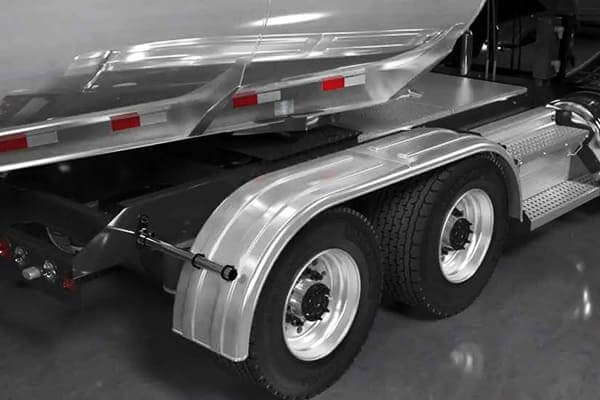
A truck fender is a shaped panel that surrounds the wheel area and helps protect the vehicle, other road users, and surrounding components from water, mud, stones, and road debris.
Depending on the vehicle design, fenders may be:
- Flat or curved
- Single-piece or multi-piece
- Press-formed or roll-formed
- Bolted, reblat, or welded
- Pintat, polit, anoditzat, or powder coated
Because the fender is both a functional and visible component, the material needs to maintain its shape while providing an acceptable surface for subsequent finishing.
2.4 Why 5052-H32 Is Different from Ordinary Aluminum Sheet
The choice of 5052-H32 reflects two separate requirements: el 5052 aliatge d'alumini provides the underlying corrosion resistance and formability, while the H32 temper provides increased mechanical strength through controlled work hardening.
For truck-fender production, this means the sheet can offer:
Higher Strength → Better Shape Retention
while retaining:
Good Ductility → Easier Bending and Forming
This balance is one of the main reasons 5052-H32 is used for formed aluminum components.
Industry material references describe 5052-H32 as having good workability, very good corrosion resistance, and good weldability.

3. Per què 5052 H32 Is Suitable for Truck Fenders
5052-H32 provides a practical combination of força, low weight, resistència a la corrosió, formabilitat, i soldabilitat, making it well suited for truck and trailer fenders.
3.1 Pes lleuger
With a density of approximately 2.68 g/cm³, 5052 aluminum is significantly lighter than steel.
This helps reduce fender weight and makes components easier to handle, install, and maintain.
3.2 Good Strength
5052-H32 provides substantially higher strength than commercially pure aluminum.
Typical specification values are around 214–262 MPa tensile strength and a minimum yield strength of about 159 MPa, depending on thickness and the applicable standard.
This provides good resistance to deformation while maintaining a relatively low component weight.
3.3 Excel·lent resistència a la corrosió
Truck fenders are regularly exposed to pluja, road spray, mud, humitat, and road salt.
5052 offers excellent resistance to atmospheric and marine corrosion, making it suitable for demanding outdoor environments.
Pintura, powder coating, or anodizing can provide additional surface protection when required.
3.4 Bona formabilitat
5052-H32 can be processed through doblegar, roll forming, and press forming, allowing manufacturers to produce curved and shaped fender profiles.
For particularly complex or deep forming, the required bend radius and temper should be carefully considered to minimize cracking and excessive springback.
3.5 Bona soldabilitat
5052 can be welded using common aluminum processes such as Soldadura MIG i TIG.
This makes it suitable for fabricated fenders and assemblies that require welded joints.
No obstant això, welding can locally affect the original H32 work-hardened condition, so joint design and heat input should be considered.
3.6 Good Surface-Finishing Performance
5052 provides a suitable substrate for pintura, powder coating, anoditzat, raspallat, and polishing.
This is useful for truck fenders where both corrosion protection and appearance are important.
3.7 Balanced Overall Performance
The main advantage of 5052-H32 is its balanced performance:
Pes lleuger + Força + Resistència a la corrosió + Formabilitat + Soldabilitat
This combination makes it a practical material for truck fenders that need to withstand outdoor exposure and routine mechanical loads without adding unnecessary vehicle weight.
4. Mechanical Properties and Temper Selection
The mechanical performance of 5052 xapa d'alumini depends strongly on its temper.
As a non-heat-treatable alloy, 5052 develops strength primarily through cold working and stabilization rather than precipitation hardening.
For truck fenders, H32 is particularly useful because it provides a balance between strength, ductilitat, and forming performance.
4.1 Typical Mechanical Properties of 5052-H32
| Propietat | 5052-H32 Typical Value / Requisit |
|---|---|
| Resistència a la tracció | 214–262 MPa |
| Límit de rendiment | ≥159 MPa |
| Elongació | Typically ≥8–12%, segons el gruix |
| Densitat | ~2.68 g/cm³ |
| Mòdul elàstic | ~70.3 GPa |
| Duresa | ~60 HB |
Values are representative. Actual mechanical requirements vary with sheet thickness, product standard, and testing method. The applicable material standard and mill test certificate should govern the final specification.
5. Especificacions típiques de 5052 H32 Aluminum Sheet for Truck Fender
The specification of 5052-H32 sheet should be determined by the fender size, profile, forming process, mounting design, and required rigidity.
Truck-fender manufacturers often use relatively thin aluminum sheet to achieve weight savings while maintaining sufficient panel stiffness.
5.1 Typical Specification Table
| Paràmetre | Especificació típica |
|---|---|
| Aliatge | 5052 |
| Tremp | H32 |
| Gruix | 1.5–4.0 mm |
| Amplada | 1,000–2,000 mm |
| Longitud | Personalitzat |
| Superfície | Final Mill / Raspallat / Personalitzat |
| Formulari | Full / Cut-to-Length |
| Formant | Doblar / Roll Forming / Press Forming |
| Aplicació | Truck Fenders / Trailer Fenders / Commercial Vehicle Fenders |
| Normes | ASTM B209/B209M / EN 485 / Customer Specification |
The dimensions above represent practical supply ranges, not universal requirements.
Final dimensions should be agreed according to the customer’s drawings and applicable standards.
6. Procés de fabricació de 5052 Làmina d'alumini H32
La producció de 5052-H32 aluminum sheet for truck fenders focuses on controlling alloy composition, rodant, humor, dimensions, i qualitat superficial. A typical process is:
Fon & Casting → Homogenization → Hot Rolling → Cold Rolling → H32 Temper Control → Cutting → Inspection → Packaging
6.1 Fusió i fosa
Aluminum is melted and alloyed with controlled amounts of magnesium and chromium to meet the 5052 composició.
Degassing and filtration may be used to improve melt cleanliness before casting.
6.2 Hot and Cold Rolling
Hot rolling reduces the cast material to an intermediate thickness, while cold rolling achieves the required final gauge and helps develop the desired mechanical properties.
The rolling process controls:
- Gruix
- Planitud
- Qualitat superficial
- Força
- Elongació
6.3 H32 Temper Control
Controlled cold working and stabilization produce the H32 temper, providing a practical balance of strength and ductility.
Consistent temper control is important for truck fenders because the sheet must withstand doblegar, roll forming, and other fabrication processes without excessive cracking or deformation.
6.4 Cutting and Finishing
The finished sheet can be slit, retallat, or cut to length according to customer requirements.
Accurate dimensions and clean edges help reduce secondary processing and material waste.
6.5 Inspection and Packaging
Before shipment, the sheet is checked for composició química, propietats mecàniques, gruix, planitud, dimensions, i qualitat superficial.
Protective packaging helps prevent humitat, esgarrapades, contaminació, i deformació during transportation.
General, controlled rolling and temper processing ensure that 5052-H32 aluminum sheet provides the força, formabilitat, estabilitat dimensional, i qualitat superficial required for truck-fender manufacturing.
7. Welding and Joining of 5052 H32 Fender Sheet
5052-H32 offers good weldability and can be joined using common aluminum fabrication methods.
The joining method should be selected according to fender thickness, joint design, volum de producció, appearance requirements, and service loads.
7.1 MIG and TIG Welding
Me (Gate) is suitable for efficient production welding, particularly for brackets, seams, and larger fender assemblies.
TIG (GTAW) provides better control and is useful for thinner sheet or joints where appearance and precision are important.
7.2 Mechanical Joining
Not every fender needs to be welded. Rivets, cargols, screws, and other mechanical fasteners can be used when the design requires easy assembly, replacement, or limited heat input.
Mechanical joining can be particularly useful for attaching fenders to brackets or vehicle frames.
7.3 Welding Considerations for H32 Material
Because H32 obtains its strength through strain hardening and stabilization, welding introduces a localized heat-affected area where the original temper properties can change.
7.4 Forming Before Joining
For many truck-fender assemblies, the preferred sequence is:
Cutting → Forming → Drilling/Trimming → Welding or Fastening → Surface Finishing
This approach helps maintain dimensional accuracy and reduces unnecessary deformation during fabrication.
8. Surface Treatment and Protection
Truck fenders are exposed to aigua, sal de carretera, mud, pols, UV radiation, and temperature changes.
Encara que 5052 provides excellent inherent corrosion resistance, surface treatment can further improve appearance, durabilitat, and resistance to environmental exposure.
8.1 Final Mill
Mill-finish 5052-H32 can be used when the natural aluminum appearance is acceptable or when the fender will receive additional finishing after fabrication.
The surface should be clean and free from significant scratches, contaminació per petroli, and other defects before coating or painting.
8.2 Recobriment en pols
Powder coating is widely used when a durable and decorative colored surface is required.
Typical process:
Cleaning → Pretreatment → Powder Application → Curing
Advantages include:
- Good appearance
- Wide color selection
- Bona resistència a la intempèrie
- Additional surface protection
8.3 Pintura
Paint systems can be selected for customized colors and specific environmental requirements.
A typical system may include a pretreatment or primer followed by a topcoat.
Proper surface preparation is essential for good coating adhesion and long-term performance.
8.4 Anoditzat
Anodizing forms a controlled oxide layer on the aluminum surface. It can provide:
- Improved surface durability
- Enhanced corrosion protection
- Decorative appearance
It is more commonly considered for applications where appearance is important.
8.5 Brushing and Polishing
Brushed or polished 5052 aluminum can provide a distinctive metallic appearance for premium or customized truck fenders.
These finishes require good substrate quality because surface imperfections can remain visible after finishing.
9. 5052 H32 Aluminum Sheet for Different Truck Fender Applications
The required 5052-H32 specification varies according to vehicle type, fender dimensions, forming method, expected loads, and appearance requirements.
9.1 Heavy-Duty Truck Fenders
Heavy-duty trucks operate under demanding road conditions and may require relatively rigid fender structures.
5052-H32 can be used for:
- Wheel fenders
- Side fenders
- Rear fender panels
- Reinforced fender assemblies
For larger or heavily loaded designs, greater sheet thickness, curved profiles, beads, or structural reinforcement may be used to increase rigidity.
9.2 Semi-Truck and Tractor Fenders
Semi-truck fenders often combine functional protection with a strong visual component.
5052-H32 is suitable for curved fender panels because it provides a good balance of formabilitat, força, resistència a la corrosió, and surface-finish potential.
Typical requirements include:
- Smooth curved profiles
- Consistent dimensions
- Good surface quality
- Low weight
- Resistance to road spray and debris
9.3 Trailer Fenders
Trailer fenders benefit from aluminum’s low density and corrosion resistance, particularly when trailers operate outdoors for long periods.
5052-H32 can be formed into:
- Rounded wheel arches
- Box-type fenders
- Full-width fender panels
- Customized curved profiles
The final thickness should be selected according to trailer size, mounting arrangement, and expected service loads.
9.4 Commercial Vehicle Fenders
Delivery trucks, utility vehicles, service trucks, and other commercial vehicles can use 5052-H32 for lightweight fender construction.
The alloy is particularly useful when manufacturers need:
Low Weight + Good Durability + Easy Fabrication + Attractive Appearance
9.5 Customized and Decorative Fenders
For customized trucks, fenders may require special shapes, polished surfaces, brushed finishes, or colored coatings.
5052-H32 can support a variety of fabrication and finishing processes, allowing manufacturers to produce both functional and decorative fender components.
10. 5052 H32 vs Other Aluminum Alloys for Truck Fenders
Choosing an aluminum alloy for truck fenders requires a balance of força, formabilitat, resistència a la corrosió, soldabilitat, pes, i cost.
5052-H32 offers a balanced combination of properties, providing higher strength than many 1xxx- and 3xxx-series alloys while retaining good forming and welding characteristics.
10.1 Comparació d'aliatges
| Propietat | 5052-H32 | 3003-H14 | 5052-O | 6061-T6 |
|---|---|---|---|---|
| Sèrie d'aliatges | 5xxx | 3xxx | 5xxx | 6xxx |
| Element d'aliatge principal | Mg | Mn | Mg | Mg + I |
| Resistència a la tracció, Typical* | 214–262 MPa | ~145–185 MPa | ~170–215 MPa | ~290–320 MPa |
| Límit de rendiment, Typical* | ≥159 MPa | ~115–145 MPa | ~70–100 MPa | ~240–275 MPa |
| Formabilitat | Bé | Molt bé | Excel·lent | Moderat |
| Resistència a la corrosió | Excel·lent | Good–Excellent | Excel·lent | Bé |
| Soldabilitat | Molt bé | Molt bé | Molt bé | Bé |
| Pes | Baix | Baix | Baix | Baix |
| Deep Forming | Bé | Molt bé | Excel·lent | Limitat |
| Fender Suitability | Excel·lent | Bé | Bé | Bé |
| Main Advantage | Força + Formabilitat + Resistència a la corrosió | Formabilitat + Economia | Maximum Ductility | Alta Força |
Mechanical properties vary with thickness, product standard, i temperament. Values shown are representative ranges for comparison rather than universal design values.
11. Conclusió
5052-Full d'alumini H32 is a practical material for truck fenders because it combines Densitat baixa, good mechanical strength, excel·lent resistència a la corrosió, bona conformabilitat, i soldabilitat fiable.
The H32 temper provides higher strength and better shape retention than softer 5052-O while maintaining sufficient ductility for common bending and forming operations.
Its corrosion resistance is also valuable for fenders exposed to pluja, road spray, mud, humitat, and road salt.
Compared with 3003-H14, 5052-H32 generally offers higher strength. Compared with 6061-T6, it provides better forming performance for many curved sheet applications.
Per tant, 5052-H32 represents a useful middle ground for truck and trailer fenders where weight reduction and fabrication performance are as important as mechanical strength.
Preguntes freqüents
1. Why is 5052-H32 used for truck fenders?
5052-H32 combines bona força, construcció lleugera, excel·lent resistència a la corrosió, formabilitat, i soldabilitat, making it well suited to outdoor vehicle components.
2. What is the typical strength of 5052-H32?
Typical specification ranges are approximately 214–262 MPa tensile strength with a minimum yield strength around 159 MPa, although requirements vary with thickness and the applicable standard.
3. Is 5052-H32 easy to form?
Sí. It has good cold-forming characteristics and can be used for doblegar, roll forming, and press forming. Very complex shapes may require a softer temper.
4. Is 5052-H32 corrosion resistant?
Sí. 5052 has excellent resistance to atmospheric and marine corrosion, making it suitable for fenders exposed to moisture, road spray, and salt.
5. Can 5052-H32 be welded?
Sí. It can be welded using common aluminum processes such as MIG and TIG. Welding design should account for local changes in the original H32 temper.
6. What thickness of 5052-H32 is commonly used for truck fenders?
A practical commercial range is approximately 1.5–4.0 mm. The final thickness depends on fender dimensions, curvature, mounting structure, expected loads, and required rigidity.
7. Is 5052-H32 better than 3003-H14 for truck fenders?
Not universally. 5052-H32 generally offers higher strength, while 3003-H14 offers very good formability. 5052-H32 is often preferred when greater rigidity and durability are required.
8. Can 5052-H32 be powder coated?
Sí. 5052-H32 is suitable for powder coating, pintura, anoditzat, raspallat, and polishing when appropriate surface preparation is used.