
Differences Between Commercial Aluminum Foil for Large Foodservice Operations and Household Foil
Commercial aluminyo foil plays a fundamentally different role in large-scale foodservice operations compared with traditional household foil, and understanding these differences is essential for selecting the right material for cooking, pag iimpake, and thermal management tasks in professional kitchens.
Background Overview
While both commercial and household foil are made primarily from rolled aluminum, their performance expectations diverge significantly. Restaurants, central kitchens, catering companies, and institutional dining facilities require foil products capable of enduring high thermal loads, mechanical stress, heavy-volume usage, and hygienic demands. In contrast, household foil is optimized for convenience, light food wrapping, and everyday cooking.
These distinctions affect alloy selection, temper, thickness, coating compatibility, tensile properties, and packaging format.
Technical Explanation
Commercial aluminum foil is generally produced in thicker gauges (10–25 microns) with higher tensile strength, better puncture resistance, and improved thermal endurance. This is achieved through:
- Selecting food-grade alloys such as 8011, 3003, o 8006.
- Optimizing the rolling reduction rate to ensure uniform thickness.
- Utilizing tighter tolerances to meet HACCP and FDA/EFSA compliance requirements.
Household aluminum foil typically uses 8011 alloy with lower hardness and 8–12 microns thickness—adequate for typical baking or food covering but unsuitable for industrial-level stress.
Manufacturing Process Details
1. Alloy Melting and Casting
Commercial foil requires alloy precision, degassing, filtration, and grain refinement to ensure strength stability.
2. Hot Rolling → Cold Rolling
Commercial foil often undergoes additional cold-rolling passes to improve surface finish and mechanical uniformity.
3. Annealing
Controlled annealing yields specific hardness levels:
- Soft temper (O) for wrapping and shaping.
- Hard temper (H18) for container forming.
Commercial foil commonly uses intermediate hardness to resist tearing during high-speed use.
4. Surface Treatment
Professional-grade foil may include:
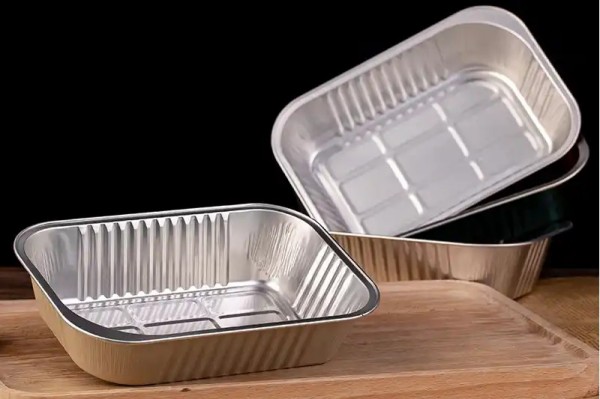
- Food-contact safe lubricants for deep-draw container forming.
- Anti-stick coatings for industrial baking applications.
- Embossing for strength enhancement.
5. Industrial Packaging
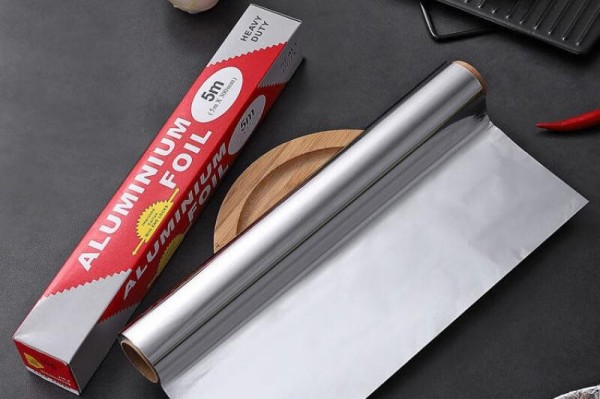
Larger core diameters, reinforced boxes, and continuous rolls (up to 100–300 meters) support non-stop commercial operations.
Application Scenarios
| Application Type | Commercial Use | Household Use |
|---|---|---|
| Food Wrapping | High-volume kitchen prep, centralized meal production | Basic food storage at home |
| Cooking & Baking | Industrial ovens, grills, steamers | Oven baking, pan lining |
| Container Forming | Foil trays, lids, catering pans | Small disposable trays |
| Heat Retention | Buffet service, delivery operations | Keep food warm briefly |
| Packaging | Frozen meals, catering packs | Leftovers, lunchboxes |
Commercial aluminum foil sustains prolonged heating cycles, higher mechanical pressure, and continuous handling—requirements household foil cannot reliably satisfy.
Data Tables
Table 1: Specification Comparison
| Parameter | Commercial Aluminum Foil | Sambahayan Aluminum Foil |
|---|---|---|
| Ang kapal | 10–25 μm | 8–12 μm |
| Alloy Options | 8011 / 3003 / 8006 | Mainly 8011 |
| Temper | O / H22 / H24 / H18 | O |
| Lakas ng Paghatak | 90–135 MPa | 60–90 MPa |
| Roll Length | 100–300 m | 5–20 m |
| Heat Resistance | Higher, stable up to 350°C | Standard, up to 250–300°C |
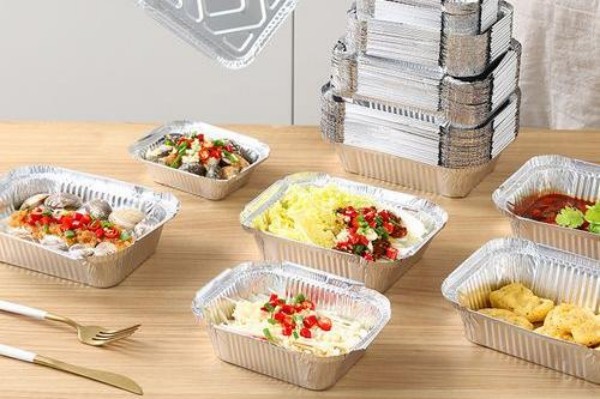
Table 2: Performance Metrics
| Pag-aari | Commercial Grade | Household Grade |
|---|---|---|
| Puncture Resistance | Mataas na | Medium |
| Tear Strength | Mataas na | Low–Medium |
| Formability | Suitable for deep drawing | Limited |
| Surface Uniformity | Industrial-level control | Basic consumer-grade |
| Cost per Meter | Lower (bulk) | Higher (retail packaging) |
Quality Control in Commercial-Grade Foil
Professional kitchens require strict QC protocols, including:
- Thickness Deviation Control (<±2% for commercial foil).
- Pinhole Density Testing to ensure minimal contamination risk.
- Surface Cleanliness Checks (natitirang langis <3 mg/m²).
- Mechanical Strength Tests for pull, tear, and puncture resistance.
- Food Safety Compliance with FDA, LFGB, and GB4806 standards.
- Roll Flatness Assessment for seamless unrolling during service.
- Odor & Coating Migration Tests for high-temperature stability.
These measures ensure durability, hygiene, and process reliability in demanding foodservice environments.
Frequently Asked Questions
Q1: Can household foil replace commercial foil in a restaurant?
Not recommended—insufficient tear resistance and thickness for professional use.
Q2: Why is commercial aluminum foil more expensive?
Higher-quality alloys, tighter tolerances, and industrial packaging increase cost.
Q3: Do both types meet food-contact standards?
Oo nga, but commercial foil undergoes stricter batch testing for consistent performance.
Q4: Is thicker foil always better?
Not always; thickness must match the application (steamers, grills, forming presses, atbp.).

Pangwakas na Salita
Commercial aluminum foil and household foil serve fundamentally different purposes. Commercial foil offers enhanced strength, tibay ng katawan, heat resistance, and structural stability—attributes essential for large-scale cooking, industrial packaging, and intensive kitchen workflows. Household foil remains suitable for daily tasks but cannot meet the mechanical and thermal demands of professional foodservice. Choosing the correct foil type directly affects efficiency, safety, and long-term operational costs in any kitchen setting.