
Common food packaging processes include heat sealing, die-cutting and folding. 6μm is thinner and prone to heat sealing offset and over-melting damage during heat sealing. How to solve such problems?
1. Introduction: Application Value of 6μm Aluminum Foil in Food Packaging and Heat-Seal Process Pain Points
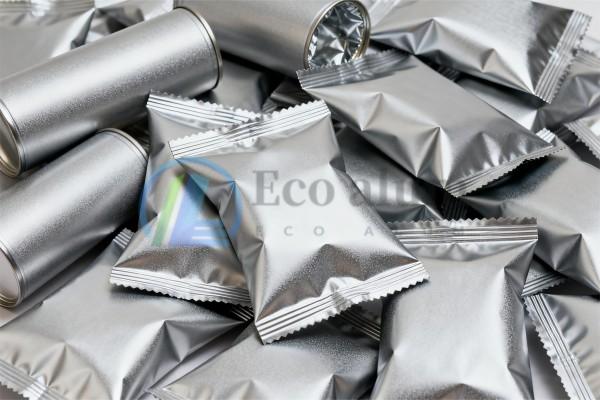
6μm aluminum foil for food packaging has become the mainstream choice for small-capacity foods (e.g., 10-50g nuts, 20ml seasoning sauces) and disposable packaging (e.g., instant coffee sachets) due to its advantages of “lightweight (areal density 16.2g/m², 7.7% lower than 6.5M), low cost (unit area cost 0.8-0.9 RMB/m²), and excellent thin-format formability”. Notably, its market share in food packaging aluminum foil reached 42% sa 2024 (per China Aluminum Foil Packaging Industry White Paper).
Gayunpaman, ang “thin-format characteristic” of 6μm aluminum foil easily triggers heat-seal issues of 6μm aluminum foil in food packaging during the heat-sealing process, manifested in two core defects: ① Heat-seal misalignment (seal edge misalignment ≥0.5mm, exceeding the “seal edge deviation ≤0.3mm” requirement in GB/T 2790-2021 Test Method for 180° Peel Strength of Adhesives), leading to insufficient seal width and a 30%-50% increase in oxygen transmission rate; ② Over-melting damage (pinholes, scorching, or substrate rupture in the heat-sealed area, with a damage rate of 8%-12%), directly causing food leakage, spoilage, and a sharp rise in production line scrap rates.
According to statistics from a packaging enterprise, annual losses caused by heat-seal issues of 6μm aluminum foil in food packaging account for approximately 15% of production costs. Given this, analyzing the causes of the problem and proposing systematic solutions is crucial for promoting the large-scale application of 6μm aluminum foil in the food packaging field.
2. Core Cause Analysis of Heat-Seal Issues of 6μm Aluminum Foil in Food Packaging
Fundamentally, heat-seal issues of 6μm aluminum foil in food packaging stem from “mismatch between material properties and process parameters”. The root causes can be disassembled from three dimensions: material, equipment, and process:
(1) Material Properties: Physical Characteristics of 6μm Aluminum Foil Amplify Process Sensitivity
- Fast heat conduction and poor heat resistance: The thermal conductivity of 6μm aluminum foil reaches 235W/(m·K) (consistent with 6.5μm), but due to its thin thickness, its heat capacity is only 92% of that of 6.5μm. During heat-sealing, heat penetrates the aluminum foil layer quickly, reducing the time to transfer to the heat-seal adhesive layer by 15%. If temperature control is imprecise, local over-melting of the adhesive layer is likely to occur. Additionally, the heat resistance threshold of 6μm aluminum foil (160℃, beyond which intergranular softening easily occurs) is lower than that of 6.5μm (170℃); a slight increase in heat-seal temperature will cause substrate damage, exacerbating this heat-seal issue.
- Low mechanical strength and easy deformation: The tensile strength of 6μm aluminum foil is 120-130MPa (4%-8% lower than 6.5μm), and its yield strength is 40-60MPa (without cold strengthening). If pressure distribution is uneven during heat-sealing, the aluminum foil is prone to “local tensile deformation”, leading to seal edge alignment deviation. Furthermore, although the bonding strength of 6μm aluminum foil composite with PET/PE (45N/15mm) is slightly higher than that of 6.5μm, the composite interface strength decreases by 20% due to adhesive layer softening during heat-sealing, further amplifying heat-seal issues of 6μm aluminum foil in food packaging.
(2) Equipment Parameters: Precision Defects of Traditional Heat-Sealing Equipment Fail to Adapt to Thin Foil Requirements
Beyond material factors, equipment precision is another key contributor to heat-seal problems:
- Insufficient temperature control precision: The temperature deviation of traditional heat-sealing machines is mostly ±3℃. Due to the small heat capacity of 6μm aluminum foil, a ±3℃ temperature fluctuation causes a 6℃ temperature difference in the heat-sealed area, exceeding the tolerance threshold of the heat-seal adhesive layer (e.g., EVA adhesive, optimal heat-seal temperature range 130-140℃). The adhesive layer remains unmelted in low-temperature areas (resulting in seal failure) and the substrate suffers over-melting in high-temperature areas (causing damage), directly inducing this heat-seal issue.
- Poor pressure uniformity: If the radial runout of the heat-seal roller exceeds 0.1mm (a common deviation in traditional equipment), 6μm aluminum foil will undergo tensile deformation due to excessively high local pressure (>0.3MPa), while insufficient pressure (<0.1MPa) leads to poor adhesion of the adhesive layer, forming “false seals”. Meanwhile, if the alignment precision of the heat-seal fixture is ±0.2mm, combined with aluminum foil deformation, the final seal edge misalignment easily exceeds 0.5mm, worsening heat-seal issues of 6μm aluminum foil in food packaging.
(3) Process Coordination: Insufficient Parameter Matching Between Lamination-Heat-Sealing-Environment
- Incompatibility between lamination and heat-sealing processes: If the lamination temperature of 6μm aluminum foil and PE heat-seal layer is too high (>120℃), the adhesive layer viscosity will be activated in advance, leading to “interlayer sliding” during heat-sealing. Uneven lamination pressure (deviation >0.05MPa) causes air bubbles at the aluminum foil-PE interface; these bubbles expand when heated during heat-sealing, triggering local over-melting and becoming one of the causes of this heat-seal issue.
- Environmental temperature and humidity interference: When environmental humidity exceeds 60%, the surface of 6μm aluminum foil easily absorbs moisture, which vaporizes when heated during heat-sealing, forming pinholes in the seal edge. An environmental temperature fluctuation exceeding 5℃ (e.g., direct blowing from workshop air conditioning vents) causes the thermal expansion and contraction of aluminum foil to reach 0.15%, further amplifying heat-seal misalignment and aggravating heat-seal issues of 6μm aluminum foil in food packaging.
3. Systematic Solutions: Targeted Resolution of Heat-Seal Issues of 6μm Aluminum Foil in Food Packaging
To address these root causes, a four-dimensional synergy—”material modification to enhance tolerance, equipment upgrading to improve precision, process adjustment to optimize parameters, and online monitoring to prevent failure”—is required to solve heat-seal issues of 6μm aluminum foil in food packaging:
(1) Material Level: Modification and Composite Structure Optimization to Improve Heat-Seal Adaptability
Starting with material improvement, enhancing the heat-seal compatibility of 6μm aluminum foil is the fundamental step:
- Heat-resistant modification of aluminum foil surface
-
- Adopting “vacuum-deposited polyimide (PI) coating”: Depositing a 0.5-1μm thick PI coating (heat resistance temperature 260℃) on the heat-seal surface of 6μm aluminum foil can increase the heat resistance threshold of the aluminum foil to 180℃, widening the over-melting temperature window from 10℃ (150-160℃) to 30℃ (150-180℃). Meanwhile, the friction coefficient of the PI coating (0.18) is lower than that of bare aluminum foil (0.25), reducing interlayer sliding during heat-sealing and decreasing misalignment by 40%, effectively alleviating this heat-seal issue.
-
- Implementing “anodizing surface treatment”: Through 20-30V DC electrolysis, a dense 50-100nm Al₂O₃ oxide film is formed on the aluminum foil surface, reducing the thermal conductivity by 12% and delaying heat transfer to the adhesive layer to avoid local over-melting. Tests by an enterprise show that the over-melting damage rate of 6μm aluminum foil after anodizing decreases from 10% sa 3.2%, significantly improving heat-seal issues of 6μm aluminum foil in food packaging.
- Optimization design of composite structure
-
- Using “gradient heat-seal layer”: Replacing the traditional single PE heat-seal layer (20μm thick) with a “PE+EVA gradient layer” (15μm PE layer, melting point 130℃; 5μm EVA layer, melting point 110℃) utilizes the low melting point of EVA to reduce the heat-seal temperature (from 140℃ to 125℃), minimizing the heating time of the aluminum foil. Additionally, the bonding strength of the gradient layer reaches 55N/15mm, 22% higher than that of the single PE layer, enhancing anti-misalignment capability and providing a material foundation for solving this heat-seal issue.

(2) Equipment Level: High-Precision Upgrading to Adapt to Process Sensitivity of 6μm Aluminum Foil
In addition to material improvements, upgrading equipment precision is critical to suppressing heat-seal defects:
- Upgrading heat-seal temperature control system
-
- Adopting “PID + infrared temperature measurement closed-loop control”: Embedding a Pt100 platinum resistor (precision ±0.1℃) in the heat-seal roller and installing an infrared thermometer (response time <0.01s) in the heat-seal area to real-time feed back temperature deviations and adjust heating power, improving temperature control precision from ±3℃ to ±0.5℃. After application in a production line, the temperature difference in the heat-seal area is stabilized within 1℃, reducing the over-melting damage rate by 60% and effectively suppressing heat-seal issues of 6μm aluminum foil in food packaging.
- Optimization of pressure and alignment system
-
- Integrating visual alignment system: Installing a 2-megapixel industrial camera (shooting frequency 50fps) at the heat-seal station, combined with machine vision algorithms (positioning precision ±0.05mm), to real-time correct the position deviation of the heat-seal fixture. This controls the seal edge misalignment from over 0.5mm to ≤0.2mm, meeting the requirements of GB/T 2790 and solving heat-seal issues of 6μm aluminum foil in food packaging from the equipment end.
(3) Process Level: Parameter Coordination and Environmental Control to Build a Stable Process Window
Complementing material and equipment upgrades, process optimization further ensures heat-seal stability:
- Orthogonal optimization of heat-seal parameters (DOE experimental design)
Through orthogonal experiments (factors: temperature T, pressure P, time t; levels: T=120-130℃, P=0.12-0.18MPa, t=0.3-0.4s) and response surface methodology analysis, the optimal process parameter combination is determined: T=125℃, P=0.15MPa, t=0.35s. At this point, the heat-seal strength of 6μm aluminum foil reaches 52N/15mm (16% higher than before optimization), the misalignment rate is 0.8%, and the over-melting damage rate is 2.1%, providing a process basis for solving heat-seal issues of 6μm aluminum foil in food packaging.
- Precise control of environmental temperature and humidity
-
- Installing a “constant temperature and humidity system” in the heat-seal workshop: Controlling the temperature at 23±2℃ (reducing the thermal expansion and contraction of aluminum foil to ≤0.05%) and humidity at 45±5% (avoiding moisture absorption on the aluminum foil surface). Meanwhile, installing local wind shields at the heat-seal station to prevent local temperature and humidity fluctuations caused by direct air conditioning blowing, further reducing the risk of misalignment and over-melting and assisting in improving this heat-seal issue.

(4) Quality Monitoring Level: Online Detection and Offline Verification to Build a Closed-Loop Management
To prevent the recurrence of heat-seal problems, a comprehensive monitoring system is essential:
- Online real-time detection system
-
- Online heat-seal strength detection: Installing a tension sensor (precision ±0.1N) after the heat-seal station to randomly sample the front, middle, and rear sections of each aluminum foil roll (one sample per 100m), real-time detecting heat-seal strength, and automatically alarming and adjusting parameters if it is lower than 40N/15mm;
-
- Online sealability detection: Using a “negative pressure sealability tester” (detection precision 1Pa) to test the sealability of heat-sealed packaging (negative pressure value -50kPa, pressure holding time 5s), automatically rejecting packaging with a leakage rate >0.5kPa/s, and preventing the recurrence of heat-seal issues of 6μm aluminum foil in food packaging from the quality end.
4. Application Verification: Improvement Effect of Solutions on Heat-Seal Issues of 6μm Aluminum Foil in Food Packaging
To validate the effectiveness of the proposed solutions, an enterprise producing 20g nut sachets applied the above measures, resulting in significant improvements in heat-seal issues of 6μm aluminum foil in food packaging and key indicators:
- Quality indicators: The heat-seal misalignment rate decreased from 8.5% sa 0.7%, the over-melting damage rate dropped from 11.2% sa 2.3%, the heat-seal strength stabilized at 50-55N/15mm, and the sealability qualification rate increased from 92% sa 99.8%, meeting the customer’s requirements of “6-month shelf life and no leakage”;
- Cost indicators: The production line scrap rate decreased from 12% sa 3.5%, reducing annual scrap losses by approximately 860,000 RMB; heat-sealing energy consumption decreased by 15% (due to the reduction of heat-seal temperature from 140℃ to 125℃), saving annual electricity costs by about 120,000 RMB;
- Efficiency indicators: The heat-seal speed increased from 40m/min to 60m/min, improving production line capacity by 50% and meeting peak season order demands.

5. Pangwakas na Salita: Core Logic for Resolving Heat-Seal Issues of 6μm Aluminum Foil in Food Packaging
Sa buod, heat-seal issues of 6μm aluminum foil in food packaging are not “inherent defects of thin materials” but result from insufficient synergy between “material properties, equipment precision, process parameters, and environmental conditions”. The core logic for solving this problem lies in:
- Material level: Enhancing the heat resistance and anti-deformation capability of 6μm aluminum foil through surface modification (PI coating, anodizing) and composite structure optimization (gradient heat-seal layer), widening the process window and reducing problem incentives from the root;
- Equipment level: Upgrading heat-sealing equipment with “high-precision temperature control, uniform pressure, and visual alignment” as the core to adapt to the process sensitivity of thin foil and suppress problem occurrence from the hardware end;
- Process and monitoring levels: Building a stable heat-seal process window through DOE experimental parameter optimization and environmental control, and forming closed-loop management with online detection to ensure the problem is completely solved from the process end.
Looking ahead, with the development of the “ultra-light and ultra-thin” food packaging trend (e.g., 5μm aluminum foil), it will be necessary to further integrate “intelligent processes (AI parameter prediction), functional coatings (high heat resistance + low friction), and high-precision equipment (nanoscale positioning)”. This will not only provide references for similar process issues of thin materials but also promote the wider application of 6μm aluminum foil in the food packaging field, achieving the multiple goals of “lightweight, high reliability, and low energy consumption”.