
Diferans ant papye aliminyòm komèsyal pou gwo operasyon sèvis manje ak papye kay
Komèsyal papye aliminyòm plays a fundamentally different role in large-scale foodservice operations compared with traditional household foil, and understanding these differences is essential for selecting the right material for cooking, anbalaj, and thermal management tasks in professional kitchens.
Background Overview
While both commercial and household foil are made primarily from rolled aluminum, their performance expectations diverge significantly. Restaurants, central kitchens, catering companies, and institutional dining facilities require foil products capable of enduring high thermal loads, estrès mekanik, heavy-volume usage, and hygienic demands. Kontrèman, household foil is optimized for convenience, light food wrapping, and everyday cooking.
These distinctions affect alloy selection, tanperaman, epesè, coating compatibility, tensile properties, and packaging format.
Technical Explanation
Commercial aluminum foil is generally produced in thicker gauges (10–25 microns) with higher tensile strength, better puncture resistance, ak amelyore andirans tèmik. Sa a se reyalize atravè:
- Chwazi alyaj manje-klas tankou 8011, 3003, oswa 8006.
- Optimize pousantaj rediksyon woule pou asire epesè inifòm.
- Itilize tolerans ki pi sere pou satisfè kondisyon konfòmite HACCP ak FDA/EFSA.
Papye aliminyòm nan kay la anjeneral itilize 8011 alyaj ki gen pi ba dite ak 8-12 mikron epesè-adekwa pou tipik boulanjri oswa kouvri manje men li pa apwopriye pou estrès nan nivo endistriyèl..
Detay Pwosesis Faktori
1. Alloy k ap fonn ak Distribisyon
Foil komèsyal mande pou presizyon alyaj, degaze, filtraj, and grain refinement to ensure strength stability.
2. Hot Rolling → Cold Rolling
Commercial foil often undergoes additional cold-rolling passes to improve surface finish and mechanical uniformity.
3. Rkant
Controlled annealing yields specific hardness levels:
- Tanperaman mou (O) for wrapping and shaping.
- Hard temper (H18) for container forming.
Commercial foil commonly uses intermediate hardness to resist tearing during high-speed use.
4. Tretman sifas
Professional-grade foil may include:
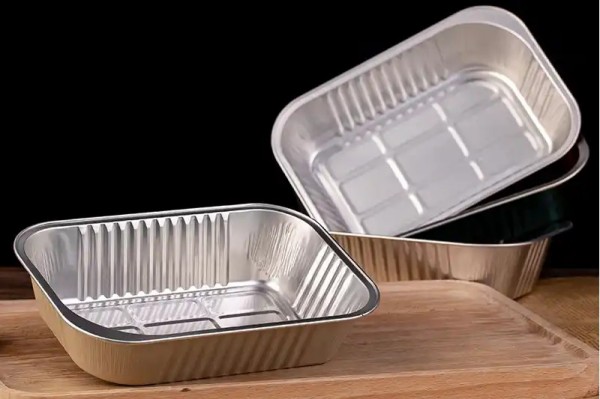
- Food-contact safe lubricants for deep-draw container forming.
- Anti-stick coatings for industrial baking applications.
- Relief for strength enhancement.
5. Endistriyèl anbalaj
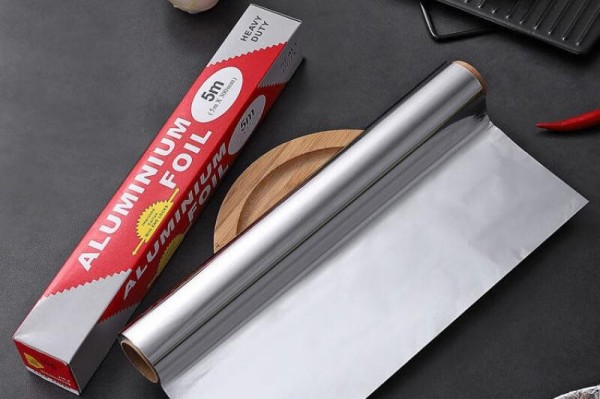
Larger core diameters, reinforced boxes, and continuous rolls (up to 100–300 meters) support non-stop commercial operations.
Senaryo aplikasyon
| Application Type | Commercial Use | Itilizasyon nan kay la |
|---|---|---|
| Anbalaj Manje | High-volume kitchen prep, centralized meal production | Basic food storage at home |
| Kwit manje & Kwit | Industrial ovens, grills, steamers | Oven baking, pan lining |
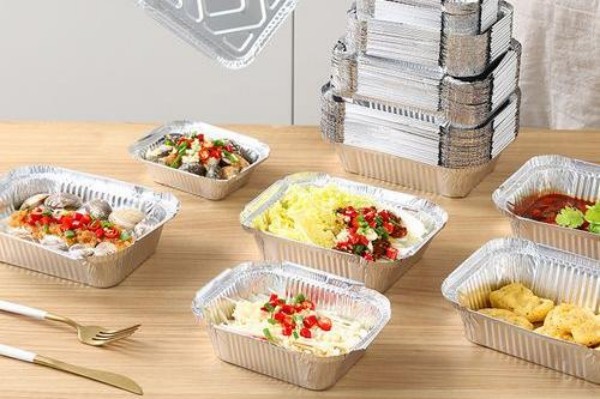
| Container Forming | Plato FOIL, kouvèti, catering pans | Small disposable trays |
| Heat Retention | Buffet service, delivery operations | Keep food warm briefly |
| Anbalaj | Frozen meals, catering packs | Leftovers, bwat manje midi |
Commercial aluminum foil sustains prolonged heating cycles, higher mechanical pressure, and continuous handling—requirements household foil cannot reliably satisfy.
Data Tables
Tablo 1: Specification Comparison
| Paramèt | Commercial Aluminum Foil | Foil aliminyòm nan kay la |
|---|---|---|
| Epesè | 10-25 μm | 8-12 μm |
| Alloy Options | 8011 / 3003 / 8006 | Mainly 8011 |
| Tanperaman | O / H22 / H24 / H18 | O |
| Fòs rupture | 90–135 MPa | 60-90 MPa |
| Roll Length | 100–300 m | 5–20 m |
| Rezistans chalè | Pi wo, stable up to 350°C | Estanda, up to 250–300°C |
Tablo 2: Metrik pèfòmans
| Pwopriyete | Komèsyal Klas | Klas nan kay la |
|---|---|---|
| Rezistans twou | Segondè | Mwayen |
| Chire fòs | Segondè | Ba–Mwayen |
| Fòmabilite | Apwopriye pou desen gwo twou san fon | Limite |
| Sifas Inifòmite | Endistriyèl-nivo kontwòl | Debaz konsomatè-klas |
| Pri pou chak mèt | Bese (en) | Pi wo (anbalaj an detay) |
Kontwòl Kalite nan FOIL Komèsyal Klas
Kwizin pwofesyonèl mande pou pwotokòl QC strik, ki gen ladan:
- Kontwòl devyasyon epesè (<± 2% pou papye komèsyal).
- Tès dansite pinhole pou asire risk kontaminasyon minimòm.
- Tèks lapwòpte sifas yo (lwil rezidyèl <3 mg/m²).
- Tès fòs mekanik pou rale, chire, ak rezistans twou.
- Food Safety Compliance with FDA, LFGB, and GB4806 standards.
- Roll Flatness Assessment for seamless unrolling during service.
- Odè & Coating Migration Tests for high-temperature stability.
These measures ensure durability, ijyèn, and process reliability in demanding foodservice environments.
Kesyon yo poze souvan
Q1: Can household foil replace commercial foil in a restaurant?
Not recommended—insufficient tear resistance and thickness for professional use.
Q2: Why is commercial aluminum foil more expensive?
Higher-quality alloys, tighter tolerances, and industrial packaging increase cost.
Q3: Do both types meet food-contact standards?
Wi, but commercial foil undergoes stricter batch testing for consistent performance.
Q4: Is thicker foil always better?
Not always; thickness must match the application (steamers, grills, forming presses, elatriye.).

Konklizyon
Commercial aluminum foil and papye kay la serve fundamentally different purposes. Commercial foil offers enhanced strength, dirab, rezistans chalè, and structural stability—attributes essential for large-scale cooking, anbalaj endistriyèl, and intensive kitchen workflows. Household foil remains suitable for daily tasks but cannot meet the mechanical and thermal demands of professional foodservice. Choosing the correct foil type directly affects efficiency, sekirite, and long-term operational costs in any kitchen setting.