




Buy 1000 Series Aluminum Foil: Grades, Tempers and Buyer’s Guide

Buy 1000 Series Aluminum Foil: Grades, Tempers and Buyer’s Guide
Perkenalan
“1000 series aluminum foil for sale” means commercially pure aluminum foil—the family of grades from 1050 Dan 1060 melalui 1100, 1235 Dan 1350 that sits behind lithium-ion batteries, shielded cables, electrolytic capacitors, laminasi fleksibel, transformer windings and air-conditioner fins.
Whenever electrical or thermal conductivity, ketahanan terhadap korosi, reflectivity or easy forming matters more than raw strength, a 1xxx foil is usually the correct and most economical choice.
Buying it well means fixing four decisions that change price and performance: the exact grade, the temper (soft O versus hard H18), the gauge and width, and the surface finish.
Ordering soft O foil for a battery current collector that needs H18, or general 1050 where a guaranteed-conductivity 1350 is specified, will stop a production line.
This guide explains the grades, tempers and end uses—with focused sections on battery, cable and capacitor foil—and how to specify and order factory-direct.

Apa 1000 Series Aluminum Foil?
The 1xxx series is commercially pure aluminum (setidaknya 99.0% Al), with iron and silicon as the main controlled impurities and only trace copper, mangan dan magnesium.
These alloys are non-heat-treatable, so they gain strength through cold rolling and are softened by annealing. Foil ranges from about 5 mikron (0.005 mm) to roughly 0.2 mm for fin stock.
- Konduktivitas listrik yang sangat baik, around 61–63% IACS annealed—the highest of the common foil families, ideal for battery collectors, cable shields and capacitor electrodes.
- Konduktivitas termal yang tinggi (about 220–235 W/(m·K)) for heat-exchanger fins.
- Strong corrosion resistance from the natural self-healing oxide film.
- Very ductile and easy to roll, melipat, wrap, deep-draw and laminate in the O temper.
- Bright surface reflecting about 80–85% of radiant heat for reflective insulation.
- Lower mechanical strength than 3xxx/8xxx alloys—the main limitation to design around.
Pendeknya, itu 1000 series trades strength for conductivity, kemurnian, corrosion resistance and formability. It is also fully recyclable, and downgauging to the thinnest foil that still performs directly cuts metal weight per battery, per meter of cable and per package.
These properties follow directly from the chemistry. Because alloying elements and impurities scatter moving electrons, the purest grades carry current most efficiently—the reason conductor and capacitor buyers specify 1060/1070/1350 rather than the cheapest grade.
Corrosion resistance comes from the thin, tightly adherent aluminum-oxide film that forms instantly on exposure to air and self-repairs after minor damage, so pure foil weathers well without paint in mild environments.
The trade-off is that, without strengthening alloy phases, pure aluminum is soft; strength is then recovered by cold rolling to an H temper, which is why the same grade can be supplied buttery-soft (HAI) for wrapping or hard (H18) for a battery web.
Grades, Composition and Temper
The grades differ mainly in purity. In the four-digit system, the last two digits show minimum aluminum above 99.00%—1050 is 99.50%, 1060 adalah 99.60% Dan 1070 adalah 99.70%.
Higher purity means better conductivity but slightly lower strength and often a higher price; 1100 Dan 1235 allow a little more iron and silicon for better rolling and strength at purity that is ample for packaging and converter uses.
| Nilai | Minimal. Al | Karakter / main use |
| 1050 | 99.50% | Economical general converter, papan nama, insulation cladding, heat panels |
| 1060 | 99.60% | Battery cathode foil, transformer windings, tab, fin stock |
| 1070 | 99.70% | High-end battery/digital cells, capacitor and electronic foil |
| 1100 | 99.00% | Balanced workability: food/kitchen foil, sirip, peralatan masak, papan nama |
| 1145 / 1200 | 99.0–99.45% | Kemasan fleksibel, converter foil, penukar panas |
| 1235 | 99.35% | Workhorse converter grade: baterai, kabel, capacitor, laminasi |
| 1350 | 99.50% | Electrical-conductor (EC) nilai, minimum about 61% IACS |
Temper is as important as grade. The digit after H shows the hardness degree (2 quarter-hard, 4 setengah keras, 6 three-quarter-hard, 8 penuh keras).
Battery current-collector foil is supplied H18 so a 10–20 micron web has the strength (about 150–200 MPa) to survive coating and high-speed slitting;
cable-shield and capacitor-cathode foil is supplied soft O so it wraps, winds and conforms; fin stock commonly uses H22/H24/H26.
| Melunakkan | Kondisi | Typical foil use |
| HAI | Sepenuhnya dianil, lembut | Cable shield, capacitor cathode, laminasi, pembungkus |
| H22/H24/H26 | Seperempat- to three-quarter-hard | Air-conditioner fin stock, tapes, pembentukan |
| H14/H16 | Half to three-quarter-hard | General converter foil and formed parts |
| H18 | Sangat keras, strongest at thin gauge | Lithium-ion cathode current collector |
Choosing the Right Grade
A simple decision sequence covers most orders.
If the foil carries current in a battery, capacitor or transformer, start with 1060/1070, atau 1350 where a cable standard writes a guaranteed IACS value.
If it shields a cable or forms a flexible-lamination barrier, use 1235-O. Untuk makanan, kitchen, fin stock or formed products needing a balance of softness and modest strength, menggunakan 1100.
If price and general formability dominate and conductivity is not critical, 1050 atau 1200 is the economical option.
Typical specifications make this concrete: an LFP battery plant orders 1235-H18 at 13 mikron, 600 mm wide, with wetting tension above 32 sarang/cm; a cable plant orders 1235-O at 9–15 microns pre-laminated to PET and slit to tape width;
a capacitor maker uses 1070 for anodes and 1235-O for cathodes at 5–10 microns; an HVAC fin press uses hydrophilic-coated 1100 pada 0.10 mm in H22. Each is a “1000 series foil,” yet alloy, temper and gauge differ completely—a one-size-fits-all quotation is a warning sign.
Baterai Aluminium Foil (Cathode Current Collector)
The most demanding 1xxx application is the lithium-ion battery. The cathode active material (LFP, NMC and similar) is coated onto thin aluminum foil that collects and carries current to the tab; the anode uses copper, not aluminum.
The foil must combine conductivity, strength and an ultra-clean high-surface-energy finish so the coating adheres uniformly.
| Nilai | Pengukur tipikal | Melunakkan | Common cell type |
| 1235 | 12–15 mikron | H18 | Power batteries, sodium-ion cells |
| 1060 | 15–20 mikron | H18 | Energy-storage and general power batteries |
| 1070 | 10–12 mikron | H18 | High-end digital and premium cells |
| 1050 / 1100 | 12–20 mikron | H18 | Standar, cost-sensitive cathode collector |
Production foil spans 9–25 microns and widths of about 200–1600 mm on 76.2 mm (3 di dalam) atau 152.4 mm (6 di dalam) cores, with thickness tolerance around ±3–5%.
Beyond chemistry, it is controlled for wetting tension (often ≥31–32 dyn/cm) so the slurry coats without dewetting, a strong cube ({001}) grain texture for uniform resistance, and a surface free of oil, streaks, pinholes and edge burrs.
Carbon-coated foil adds a conductive primer that lowers internal resistance for high-rate and LFP cells. Note that soft-pack pouch-cell aluminum-plastic film is a different part—soft 8079/8021/1235 at 0.015–0.06 mm, chosen for deep drawing rather than conductivity.
The market continues to downgauge as energy-density targets rise, with mainstream cathode foil moving from 14–16 microns toward 12–13 and premium digital cells near 10, which demands ultra-clean metal and tight rolling to keep the hard web pinhole-free.
On the line, battery foil is checked for gauge profile, kekuatan tarik, membasahi ketegangan, surface resistance and a burr-free slit edge; a web that fails any of these can cause coating defects, wrinkling or internal shorts.
Carbon-coated foil is specified by coating weight and surface resistance, and emerging polymer-core composite collectors are not a drop-in replacement for solid 1xxx foil, so conventional cells still use solid 1060/1235/1070 H18.

Cable-Shield and Capacitor Foil
Communication and power cables wrap a thin aluminum foil–plastic laminate around the conductors to block EMI/RFI interference, separate cable groups and provide grounding.
The standard grade is 1235 in soft O temper at 6–40 microns, laminated as single-sided AL/PET, double-sided AL/PET/AL or AL/PE.
A 9-micron 1235 foil in a laminated tape can deliver well over 60 dB shielding at 1 GHz; where a standard requires a guaranteed conductivity value for the conductor, the EC grade 1350 is specified instead.
Aluminum electrolytic capacitors use an etched and formed anode foil and a cathode foil separated by paper in electrolyte. High-voltage anodes need the highest purity (1070 and above), because the foil is electrochemically etched to enlarge its surface and anodized to grow the oxide dielectric;
any coarse impurity causes uneven etching and leakage. Pertengahan- and low-voltage cathodes and film-capacitor electrodes widely use 1235 atau 1070 in O temper from about 5 mikron, supplied with tight Fe-Si particle control and an exceptionally clean, permukaan bebas minyak.
Cable tape is specified by the lamination partner (AL/PET, AL/PET/AL or AL/PE), foil gauge, lajang- or double-sided construction and the exact slit strip width, since it is a converter product built to the cable maker’s dimensions.
Capacitor foil is the most purity-sensitive of all: the anode is etched to multiply its effective surface and then anodized to form the dielectric, so coarse intermetallic particles or residual rolling oil produce weak oxide spots and higher leakage;
it is therefore ordered with explicit cleanliness, thickness and pinhole limits on clean cores ready for etching and winding.
Other Applications and Alloy Comparison
- HVAC fin stock – 1100/1200 (Dan 8011) at 0.08–0.2 mm as plain, blue/gold hydrophilic or anti-corrosion fin in H22/H24/H26.
- Transformer foil windings and busbar connections – soft high-purity 1060/1070.
- Flexible packaging and lamination – 1235/1145 at 6–9 microns as the barrier layer.
- Isolasi reflektif, duct wrap, papan nama, papan tanda, bottle caps and general converter products.
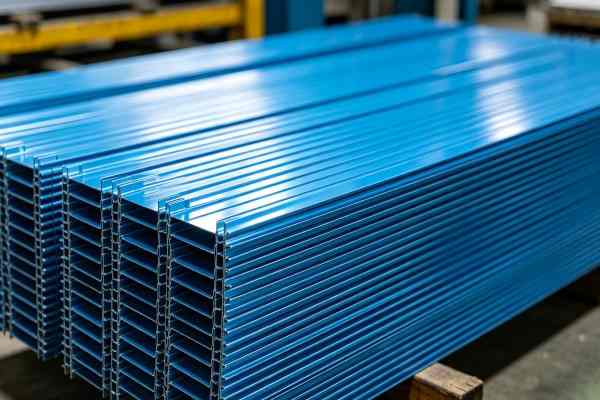
Angka 5. Hydrophilic-coated 1100/1200 fin stock for HVAC heat exchangers.
Image alt text: Stacked blue hydrophilic coated aluminum foil fins for air conditioner heat exchangers in an HVAC fin stock factory
| Family | Kekuatan | Daya konduksi | Typical role |
| 1xxx (murni) | Lebih rendah | Paling tinggi (61–63% IACS) | Baterai, kabel, capacitor, sirip, transformator |
| 3003 / 3004 | Tinggi (M N) | Sedang | Kontainer, nampan, deep-drawn parts |
| 8011 | Sedang-tinggi | Sedang | Household/food foil, penutup, sirip |
| 8079 / 8021 | Tinggi | Sedang | Ultra-thin high-barrier, farmasi, pouch film |
Choose 1xxx when conductivity, thermal transfer, kemurnian, reflectivity or maximum formability leads; 3003/3004 when a formed part needs real strength;
8011 for household and food foil; Dan 8079/8021 when the lowest pinhole count in an ultra-thin barrier is decisive.
Kapan 1100, 1145 atau 1235 is used for food contact, kitchen foil or lidding, order it with food-grade compliance documented for the market (FDA 21 CFR in the US, UE 1935/2004 in Europe, GB 4806 in China);
note that most converters still prefer 8011-O for bare retail kitchen rolls because it gives fewer pinholes and a sturdier feel, while 1xxx foil is more often the barrier layer inside a laminate.
Specifications to Define
| Parameter | Typical range / pilihan |
| Paduan / melunakkan | 1050/1060/1070/1100/1235/1350 in O, H14, H18, H22/H24/H26 |
| Ketebalan | 5–40 μm converter/electronics; 80–200 μm fin stock |
| Lebar / core | 100–1600 mm slit to your line; cores 76.2 mm (3 di dalam) / 152.4 mm (6 di dalam) |
| Permukaan | One-/two-side bright, matte, timbul, hydrophilic coated, treated for wettability |
| Special values | IACS %, membasahi ketegangan (sarang/cm), jumlah lubang jarum, grain texture (baterai) |
| Typical MOQ | Tentang 3 ton per spesifikasi; trial orders negotiable |
For material planning at a pure-aluminum density of about 2.70 gram/cm³,
weight per square meter is thickness in microns × 2.70: 12¼m foil is about 32.4 gram/m² (≈30,900 m²/ton), 15¼m about 40.5 gram/m² (≈24,700 m²/ton) and 20¼m about 54.0 gram/m² (≈18,500 m²/ton), slightly less after trim, cores and packaging.
Give the mill your line width, core, maximum coil OD and the slit-strip layout so the parent width minimizes trim scrap.
Kontrol Kualitas, Pricing and Ordering
Battery and capacitor foil needs the cleanest melt and tightest rolling; key checks are gauge profile (micrometers plus on-line X-ray/optical), conductivity by eddy-current meter (% IACS)
tensile and elongation, wetting tension with dyne liquids, pinholes on a back-lit table or optical scanner, and chemistry by spectrometer on the mill test certificate.
Ask for the MTC, gauge/width report, conductivity or wetting values, a pinhole report and production-gauge samples; ISO 9001 mills support SGS/BV/TUV inspection, and battery buyers commonly audit the line and approve a signed golden sample.
Price is the aluminum base (linked to ingot/LME) plus a conversion fee; higher purity, H18 battery temper, tight gauge and wetting requirements, narrow slitting, coating and small quantities all raise it.
Compare offers per ton and per thousand square meters on identical alloy, melunakkan, mengukur, width and Incoterm. Distinguish a real foil mill from a trader—only a mill can hold gauge, wetting and pinhole values consistently and issue its own certificates.
Standard terms are about 30% deposit with balance against the bill of lading, or L/C for large orders, FOB/CFR/CIF, with moisture-proof packing on fumigation-free pallets.
To order, state alloy and temper, thickness and tolerance, lebar, roll OD/length and core, surface or coating, lamination partner for cable tape, kuantitas, destination port and Incoterm, and the test values you need.
Always run production-gauge samples on your coater, etcher, slitter or wrapping line before approving bulk.
Distinguish a genuine foil mill from a trader, especially for battery and capacitor material: only a mill with thin-gauge rolling, controlled melt cleanliness and slitting capability can hold gauge, wetting tension and pinhole values consistently and issue its own certificates.
Ask for production-line photos or a video audit, the gauges and widths actually produced in-house, samples from the target gauge and references in your market.
Never approve foil from a photo and price alone—run production-gauge samples on your coater, etcher, slitter or wrapping line at normal speed, measure thickness across the width, test conductivity or wetting tension yourself, and inspect against light for pinholes.
A signed pre-production sample then becomes the standard for inspecting the bulk shipment.
Pertanyaan yang Sering Diajukan
Q: Apa 1000 seri aluminium foil?
A: Commercially pure aluminum foil (setidaknya 99.0% Al) in grades such as 1050, 1060, 1070, 1100, 1235 Dan 1350, valued for conductivity, thermal transfer, corrosion resistance and formability.
Q: Which grade is used for lithium batteries?
A: The cathode current collector uses 1060/1070/1235/1050/1100 in H18 at 9–25 microns (1235 at 12–15µm, 1060 at 15–20µm, 1070 at 10–12µm). The anode uses copper.
Q: Apa 1235 foil used for?
A: It is the workhorse converter grade for battery cathode foil, cable-shielding tape, electrolytic capacitor cathode foil and flexible lamination, in O or H18 from about 5–40 microns.
Q: Apa 1350 aluminium foil?
A: An electrical-conductor (EC) grade with guaranteed minimum conductivity around 61% IACS, used where cable or conductor standards specify a conductivity value.
Q: Should battery foil be O or H18?
A: H18 hard temper, for the strength to survive coating and high-speed slitting; soft O is reserved for cable wrap, capacitor cathodes and forming. Pouch film is a different soft 8079/8021 produk.
Q: 1000 series vs 8011 – which should I buy?
A: 1xxx for batteries, elektronik, kabel, kapasitor, fins and transformers; 8011 for household and food foil, lidding and fins where pinhole resistance and a little more strength matter.
Q: Apakah Anda memberikan sampel, certificates and OEM service?
A: Yes—production-gauge samples, MTC, conductivity/wetting and pinhole reports, ISO 9001 and third-party inspection, plus custom slitting, coating and private-label packaging.
Q: What thickness, lebar, MOQ and lead time apply?
A: Converter and electronics foil runs about 5–40 microns and fin stock 80–200 microns, in widths of roughly 100–1600 mm on 76 mm atau 152 mm cores. MOQ is commonly about 3 tons per specification with trial orders negotiable; lead time depends on quantity and customization.
Q: How much foil is in a ton, and how should I compare prices?
A: At about 2.70 gram/cm³, weight per m² is thickness in microns × 2.70, so 12¼m foil covers roughly 30,900 m² per ton. Compare suppliers per ton and per thousand square meters on the same alloy, melunakkan, mengukur, lebar, format and Incoterm rather than on headline price alone.
Kesimpulan
Buying 1000 series aluminum foil well is a matter of matching purity and temper to the job:
1060/1070 in H18 for battery cathode collectors and in O for transformers and capacitor components, 1235-O for cable shield, capacitor cathodes and lamination, 1350 for guaranteed IACS conductor duty, Dan 1100/1050/1200 for fins, food foil, insulation and general converter products.
Specify alloy, melunakkan, mengukur, lebar, surface and the electrical or wetting values your process depends on, then buy on measured data, approved samples and export-grade packing rather than the lowest headline price.


