Disk alumini për ngrohje LED
| Specifikimi | Vlera |
| Temperatura | O (i butë, tjerrje) / H14-H24 (stampim, rigid plates) |
| Trashësia | 0.5– 6 mm |
| Diametri | 50– 500 mm (cut to blank size) |
| Përçueshmëri termike | ~220–230 W/mK (1xxx) |
| Toleranca | diameter ±0.2–0.5 mm, thickness per spec |
| Aplikacionet | spun LED cups, base plates, bulb/street/high-bay heat sinks |
Disk alumini për ngrohje LED
Prezantim
An aluminum disc for LED heatsinks is a round blank of high-purity aluminum (most often 1050, 1060 ose 1100) that lighting manufacturers spin, vulë, deep-draw or machine into the heat-spreading body of an LED luminaire.
LEDs are sensitive devices: if they cannot shed heat, their junction temperature rises, light output drops, color shifts and life shortens.
The aluminum disc is the raw material that becomes the heat sink, the light-cup shell and the base plate that conducts heat from the LED board to the surrounding air.
For LED thermal management, aluminum beats most alternatives.
It is light, kosto e ulët, easy to spin and stamp, rezistente ndaj korrozionit, and—in its pure 1xxx form—a good thermal conductor.
This guide explains which aluminum discs are used for LED heatsinks, why pure alloys outperform stronger ones for heat, the tempers and sizes available, how blanks are made and formed, the main luminaire applications, anodizing and surface finishes, thermal design, kontrollin e cilësisë, çmimi dhe porositja, dhe një tabelë specifikimesh thelbësore.

What Is an Aluminum Disc for LED Heatsinks?
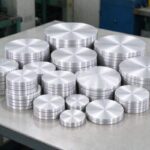
An aluminum disc (also called an aluminum circle or blank) is a round sheet cut from aluminum coil. For LED heatsinks it is usually 0.5–6 mm thick and from roughly 50 mm to several hundred millimeters in diameter, depending on the luminaire.
The disc is then converted downstream—spun into a cup, stamped into a shallow pan, or machined—to become the heat-spreading shell of a spotlight, downlight, bulb or street fixture.
The disc is chosen for two properties at once: thermal conductivity and formability.
A 1050/1060/1100 disc conducts heat well (pure aluminum is around 220–230 W/mK) and is soft enough in O temper to spin or deep-draw without cracking.
Stronger alloys such as 3003 ose 5052 are stiffer and more corrosion-resistant but conduct heat less well; they are reserved for mechanically demanding parts rather than pure heat spreading.
The most common blank is the 1050 rreth alumini; stiffer formed parts sometimes use 3003 rreth alumini.
The term covers both small thin discs spun into light cups and larger thick discs that are machined into base plates.
What unites them is that the disc is the starting blank, not the finished part: the lighting maker forms it, anodizes it, mounts the LED board and driver, and ships the luminaire.
This is why spec precision matters—a disc that is too thin cracks on the spinning line, one that is not flat runs eccentrically, and one in the wrong alloy cannot shed the heat a high-power LED produces.
Why Aluminum for LED Thermal Management?
Përçueshmëri e mirë termike: pure 1xxx aluminum conducts heat far better than plastics or die-cast zinc.
Peshë e lehtë: about one third the density of copper, important for recessed and retrofit fixtures.
Easy to spin and stamp into thin, thin-wall light cups and pans.
Low cost and widely available compared with copper heat sinks.
Naturally corrosion-resistant and accepts anodizing for heat dissipation and insulation.
Recyclable and compatible with the lighting industry’s cost and volume targets.
Copper conducts better than aluminum but is heavier and more expensive; plastic is cheap but is an insulator. Aluminum sits in the sweet spot: conductive enough to cool a high-power LED, light enough for a ceiling fixture, and cheap enough for a consumer bulb. That is why almost every LED heat sink shell on the market—especially the spun or stamped round ones—starts as an aluminum disc.
Krahasuar me plastikën, aluminum conducts heat orders of magnitude better, so a plastic bulb body traps heat and shortens LED life.
Compared with die-cast aluminum, a spun 1050 cup is thinner, smoother and cheaper to tool, and conducts better than porous die-cast.
Compared with copper, aluminum is about a third of the weight and much cheaper, and at the temperatures a small LED sink sees, the conductivity gap is more than made up by the larger surface area a light aluminum shell allows.
Cila aliazh? Thermal Conductivity vs Strength
| aliazh | Përafërsisht. përçueshmëri termike (W/mK) | Karakteri | Use for LED heatsinks |
| 1050 / 1060 | ~225–230 | i pastër, shumë i butë, highest conductivity | spun cups, base plates, thermal spreaders |
| 1100 | ~218 | pure with a little Cu, i butë, formueshmëri e mirë | stamped pans, light cups |
| 3003 | ~160–190 | aliazh Mn, më i fortë, më të ngurtë | mechanically demanding formed parts |
| 5052 | ~130 | aliazh Mg, të fortë, rezistente ndaj korrozionit | structural housings, not primary heat sink |
Rregulli është i thjeshtë: for the part that spreads LED heat, choose the purest soft alloy that still forms.
As alloying elements are added (Mn in 3003, Mg in 5052), strength and corrosion resistance rise but thermal conductivity falls.
A 5052 heat sink looks strong but moves heat poorly; a 1050 disc conducts well but may be too soft for a structural wall. Most spun LED cups are 1050/1060 O, which balances both.
Reflective inner surfaces for some luminaires use a 5052 fletë pasqyre me reflektim të lartë; general structural sheet can come from the 5000 fletë alumini të serisë varg.
Këshilla praktike: do not over-specify. A lighting buyer asked for “strongest aluminum” may end up with 5052, which feels premium but moves heat about 40% less well than 1050 and runs the LED hotter.
Reserve 3003/5052 for the few parts that really need mechanical stiffness or outdoor corrosion, dhe përdorni 1050/1060 for the heat-spreading cup and base.
If in doubt, a sample in each alloy with a simple temperature test under the same LED and current settles the question faster than datasheets.
Temperatura: O for Spinning, H for Stiffness
O Temperatura (me anale, i butë) is the standard for LED discs that will be spun or deep-drawn.
A soft disc flows under the spinning roller without cracking, which is essential for thin light cups and tapered shells.
H14/H24 or half-hard tempers are used when the disc is stamped into a shallow pan that must keep its shape, or when the finished part needs stiffness rather than deep forming.
Getting the temper wrong is a classic defect: a half-hard disc spun into a deep cup cracks at the base, while an O disc used as a rigid base plate is too soft and dents.
The blank supplier therefore matches the temper to the forming process—O for spinning and deep drawing, H for shallow stamping and rigid plates—and the converter trials a sample before volume.
Spinning in particular is temper-sensitive. An O disc needs enough annealed softness to flow under the roller without springback, but fully annealed stock that is too soft can wrinkle or tear on a deep draw.
The mill controls the anneal to a consistent temper, and the spinning line sets roller pressure and feed speed to match.
Variation in temper between batches is a common cause of cracked cups, which is why a mill certificate on temper—not just alloy—is part of the spec.
Specifikimet tipike
| Parametri | Gama tipike |
| aliazh / baticë | 1050 / 1060 / 1100, O (i butë) or H14/H24 |
| Trashësia | 0.5– 6 mm; spun cups ~0.6–2 mm, base plates 2–6 mm |
| Diametri | 50– 500 mm, cut to the cup/base blank size |
| Rrafshimi | banesë, buzë pa gërvishtje, consistent diameter |
| Sipërfaqja | përfundimi i mullirit; mund të anodizohet, blasted or brushed downstream |
| Prerja | sheared or blanked circle, controlled burr and edge |
| Toleranca | diameter ±0.2–0.5 mm, thickness per spec |
Blank diameter is calculated from the finished cup dimensions using the surface area of the drawn part—a deep, thin cup needs a larger blank than a shallow pan.
Thickness depends on thermal mass and wall thinning during spinning: a thin cup uses 0.6–1.5 mm, while a solid base plate under a high-power COB LED uses 3–6 mm to spread heat.
Blank sizing is the first engineering step. The spun cup thins as it forms, so the disc must be thick enough to leave a minimum wall after drawing.
Buyers often work backwards from the cup drawing: required wall thickness, cup diameter and depth set the blank diameter and starting gauge.
Leaving too large a blank creates trim waste; too small a blank splits at the rim. Because circle cutting is cheap, it is normal to cut a few blank sizes, spin samples, and lock the diameter that gives a clean cup with the least scrap.
Nga spiralja në disk: How Blanks Are Made
LED heat-sink discs start from cold-rolled aluminum coil in the chosen alloy and temper.
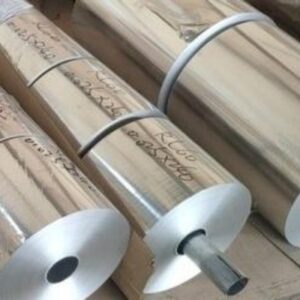
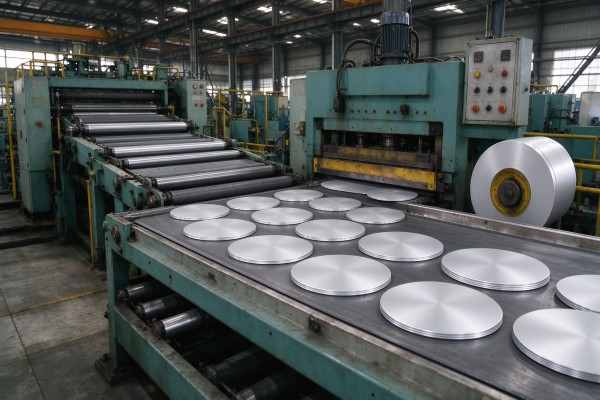
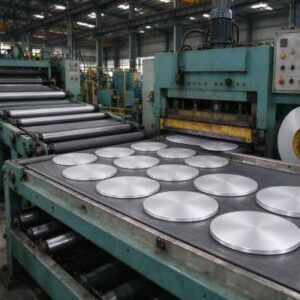
Spiralja është e zhveshur, niveluar, and blanked on a circle-cutting line—either sheared with round dies or punched in a blanking press—into round discs of the target diameter.
The edge is controlled for burr and the disc is stacked, interleaved if needed, and inspected for flatness and gauge.
The key quality points are flatness (a warped disc spins eccentrically), buzë buzësh (which causes cracking in forming), konsistenca e matësit, dhe pastërtia e sipërfaqes.
Because the blank is spun into a thin shell, even small gauge variation shows up as uneven wall thickness or splitting.
A good circle line cuts clean, banesë, burr-free discs that the converter can run directly on the spinning or stamping machine.
Yield on a circle line depends on nesting: cutting the maximum number of discs from a coil width to minimize scrap.
For large diameters the trim between circles is the main cost, so specifying a diameter that nests well on a standard coil width reduces price.
Tolerance and edge condition are specified per application—anodizing-grade discs need a clean, scratch-free surface because anodizing reveals every rolling mark, while spun cups mainly need flatness and burr control.

Formimi: Spinning vs Stamping vs CNC
Three processes turn a disc into a heat sink. Spinning clamps the disc over a mandrel on a lathe and rollers press it into a tapered cup—ideal for thin, round LED light cups and spotlights, and cheap for medium and large runs.
Stamping and deep drawing press the disc in a die into shallow pans and flatter base plates.
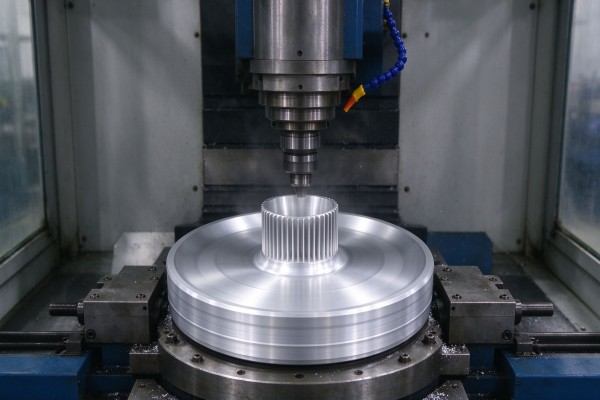
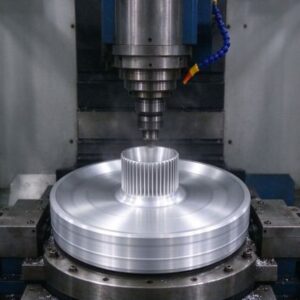
CNC machining is used for high-power finned heat sinks cut from solid disc or plate, where precise fin geometry matters.
Spinning is the dominant process for round LED heat cups because it is fast, tooling is cheap, and it produces the tapered, thin-wall shell that lights need.
O-temperamenti 1050/1060 disc flows smoothly under the roller. Stamping suits flat plates and shallower parts; CNC suits high-power, finned industrial and street heat sinks where thermal performance is engineered rather than shaped.
The choice of process drives the disc spec. Spinning wants a soft O disc with a clean, burr-free edge and good flatness; stamping wants consistent gauge so the die does not overload;
CNC wants a thicker plate or disc with stable thickness and a clean, machinable surface.
Telling the blank supplier which process the disc will go into prevents the most common mismatch—a stamping-grade disc that is too soft, or a spinning disc with an edge burr that cracks under the roller.

Kërkesë: LED Spotlights and Downlights
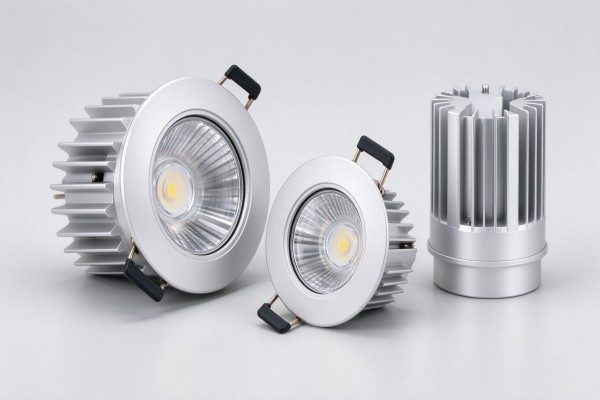
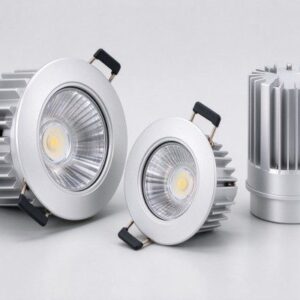
The classic spun aluminum heat cup is the body of an LED spotlight, PAR lamp or downlight.
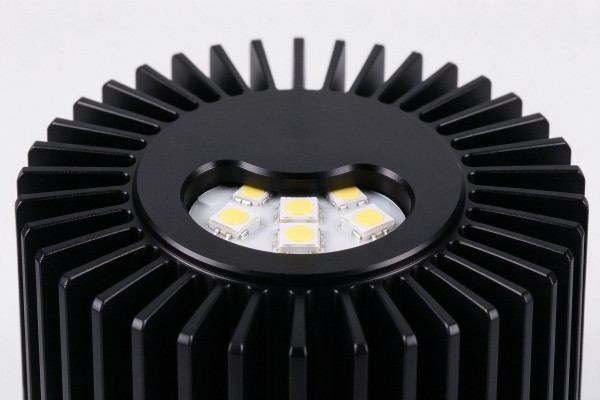
The disc is spun into a tapered shell that doubles as the heat sink and the lamp body: the LED board mounts on the flat back or base, heat conducts through the aluminum wall, and the outer surface (often finned or fluted) radiates to the air.
This is why the cup must be thermally conductive and dimensionally round.
For recessed downlights and spotlights, weight and thermal performance both matter—the fixture hangs in a ceiling and must cool the LED without a fan.
A 1050/1060 O disc spun thin gives low mass and good conduction; the outside is often anodized black or white to match the interior.
Consistent blank diameter and flatness keep the spun cups concentric and the fixture cosmetic.
Recessed downlights are a thermal tight spot: the fixture sits inside a ceiling void with little air flow, so the spun cup must shed heat conductively to its outer surface and through the trim.
A thin, low-mass cup looks elegant but can run hot; makers balance wall thickness, fluting and anodizing to keep junction temperature within the LED’s rating.
Because these cups are visible after install, surface finish and roundness are as much a selling point as cooling.

Kërkesë: LED Bulbs and Retrofit Lamps
LED bulbs (A-shape, candle, reflector) and retrofit lamps use small aluminum discs spun or stamped into the heat sink base under the plastic or glass bulb.
The bulb’s driver and LED board sit on this aluminum body, which must shed heat into the ambient air. Because bulb heat sinks are small and thin, a high-conductivity 1050/1060 disc and good surface area (finned or fluted) are what keep a 5–15 W bulb running cool.
Retrofit compatibility adds constraints: the heat sink must fit the existing lamp envelope, be light, and not look like a block of metal. Spun and finned aluminum discs meet this, often with a glossy or anodized finish and a plastic skirt over part of the body.
The blank is small (50–120 mm) and thin, so consistency and burr control are critical for high-volume bulb lines.
Bulb heat sinks face a cost and size squeeze: the body must look like a classic bulb, keep the driver cool, and be cheap enough for a consumer lamp.
Spun and finned 1050/1060 aluminum does this, often with a plastic skirt over the middle and the aluminum fins exposed at the base.
Because these are made in the millions, disc diameter, gauge and edge must be rock-consistent so the spinning press does not jam or scrap.
Color and surface (argjend, anodized black or painted) are cosmetic, but the underlying conductivity is what sets bulb life.

Kërkesë: Street, High-Bay and Industrial Luminaires
Higher-power LED street lights, high-bay fixtures and floodlights move more heat and often use finned, machined or extruded aluminum rather than a simple spun cup.
The base plate starts as a thicker aluminum disc or plate—2–6 mm of 1050/1060, or stiffer 5052 for structural housings—and fins are machined or bonded to increase surface area.
The disc spreads heat from the LED array to the fins.
For these fixtures, thermal design is engineering-led: the base plate must be flat and thick enough to spread heat evenly across the array, and the surface must make good thermal contact with the LED board (often with thermal paste).
Outdoor use adds corrosion and weathering, so anodizing or coating is common. Here the disc is part of a engineered heat sink, not just a cosmetic cup.
High-power fixtures also demand good thermal contact between the LED array and the base plate. Warped or rough base plates create air gaps that act as insulation, defeating the best alloy.
A flat, trashë 1050/1060 disc with a machined or sanded mounting face lets thermal paste fill the gap and spread heat to the fins.
Outdoor units further require anodizing or coating to resist humidity and road spray, so the disc surface must take that finish evenly and without blistering.

Përfundimi i sipërfaqes: Anodizimi, Blasting and Reflective Surfaces
The bare aluminum disc is often finished downstream. Anodizing grows a hard, protective oxide layer that improves corrosion resistance, gives electrical insulation (useful where the board mounts), and can be dyed black, silver or other colors.
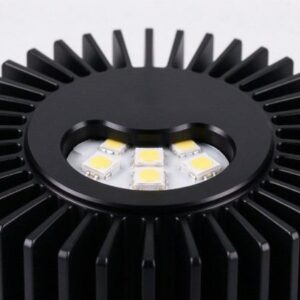
Black anodizing also improves heat radiation from the surface. Sandblasting or texturing gives a uniform matte look; polishing or mirror finishing is used where the inner surface must reflect light.
Anodizing is the most common LED heat-sink finish because it protects the aluminum and adds the cosmetic black or white look of modern luminaires.
The blank itself should be clean and burr-free, because anodizing amplifies surface defects—scratches and rolling marks show up after anodizing rather than being hidden.
Reflective inner surfaces for PAR and spot reflectors may use bright or mirror-finish aluminum.
Because anodizing is a conversion of the surface rather than a paint, it follows the underlying finish: a smooth polished disc anodizes to a clean bright part, while a scuffed or rolled disc shows the marks through the anodic layer.
This is why heat-sink discs destined for anodizing are supplied with a clean, scratch-free surface and controlled rolling texture.
Black anodizing, në veçanti, makes every surface flaw visible, so suppliers that know the lighting trade handle the discs carefully between blanking and delivery.

Thermal Design: How the Disc Cools the LED
Heat flows from the LED junction through the board and TIM (thermal interface material) into the aluminum disc, then conducts across the disc wall to the outer surface and radiates/convects to air.
The disc’s job is to spread heat from the small LED package over the whole heat-sink area. Three factors dominate: alloy conductivity (përdor 1050/1060), wall and base thickness (enough mass to spread heat), and outer surface area (fins, fluting, black anodizing).
A common mistake is making the cup too thin to save weight: a 0.4 mm wall may look fine but cannot spread heat, so the LED runs hot.
Thermal simulation or a simple temperature test (thermocouple on the junction, ambient and sink) validates the design. For high-power arrays, a thicker base plate and a properly sized disc diameter—rather than just a tall decorative shell—is what actually lowers junction temperature.
The interface between board and disc matters as much as the alloy. Even a 1050 plate fails if the LED board sits on it with air gaps or oxidation.
A flat, clean mounting face, thin thermal interface material, and good bolt pressure keep contact resistance low.
This is why machined base plates for COB modules are often specified with a flatness and surface finish callout rather than just a thickness.
The disc supplier controls flatness and gauge; the luminaire maker controls assembly pressure and TIM.
Quality Control of Heat-Sink Discs
| Kontrollo | Kërkesa |
| aliazh / baticë | certifikatë mulliri 1050/1060/1100 O or H |
| Trashësia & diametri | within tolerance, consistent across batch |
| Rrafshimi | no wave or cupping; spins concentrically |
| Buzë | burr-free, no cracks or laminations |
| Sipërfaqja | pastër, pa vaj, scratches or rolling defects |
| Formimi i gjyqit | sample spins/stamps without cracking or splitting |
| Termike | conductivity per alloy (traceable via alloy cert) |
The converter trials a sample batch on its own spinning or stamping line before volume: if the disc cracks, spins eccentrically or leaves uneven wall thickness, aliazhin, temperamenti ose diametri i zbrazët është i fikur.
Incoming checks of flatness, edge burr and gauge catch most problems; anodizing in-house further reveals surface defects that were invisible on the bare disc.
Custom Sizes and Tolerances
Heat-sink discs are cut to the customer’s blank size, not to a standard catalog.
The buyer provides the finished cup drawing or the spun dimensions, and the mill calculates the blank diameter, then cuts discs to that diameter in the required gauge and temper.
Because tooling for circle dies is low-cost, custom diameters are flexible; tight tolerances on diameter and flatness are specified for high-speed spinning.
For new luminaire designs, buyers often send the cup or base drawing and ask for a calculated blank size plus sample discs.
The converter spins or stamps the sample, adjusts the blank size if the wall thins unevenly, and then releases the specification for volume.
Hole patterns, centers or pre-punched features can be added for base plates, though most spun cups use a plain disc and form the features in the mandrel.
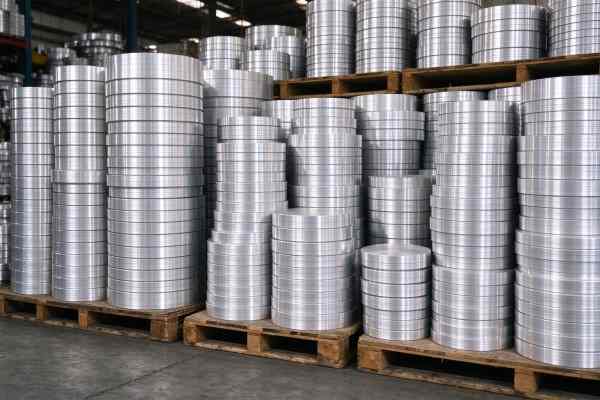
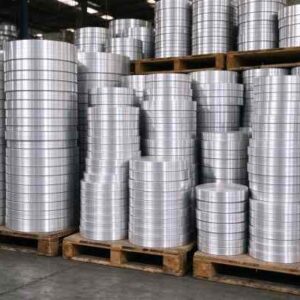
Because the discs are usually further formed or anodized, they are packed to stay clean and undamaged: stacked with interleaving paper to prevent scratches, banded on pallets, and wrapped against moisture and dust.
Anodizing-grade discs in particular must not be scuffed in transit, since every scratch shows after anodizing.
Export pallets are tagged with alloy, baticë, diametri, trashësi, lot and mill certificate, and shipped with the documentation the lighting maker needs for incoming inspection.

Çmimi dhe MOQ
Discs are priced on the aluminum base (i lidhur me LME) plus zbardhjen dhe përpunimin.
I pastër 1050/1060 discs cost a little more per kg than 3003 because of the rolling, but the thermal performance justifies it for heat sinks.
Trashësia, diametri, tolerancës, cut quality and anodizing-ready surface affect price; i hollë, i madh, tight-tolerance discs cost more than thick, loose ones.
MOQ is usually a few hundred kg or a pallet for custom sizes; standard sizes are quicker.
Buyers control cost by matching the alloy to the thermal job (not over-specifying to 5052 kur 1050 is better), ordering container quantities, and getting the blank diameter right the first time—re-cutting because a cup splits wastes material and time.
Kostoja totale përfshin rendimentin e formimit: një banesë, burr-free 1050 disc with high yield beats a cheap disc that cracks on the spinning line.
How to Order LED Heatsink Discs
Tregoni lidhjen (1050/1060/1100), baticë (O for spinning, H for rigid plates) dhe trashësi.
Give the finished cup/base drawing or the blank diameter you need.
Specify diameter tolerance, sheshtësi, edge burr limit and surface condition.
Request a forming sample batch before volume production.
Confirm mill certificate for alloy and temper, and anodizing-ready surface if you anodize.
Një hetim i drejtuar mirë përshpejton. The buyer who sends the finished cup drawing (ose madhësia bosh e llogaritur tashmë), matësi i synuar dhe temperamenti, procesi i rrjedhës së poshtme (tjerrje, stamping or CNC), and whether the discs will be anodized gets a quotation matched to the job rather than a generic per-kg price.
It also avoids the most common return—discs that are the wrong temper for spinning or that show scratches under anodizing.
Për prodhim të vazhdueshëm, agree on a written spec sheet (aliazh, baticë, matës, diameter tolerance, sheshtësi, buzë buzësh, sipërfaqe, certificate) and reorder against it, so every shipment matches the approved sample.
Lead time is short for standard 1050/1060 discs in common sizes; custom diameters and anodizing-ready surface add a small setup.
Because aluminum pricing tracks the LME, quotations carry a short validity, so confirm price when the spec is locked.
Rreth Eco Alum
Eco Alum është një specialist i furnizimit me alumin i themeluar në mars 2025, koordinimi i një zinxhiri furnizimi të aluminit të kualifikuar kinez të rrotullimit dhe zbrazjes për klientët në mbarë botën.
Ne fokusohemi te pjatat, mbështjellje, petë, shirita dhe rrathë nëpër 1000 seri (1050, 1060, 1070, 1100, 1235 dhe 1350), së bashku me 3003 dhe 5000-seri si p.sh 5052.
Më tepër se një tregtar me një mulli të vetëm, përputhemi me mullirin e duhur, aliazh, kaliteni dhe uleni në aplikimin e secilit klient dhe menaxhoni cilësinë, certifikatat dhe paketimin e eksportit.
For LED lighting and heat-sink manufacturers, we supply high-purity 1050, 1060 dhe 1100 disqe alumini dhe rrathë në temperamentin O ose H, cut to spun-cup and base-plate diameters, me banesë, burr-free, anodizing-ready blanks and mill certificates.
Ne gjithashtu furnizim 3003 dhe 5052 for stiffer formed or structural parts and 5052 reflective sheet where needed.
Kontaktoni [email protected] ose telefononi +86 19924932491 with your cup drawing or blank size for a factory-coordinated quotation and forming samples.
We support lighting makers through the whole thermal-disc loop: blank-size calculation from your cup drawing, alloy and temper selection for spinning or CNC, mostra e disqeve përpara vëllimit, çertifikatat e shumë mullirit, anodizing-ready surface handling, dhe riporositë konsistente të mbajtura sipas të njëjtit specifik.
Në vend që të rishiten, ne koordinojmë mullinjtë e kualifikuar të rrotullimit dhe boshllëkut në mënyrë që disqet të arrijnë të sheshtë, burr-free and spin-ready—reducing the cracked cups and rejects that come from inconsistent or mis-specified stock.
Pyetjet e bëra më shpesh
P: What aluminum disc is used for LED heatsinks?
A: High-purity 1050, 1060 ose 1100 in O temper for spun cups and base plates; më i fortë 3003/5052 only for structural or mechanically demanding parts.
P: Why not use a stronger alloy?
A: Adding alloying elements (Mn, Mg) raises strength but lowers thermal conductivity; a heat sink needs conduction more than strength.
P: O or H temper for spun LED cups?
A: O (i butë) for spinning and deep drawing; H14/H24 for shallow stamped pans and rigid base plates.
P: What disc thickness do I need?
A: Spun cups about 0.6–2 mm; solid base plates for high-power LEDs about 2–6 mm, depending on thermal mass.
P: Can the discs be anodized?
A: Yes—specify anodizing-ready, pastër, burr-free blanks; anodizing gives protection, insulation and black/silver cosmetic finishes.
P: Si llogaritet diametri i zbrazët?
A: From the finished cup’s surface area (drawing the spun shape), më pas vërtetohet me një mostër formuese.
P: Are custom diameters available?
A: Po—prerja rrethore është e pakët, so custom diameters and gauges are cut to your cup drawing.
P: How does the disc cool the LED?
A: It spreads heat from the LED board through the aluminum wall to the outer finned or anodized surface, which radiates and convects to air.
konkluzioni
The aluminum disc is the thermal heart of most round LED luminaires.
High-purity 1050/1060/1100 in O temper gives the best balance of heat conduction and spinability, becoming the thin light cup of spotlights and downlights, the small body of LED bulbs, or the thick base plate of high-power fixtures.
Pikat e blerjes janë aliazhi dhe temperamenti i duhur, një prerje e sheshtë bosh pa gërvishtje në diametrin e llogaritur, anodizing-ready surface, dhe një mostër formuese përpara vëllimit.
Sigurimi i disqeve nga një zinxhir furnizimi i koordinuar që kontrollon aliazhin, baticë, blanking and certificates gives lighting makers a consistent heat sink that spins cleanly, cools the LED reliably and looks good after anodizing.