



Aṣa 1060 Iwe Aluminiomu: Grades, Ibinu, Sizes and Buyer’s Guide

Aṣa 1060 Iwe Aluminiomu: Grades, Ibinu, Sizes and Buyer’s Guide
Ifihan
Aṣa 1060 aluminum sheet is one of the most widely ordered commercially pure aluminum plates in the world.
As a 1xxx-series grade with a minimum 99.60% aluminum content, 1060 combines excellent formability, ipata resistance, electrical and thermal conductivity and weldability with a low, stable price
—which makes it the default choice for signage, building cladding, insulation jacketing, lamp reflectors, igbona ooru, stamping and deep-drawn parts that do not need high strength.
Ordering it as a “custom” product means fixing the temper, sisanra, sheet size, surface finish and cut dimensions to your product rather than accepting stock plate.
This short guide covers the composition and mechanical properties of 1060, how to choose the temper, standard sizes and weights, aṣoju awọn ohun elo, how it compares with 1050, 1100 ati 3003, and what to specify when ordering factory-direct.
Kini Ṣe 1060 Iwe Aluminiomu?
1060 is a non-heat-treatable commercially pure aluminum; it is strengthened only by cold working and softened by annealing. Sheet generally runs from about 0.2 si 6 mm nipọn (thicker material is classed as plate), ti pese sile tabi ni ge-si-ipari paneli. Awọn anfani abuda rẹ jẹ:
- O tayọ ductility fun atunse, ontẹ, alayipo ati ki o jin iyaworan, paapaa ninu ibinu O.
- Agbara ipata oju aye ti o dara pupọ lati fiimu ohun elo afẹfẹ adayeba, apẹrẹ fun ita signage ati idabobo jaketi.
- Ga itanna ati ki o gbona iba ina elekitiriki, ti o baamu si awọn busbars, batiri asopọ, reflectors ati ooru-itankale awọn ẹya ara.
- O tayọ weldability ati ki o rọrun machining, gige ati anodizing.
- Kekere iwuwo (nipa 2.71 g/cm³) fun imole, ipata-free paneli, ni a kekere iye owo ju alloyed onipò.
- The trade-off is low mechanical strength; load-bearing or high-wear parts should use 3003, 5052 tabi 6061 dipo.
Composition and Mechanical Properties
The controlled chemistry (fun GB/T 3190, iwuwo %) keeps iron and silicon low so conductivity and corrosion resistance stay high:
| Ida | Al | Ati | Fe | Ku | Mn | Mg | Zn | Ti |
| 1060 | ≥99.60 | ≤0.25 | ≤0.35 | ≤0.05 | ≤0.03 | ≤0.03 | ≤0.05 | ≤0.03 |
Mechanical properties change sharply with temper, so the same 1060 sheet can be supplied soft and deep-drawable or hard and rigid:
| Ibinu | Agbara fifẹ (MPa) | Ilọsiwaju | Ohun kikọ |
| O (onmealled) | sunmọ. 60-100 | 25-40% | Rirọ julọ; o jinlẹ, alayipo, o pọju formability |
| H12 / H22 | sunmọ. 75–115 | 10–20% | Quarter-hard; light forming |
| H14 / H24 | sunmọ. 95–135 | 6-15% | Idaji-lile; the common general-purpose and sign temper |
| H16 / H26 | sunmọ. 120– 160 | 3-10% | Three-quarter-hard; stiffer panels |
| H18 | sunmọ. 160–190 | 2-8% | Kikun-lile; rigid, limited forming |
Values vary slightly with thickness and standard; always confirm the tensile and yield range on the mill certificate for your gauge.
Standard Sizes, Surfaces and Weight
1060 sheet is produced from about 0.2 si 6 mm (plate to 200 mm+ on request), in widths up to roughly 2600 mm and lengths to 12,000 mm. Common stock and cut sizes include 4×8 ft (1219×2438 mm), 4×10 ft, 1000×2000, 1220×2440, 1250×2500 and 1500×3000 mm, plus fully custom blanks cut to your drawing.
| Dada / pari | Aṣoju lilo |
| Pẹkipẹki (with optional PVC/PVDF protective film) | General sheet, isọdi, fabrication stock |
| Fẹlẹ / hairline or mirror-polished | Decorative panels, awọn apẹrẹ orukọ, tan ina |
| Anodized or color-coated (PVDF/PE) | Curtain wall, orule, durable outdoor signage |
| Embossed stucco / five-bar tread | Insulation jacketing, anti-slip and decorative sheet |
Weight is easy to calculate at a density of 2.71 g/cm³: kg per m² = thickness (mm) × 2.71. A 4×8 ft sheet covers about 2.972 m².
| Sisanra | kg / m² | Weight per 4×8 sheet |
| 0.5 mm | 1.36 | sunmọ. 4.0 kg |
| 1.0 mm | 2.71 | sunmọ. 8.1 kg |
| 1.5 mm | 4.07 | sunmọ. 12.1 kg |
| 2.0 mm | 5.42 | sunmọ. 16.1 kg |
| 3.0 mm | 8.13 | sunmọ. 24.2 kg |
Awọn ohun elo aṣoju
- Aami, opopona ami, nameplates and advertising boards – usually H14/H18 sheet that prints, anodizes and vinyl-mounts cleanly.
- Building curtain wall, orule, ceiling and decorative panels, often anodized or color-coated.
- Anti-corrosion insulation jacketing (aluminum cladding) for pipes, tanks and ducting, frequently stucco-embossed and in H14/H16.
- Lamp reflectors, lighting parts, heat sinks and radiator components, plus battery flexible connectors and conductive parts.
- Ẹrọ sise, lamp shells and deep-drawn or spun parts in soft O temper, plus general stamping, bending and laser-cut blanks.
1060 vs 1050, 1100 ati 3003
| Ipo | Min. Al / alloying | Agbara | Best fit |
| 1050 | 99.50% Al | Lọ silẹ | Most economical general sheet, cladding and insulation |
| 1060 | 99.60% Al | Lọ silẹ | Signs, conductive and reflective parts; better conductivity than 1050 |
| 1100 | 99.00% Al, a little Cu | Low-medium | Ni okun diẹ; ṣẹda, alurinmorin, ohun elo kemikali, ẹrọ sise |
| 3003 | Al + Mn (nipa 1.2%) | Laarin | Nipa 20% ni okun sii, better for floors, tread plate and tougher cladding |
Yan 1060 when purity, ifarakanra, reflectivity or price leads and strength is not critical; step up to 1100 for a little more strength and weldability, ati lati 3003 (tabi 5052/6061) for load-bearing, abrasion or structural duty.
Custom Options, Quality Control and Ordering
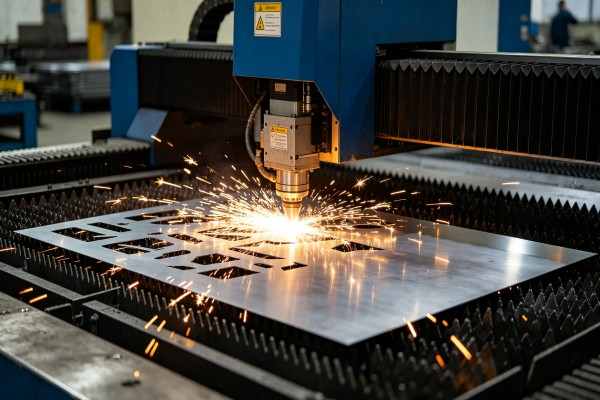
A custom 1060 order can specify temper (O, H12/H14/H16/H18 or H22/H24/H26), thickness and tolerance, sheet or blank dimensions, edge type (slit or sawn), dada pari, protective film, anodizing/coating color, embossing and packaging. Fabrication services often include laser, plasma or water-jet cutting, ṣigọgọ, punching, drilling and CNC blanks made to drawing.
Quality control covers thickness and flatness, width/length and diagonal tolerance, Didara dada (ko si scratches, awọn abawọn, oil or roll marks on critical faces), tensile properties by temper and alloy chemistry on the mill test certificate;
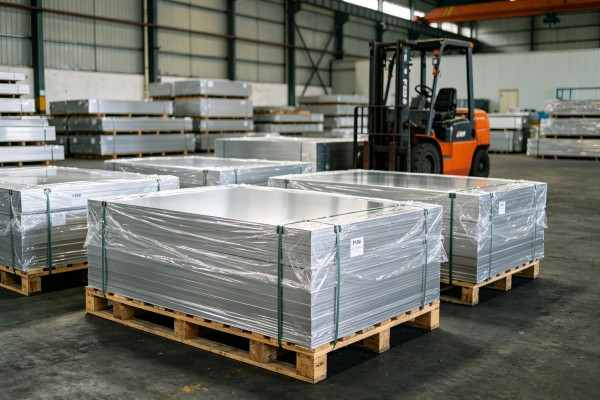
ISO 9001 mills support SGS/BV/TUV inspection. Sheets are normally interleaved with protective film, packed on wooden pallets or in wooden cases with moisture-proof wrapping for export.
Pricing follows the aluminum ingot base plus a processing fee, with thinner or wider gauge, custom cutting, surface treatment and small quantities adding cost; compare suppliers per ton and per finished blank on identical temper, iwon, size and finish, under FOB/CFR/CIF terms (commonly 30% deposit with balance against the bill of lading).
Awọn ibeere nigbagbogbo
Q: What is custom 1060 Apẹrẹ aluminiomu ti a lo fun?
A: Awọn ami ati awọn orukọ, building cladding and roofing, pipe/tank insulation jacketing, Awọn alahan, igbona ooru, conductive parts, cookware and stamped, spun or deep-drawn components that need formability and corrosion resistance rather than high strength.
Q: What temper should I choose?
A: Use O for deep drawing and spinning, H14/H24 for general sheet and signage, H16/H26 for stiffer panels and H18 for the flattest, most rigid sheet with little forming.
Q: What thicknesses and sizes are available?
A: Common sheet runs 0.2–6 mm in widths up to about 2600 mm, including 4×8 ft and metric standards, with plate and fully custom cut-to-size blanks on request.
Q: How much does a 4×8 sheet weigh?
A: Ni aijọju 8.1 kg at 1 mm, 12.1 kg at 1.5 mm, 16.1 kg at 2 mm ati 24.2 kg at 3 mm, using kg/m² = thickness (mm) × 2.71 lori 2.972 m².
Q: 1060 vs 3003 sheet – which do I need?
A: 1060 for economy, conductivity and corrosion resistance in light-duty work; 3003 when you need about 20% more strength for floors, te agbala, roofing or tougher formed parts.
Q: Can it be anodized, coated and cut to size?
A: Bẹẹni. 1060 anodizes well and can be brushed, mirror-polished, color-coated, embossed and supplied with protective film, plus laser-cut, bent or CNC-fabricated to your drawing.
Ipari
Aṣa 1060 aluminum sheet is the economical, easy-to-fabricate pure-aluminum workhorse for signage, isọdi, igboru sara, reflectors and formed parts.
Specify the temper from how the panel is processed (O for deep forming, H14/H24 for general and sign use, H18 for rigidity), fix thickness and cut size, choose the surface finish, and buy on mill certificates, dimensional tolerances and approved samples rather than price alone.