
Technical Advantages of Aluminum Foil Materials in Battery Cell Packaging
Driven by the rapid expansion of the new energy industry, demand for lithium batteries continues to escalate. Battery cell packaging plays a decisive role in determining battery lifespan, energy density, and safety performance. Owing to its distinctive physical, químico, and process compatibility characteristics, aluminum foil has become a core packaging material. Based on standards, data, and application cases, this article systematically explains the properties and process advantages of aluminum foil, providing reference value for industry practitioners and customers.

I. Industry Background and Material Requirements for Battery Cell Packaging
1.1 Core Functions of Cell Packaging and Industry Development Trends
The core functions of battery cell packaging include:
- Physical protection: resisting impact, puncture, and deformation to safeguard internal components
- Environmental barrier: preventing moisture and oxygen ingress to avoid performance degradation
- Sealing and insulation: isolating electrical circuits and preventing short circuits or electrolyte leakage
Lithium battery development is trending toward higher energy density, enhanced safety, longer cycle life, and lightweight design. Consumer electronics emphasize ultra-thin and irregular shapes, power batteries prioritize safety redundancy, and energy storage batteries focus on long-term stability and cost efficiency. Traditional materials struggle to meet these diversified requirements.
Aluminum foil and aluminum-plastic films, due to their lightweight nature, high barrier performance, and processing flexibility, have become the preferred materials for pouch and blade batteries, with continuously increasing market penetration.
1.2 Core Performance Requirements for Cell Packaging Materials
Key performance requirements for packaging materials include:
- High barrier performance:
- Water vapor transmission rate (WVTR) ≤ 0.01 g/m²·day
- Oxygen transmission rate (OTR) ≤ 0.005 cm³/m²·day
- Mechanical properties: high tensile strength, elongation, and puncture resistance
- Stable heat-sealing performance: heat seal strength ≥ 35 N/15 mm
- Electrolyte corrosion resistance
- Lightweight and cost efficiency
- Compliance with environmental regulations such as RoHS
1.3 Comparison of Mainstream Cell Packaging Materials
Current cell packaging materials include metal housings, aluminum-plastic films, and plastic films. A comparison is shown in Table 1.
| Material Type | Core Composition | Barrier Performance | Mechanical Performance | Lightweight Level | Processing Flexibility | Electrolyte Resistance | Cost | Typical Applications |
|---|---|---|---|---|---|---|---|---|
| Aluminum alloy housing | Aleación aluminio | Jach ma'alo'ob | Jach ma'alo'ob (impact, compression) | Medium (density 2.7 g leti' cm³) | Óotsil | Medium (requires coating) | Medium–High | Prismatic, cylindrical cells |
| Stainless steel housing | Stainless steel | Jach ma'alo'ob | Jach ma'alo'ob (Ka'anal resistencia) | Óotsil (density 7.9 g leti' cm³) | Óotsil | Jach ma'alo'ob | Ka'anal | High-end power and specialty batteries |
| Aluminum-plastic film | Ju'un aluminio + nylon + CPP | Jach ma'alo'ob (near metal) | Ma'alob (puncture resistance, elongation) | Jach ma'alo'ob (50% lighter than metal cases) | Jach ma'alo'ob | Jach ma'alo'ob | Medium (decreasing with localization) | Pouch and blade batteries |
| Plastic film | PET, CPP | Óotsil | Moderado | Jach ma'alo'ob | Jach ma'alo'ob | Moderado | Low | Low-end consumer cells |

Key conclusion:
Aluminum-plastic film, with aluminum foil as the core barrier layer, provides a balanced optimization of key performance indicators, making it highly suitable for pouch and blade batteries. Aluminum foil performance directly determines packaging quality and must be the primary focus in material selection.
II. Core Characteristics of Aluminum Foil for Battery Cell Packaging
Aluminum foil used for cell packaging primarily includes high-purity aluminum foil (1050, 1060 serie) and aluminum alloy foil (3003 serie). Through specialized rolling and surface treatment processes, these materials provide critical support for cell packaging performance.
2.1 Fundamental Properties of Aluminum Foil
2.1.1 Physical Properties
- Peso ligero: density 2.7 g leti' cm³ (one-third that of stainless steel), improving energy density
- High ductility: elongation 8–20%, rollable to ≤ 5 μm, suitable for deep drawing
- Good thermal conductivity: 237 W/(m·K), enhancing thermal stability
2.1.2 Chemical Properties
- Naturally forms a dense 2–5 nm Al₂O₃ oxide layer at room temperature, offering intrinsic oxidation and corrosion resistance
- Chromium-free zirconium or titanium passivation further enhances oxide stability and electrolyte resistance
2.1.3 Propiedades mecánicas
Mechanical performance can be precisely controlled through alloying and rolling processes.
| Grado aleación | Main Alloying Elements | Resistencia le tracción (Mpa) | Alargamiento (%) | Key Advantages | Typical Applications |
|---|---|---|---|---|---|
| 1050 | Al ≥ 99.5% | 70–130 | 5–20 | Excellent ductility, Resistencia le corrosión | Standard consumer cells |
| 1060 | Al ≥ 99.6% | 70–180 | 8–20 | Ka'anal pureza, excellent processability | High-end consumer and pouch cells |
| 3003 | Mn 1.0–1.5% | 110–230 | 12–20 | Ka'anal resistencia, stable forming | Power and energy storage batteries |
2.2 Special Process Requirements for Packaging Aluminum Foil
2.2.1 Ultra-Thin Rolling
Typical thickness ranges from 20–40 μm, while high-end products reach ≤ 5 μm. Thickness deviation is controlled within ±4% (high-end ≤ ±2%).
Example: Chalco’s 0.005 mm aluminum foil for aluminum-plastic film supports solid-state batteries with energy density > 500 Wh/kg.
2.2.2 Surface Treatment
Includes surface cleaning, chromium-free passivation, and nano-coatings (Al₂O₃, SiO₂), improving corrosion resistance and adhesive compatibility while increasing barrier performance by over 10×.
2.2.3 Pinhole Control
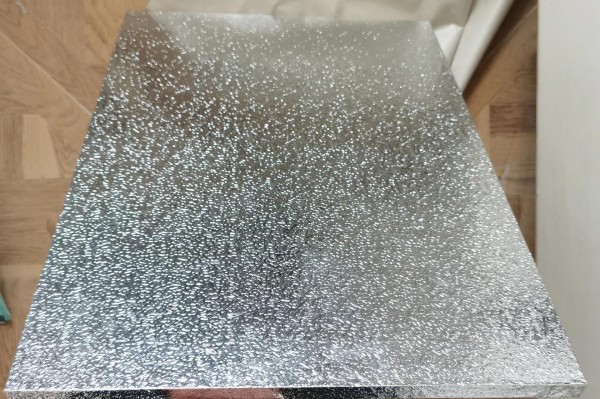
According to GB/T 3198-2020, premium aluminum foil requires pinhole density ≤ 400 pcs/m², while high-end products ≤ 100 pcs/m², achieved via precision rolling and online inspection systems.
III. Technical Advantages of Aluminum Foil in Cell Packaging Manufacturing Processes
3.1 Aluminum-Plastic Film Lamination
Aluminum foil exhibits strong compatibility across dry, termal, and dry-thermal lamination processes, achieving peel strength ≥ 15 N/15 mm in high-end applications.
3.2 Deep Drawing Forming
With elongation of 8–20%, aluminum foil supports 5–10 mm deep drawing without cracking. Its smooth surface (Ra ≤ 0.2 μm) reduces friction and improves forming efficiency.
3.3 Heat Sealing
High thermal conductivity ensures uniform CPP melting. Heat seal strength ≥ 35 N/15 mm (tak 50 N/15 mm), with stable performance at 155 ± 5°C.
3.4 Cutting and Edge Processing
Moderate hardness enables burr-free cutting with dimensional deviation ≤ ±0.1 mm, suitable for automated lines operating at 10–15 m/min.
IV. Core Performance Advantages and Application Validation
4.1 High Barrier Performance
≥ 20 μm aluminum foil achieves WVTR ≤ 0.01 g/m²·day and OTR ≤ 0.005 cm³/m²·day.
Case: 30 μm aluminum foil film maintained ≥ 90% capacity after 1000 h at 85°C/85% RH.
4.2 Mechanical Safety Margin
Tensile strength up to 230 Mpa, puncture resistance ≥ 300 N, and excellent performance in drop, compression, and needle penetration tests.
4.3 Lightweight Advantage
Compared with metal housings, aluminum-plastic packaging reduces weight by 50–70%, improving energy density by up to 10%.
4.4 Electrolyte Corrosion Resistance
Chromium-free passivated aluminum foil maintains > 90% peel strength after 7 days at 60°C electrolyte immersion.
4.5 Eficiencia Baajux
Domestic aluminum foil costs ~3–5 RMB/m², significantly lower than imported aluminum-plastic films, with recyclability ≥ 95%.
V. Quality Control and Industry Standards
5.1 Core Quality Control Indicators
| Indicator | Requirement | Standard | Test Method |
|---|---|---|---|
| Thickness deviation | ≤ ±4% (high-end ≤ ±2%) | GB/T 3198-2020 | Laser thickness gauge |
| Pinhole density | ≤ 400 pcs/m² (high-end ≤ 100 pcs/m²) | GB/T 3198-2020 | Dark-field imaging |
| Surface quality | Ra ≤ 0.2 μm | GB/T 3615-2022 | Roughness measurement |
| Mechanical properties | Tensile ≥ 70 Mpa, elongation ≥ 8% | GB/T 228.1-2021 | Tensile testing |
| Barrier properties | WVTR ≤ 0.01 g/m²·day | GB/T 1037-2021 | Permeability testing |
VI. Application Cases and Market Validation
6.1 Consumer Electronics
- Huawei Mate 60 Pro: 1060 ju'un aluminio, battery thickness 2.8 milímetro, energy density 280 Wh/kg
- Apple MacBook: 3003 Ju'un aleación aluminio, energy density ≥ 300 Wh/kg
6.2 Power Batteries
- BYD Blade Battery: 3003 Ju'un aleación aluminio, energy density 180 Wh/kg, enhanced safety
- CATL Qilin Battery: 8 μm composite aluminum foil, energy density 250 Wh/kg
6.3 Energy Storage Batteries
- Residential storage systems: 1060 ju'un aluminio, cycle life ≥ 6000 cycles, 15-year lifespan
VII. Q&Un (Frequently Asked Questions)
- How do foil requirements differ by cell type?
Pouch cells favor high-purity foil; blade cells require higher strength alloy foil. - How does foil thickness affect performance?
Thicker foil improves barrier properties but reduces energy density; composite solutions balance both. - Domestic vs imported foil differences?
Key gaps lie in ultra-thin precision, pinhole stability, and surface consistency. - Long-term electrolyte exposure risks?
Mitigated by chromium-free passivation and nano-coatings. - How to verify production line compatibility?
Validate lamination, heat sealing, and cutting performance via pilot trials. - New requirements from solid-state batteries?
Ultra-thin (≤ 5 μm), higher barrier, stronger interface compatibility, and vacuum process adaptability.