
Electronic Aluminum Foil: Production, Propiedades, Applications and Quality Identification
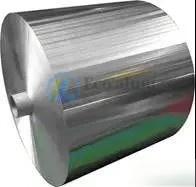
Electronic aluminum foil is a type of aluminum foil processed from high-purity aluminum ingots through a series of processes such as rolling, cleaning, and slitting. It is a key raw material for the production of aluminum electrolytic capacitors.
2. Overview
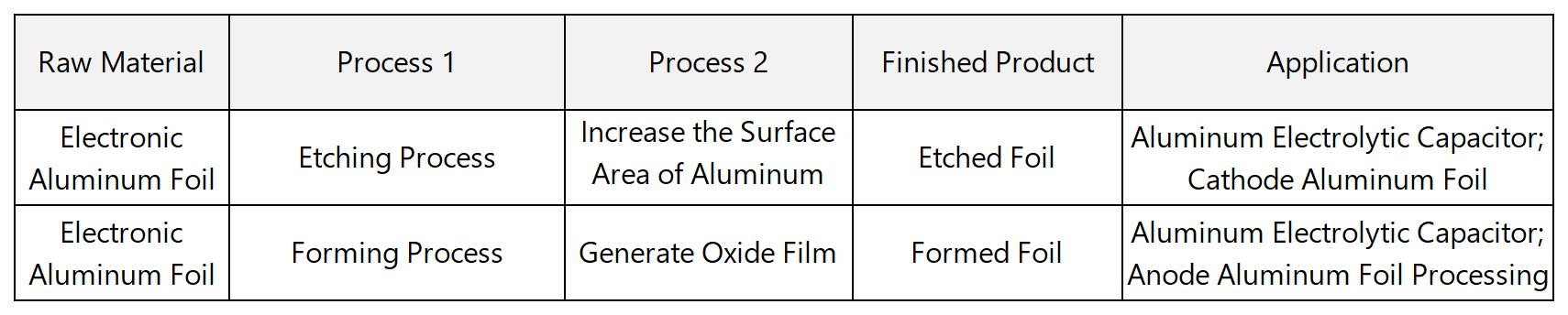
After aluminum materials are processed into foil, electronic aluminum foil undergoes surface etching treatment and re-oxidation treatment, followed by winding processing to manufacture capacitors. Aluminum foil before etching is called plain foil, after etching it is called etched foil, and after re-oxidation treatment it is called formed foil. Electronic aluminum foil specifically refers to plain foil, which is a critical raw material for aluminum electrolytic capacitor production. Based on the sequence of the manufacturing process, it is categorized into electronic aluminum foil and electrode foil—where electrode foil includes etched foil and formed foil.
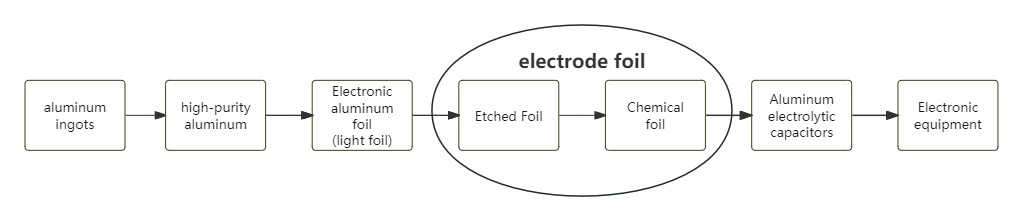
Together with electrolyte, electronic aluminum foil accounts for 30%-70% of the raw material costs of aluminum electrolytic capacitors (varying with the size of the capacitors). It can store electrical energy and also serve as the positive and negative electrodes of electrolytic capacitors.
3. List of Electronic Aluminum Foil Industry Chain

As one of the most fundamental electronic components, aluminum electrolytic capacitors are widely used in the electronic information industry, Electrodomésticos, and various other electronic products. They feature small size, large capacitance, and low cost—most notably, their price per unit capacitance is the lowest among all capacitor types, aligning with the low-cost development trend of information products. These capacitors are extensively applied in industries such as communications, Electrodomésticos, automobiles, electrónica, aeroespacial, and new materials, with enormous market demand. Currently, the output of aluminum electrolytic capacitors accounts for 45% of the total output of all capacitors.
4. Manufacturing Process of Electronic Aluminum Foil
Electronic aluminum foil is a type of high-purity aluminum foil. It is produced by hot-rolling refined aluminum (high-purity aluminum) ingots into aluminum sheets, followed by further cold rolling and annealing. The specific production processes of electronic aluminum foil include:Casting – Soaking – Hot Rolling – Pre-Annealing – Cold Rolling – Intermediate Annealing – Cold Rolling – Foil Rolling – Slitting – Performance Testing – Packaging
5. Classification of Electronic Aluminum Foil
Electronic aluminum foil can be divided into three main categories: high-voltage anode foil, low-voltage anode foil, and cathode foil.
- High-voltage anode foil undergoescylindrical pore corrosion;
- Low-voltage anode foil undergoesspongy corrosion;
- Medium-voltage anode foil undergoesworm-eaten corrosion.
High-voltage anode foil is further split into two types: high-quality high-voltage foil and ordinary high-voltage foil.
- High-quality high-voltage anode foilis characterized by “two highs and one thin”: high purity, high cubic texture, and a thin surface oxide film. This type of product offers superior quality but comes with higher costs—it requires aluminum purity > 99.99%, cubic texture of 96%, and vacuum heat treatment conducted under conditions of 10⁻³ Pa ~ 10⁻⁵ Pa.
- Ordinary high-voltage anode foilis an economical and practical alternative, with aluminum purity > 99.98%, cubic texture > 92%, and vacuum heat treatment performed under conditions of 10⁻¹ Pa ~ 10⁻² Pa.
Cathode foil is available in two states: soft state and hard state.
- Japan primarily uses electrochemical etching for soft-state cathode foil;
- Western Europe mainly adopts chemical etching for hard-state cathode foil.
Each state has its own pros and cons:
- Soft-state cathode foil uses high-purity aluminum foil (> 99.85%) with no copper content, ensuring excellent quality but higher costs;
- Hard-state cathode foil uses low-purity copper-containing aluminum foil, resulting in lower costs.
6. Applications of Electronic Aluminum Foil
Electronic aluminum foil is most widely used in capacitors. Capacitors are classified into three major types based on material: aluminum electrolytic capacitors, ceramic capacitors, and film capacitors. Among these, aluminum electrolytic capacitors are the most widely used type of electronic capacitor.
The rapid development of China’s capacitor manufacturing industry has driven a steady increase in domestic demand for electronic aluminum foil. Chéen ba'ale', due to the high technical difficulty in producing electronic aluminum foil for capacitor anodes, domestic supply capacity for mid-to-high-end products remains insufficient. Nevertheless, this situation has improved significantly as the supply volume of domestic aluminum foil products continues to grow.
Ti' 2016:
- China’s electronic aluminum foil production capacity reached approximately 85,000 tons, an increase of 7,000 tons compared to 78,000 tons in 2015;
- The industry’s output was about 51,900 tons, a year-on-year growth of 2.77% from 50,500 tons in 2015;
- Market consumption stood at roughly 47,900 tons, up 3.01% year-on-year from 46,500 tons in 2015;
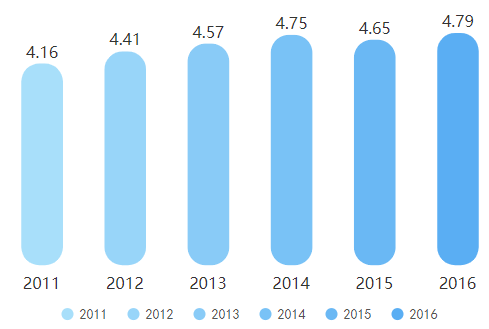
- The industry’s market size reached around 1.207 billion yuan, a year-on-year increase of 5.97% from 1.139 billion yuan in 2015.

ImageStatistics on the Market Size of China’s Electronic Aluminum Foil Industry (2011-2016)
ImageStatistics on the Demand Volume of China’s Electronic Aluminum Foil Industry (2011-2016)

ImagePrice Trend Chart of China’s Electronic Aluminum Foil (Plain Foil) (2011-2016)
7. Technical Analysis of Electronic Aluminum Foil
The production of electronic aluminum foil is a precision processing process, and product quality is closely linked to raw materials, control systems, and the advancement of production equipment.
Globally, while China’s electronic aluminum foil production is developing rapidly, European and American enterprises still hold advantages in advanced technologies—particularly in high-voltage electronic aluminum foil. Due to the strict requirements for process technology, equipment technology, and production management in electronic aluminum foil manufacturing, production must strictly follow process flows and equipment characteristics to ensure qualified products.
Ichil, with advancements in science and technology, the main equipment used for electronic aluminum foil production has been localized in China. Currently, the quality of products made by domestic electronic aluminum foil factories using domestic equipment has caught up with and even surpassed that of products from Japan and South Korea. Chéen ba'ale', in terms of control systems, the technology of major domestic manufacturers remains immature, so most still rely on foreign control systems. Technically, domestic production lines and processes either imitate and adopt foreign technologies or use technical models involving cooperation with foreign capital.
To continuously improve the performance of aluminum electrolytic capacitors, China has made significant technical advancements in aluminum foil processing:
- The adoption of high-purity, high-performance aluminum foil materials has greatly enhanced etching performance and reduced the leakage current of dielectric oxide films;
- The development of advanced etching and formation processes has increased the specific capacitance of cathode and anode foils while further lowering the leakage current of anode plain foil;
- To achieve capacitor miniaturization and flattening, progress has been made in processing technologies for high specific capacitance and high strength of formed aluminum foil.
Extended Reading: How to Distinguish the Quality of Aluminum Foil?
1. Scratches
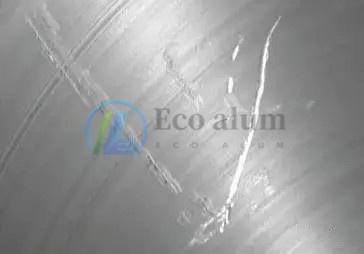
ImageAluminum foil scratches refer to damage on the foil’s surface or end face caused by collision with other objects during handling or storage. Most scratches occur due to carelessness during packaging.
2. Corrosion

ImageCorrosion refers to defects formed on aluminum foil surfaces after chemical or electrochemical reactions with surrounding media. Corroded foil loses luster, and in severe cases, gray corrosion products form—greatly affecting the aesthetic appearance of end products.
3. Surface Bubbles

ImageAluminum foil with surface bubble defects has irregular circular or strip-shaped cavity protrusions on its surface. These protrusions have smooth edges, are asymmetrical on both sides, and are randomly distributed. Surface bubbles cause uneven stress on the foil strip, potentially leading to breakage and production shutdowns.
4. Dark Side Stripes

ImageDark side stripes mostly appear on double-rolled aluminum foil. Leti'e' “dark side” shows obvious alternating light and dark strip-shaped patterns along the rolling direction, which impairs the foil’s appearance.
5. Impressions
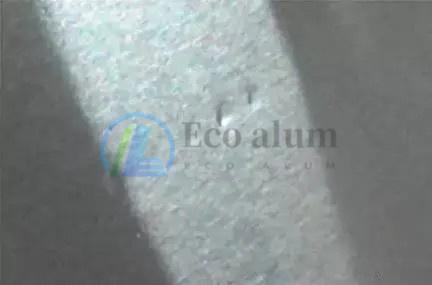
ImageImpressions on aluminum foil can result from multiple factors: defects or adhered metal chips/dirt on rolling/guide rolls; unclean sleeves/cores or local smooth protrusions; or foreign objects stuck to the foil during winding. Foil with impressions typically has single or periodic depressions/protrusions, which are easy to identify.
6. Oil Stains

ImageCommon oil stains on aluminum foil form after annealing, usually appearing as light yellow, brown, or tawny spots.
7. Incomplete Degreasing

ImageTo test for complete degreasing, a water brushing test is used to check the degreasing level after annealing. If the foil fails to meet the specified level of the water brushing test, it may still contain oil.
8. Edge Cracks

ImageEdge cracks refer to longitudinal cracking on the foil’s edges. In severe cases, obvious gaps are visible on the edges.
9. Poor Flatness

ImagePoor flatness describes local undulations on the foil surface caused by uneven deformation. Based on the defect location, it is classified as:
- Center waves (undulations in the middle);
- Edge waves (undulations at the edges);
- Two-rib waves (undulations neither in the center nor at the edges);
- Compound waves (a combination of center and edge waves).
10. Adhesion

ImageFoil rolls with adhesion issues are difficult to unroll into single sheets; multiple sheets may form a caked mass, and the free hanging length fails to meet standards. In severe cases, single sheets cannot be unrolled at all—seriously disrupting production.
11. Holes

ImageHoles are a common defect on aluminum foil surfaces.
12. Loose Winding

ImageLoose winding occurs when foil is not tightly wound during slitting. When held vertically along the core, interlayer displacement happens; pressing the foil with fingers creates local depressions.
13. Burrs

ImageBurrs are spine-like protrusions of varying sizes on the foil’s edges after cutting.
14. Layer Misalignment

ImageLayer misalignment refers to irregular interlayer displacement on the end face of the foil roll, resulting in an uneven end face.
15. Tapered Edge

ImageTapered edge (o “tower-shaped edge”) is a special case of layer misalignment, where interlayer displacement on the foil roll’s end face creates a tower-like deviation—with the side resembling a tower tip.