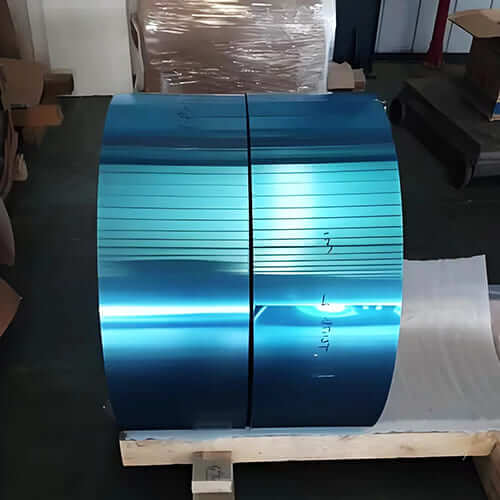
Epoxy Coated Aluminum Foil

| Aleación | 1050 / 1100 / 1235 / 3003 / 8011 |
| Atemperar | O / H14 / H18 |
| Foil Thickness | 6–25 μm |
| Coating Thickness | 2–10 μm |
| Coating Side | One Side / Two Sides |
| Main Applications | Embalaje / Electrical / Aislamiento / Industrial |
1. Executive Summary
Epoxy coated aluminum foil is a functional aluminum foil product that combines the barrier, lightweight, termal, and conductive properties of aluminum with the protective characteristics of an epoxy resin coating. The coating can be applied to one or both sides of the foil, depending on the intended application.
The epoxy layer forms a continuous polymer film on the aluminum surface. Proper substrate preparation and correct coating curing can improve surface protection, adhesion, Resistencia le corrosión, chemical resistance, and compatibility with printing, lamination, or bonding processes.
The actual performance depends strongly on the resin formulation, pretreatment, coating thickness, and curing conditions. Studies on epoxy-coated aluminum have also shown that surface pretreatment can significantly affect coating adhesion and corrosion protection.
The aluminum substrate can be selected from different alloys according to the required mechanical and processing characteristics. Common options include 1050, 1100, 1235, 3003, y 8011.
Je'ebix., 1050 y 1100 are suitable when ductility and conductivity are important, ka' jo'op 3003 provides higher strength with good formability and 8011 offers a useful balance of strength and foil-processing performance.
2. What Is Epoxy Coated Aluminum Foil?
2.1 Definition
Epoxy coated aluminum foil is aluminum foil with a controlled layer of epoxy-based resin coating applied to one or both sides of the substrate.
The aluminum provides the fundamental physical properties of the product, while the epoxy coating gives the surface additional functionality.
In simple terms:
Aluminum Foil = Barrier + Peso ligero + Strength + Thermal/Electrical Properties
Epoxy Coating = Surface Protection + Adhesion + Resistencia química + Functional Surface
Unlike bare aluminum foil, epoxy coated foil offers an engineered surface that manufacturers can customize for specific requirements such as corrosion protection, aislamiento, imprenta, lamination, or bonding.
2.2 Basic Structure
The simplest structure consists of two functional layers:
Epoxy Coating → Ju'un aluminio
For double-sided applications:
Epoxy Coating → Aluminum Foil → Epoxy Coating
The aluminum substrate acts as the structural and barrier layer, while the epoxy coating protects the surface and modifies its interaction with the surrounding environment.
In some applications, additional layers such as primer, adhesive, ink, or laminate may be incorporated. Tune', the final construction depends on the intended end use.

2.3 Function of the Epoxy Coating
The epoxy coating provides a protective and functional surface.
Depending on its formulation, it can improve:
Corrosion Protection
The coating helps isolate the aluminum substrate from moisture and aggressive external environments.
Chéen ba'ale', corrosion performance depends on coating continuity, adhesion, substrate preparation, and the exposure conditions.
Resistencia química
A properly formulated and cured epoxy coating can provide resistance to selected chemicals, oils, humedad, and other media.
The exact resistance should always be verified against the actual chemical and temperature conditions.
Surface Adhesion
Good adhesion between the epoxy film and aluminum substrate is essential.
Surface pretreatment can significantly improve the adhesion and long-term corrosion performance of epoxy-coated aluminum.
Electrical Insulation
The epoxy layer can electrically isolate the coated aluminum surface while retaining the thermal and shielding characteristics of the aluminum substrate.
This makes coated foil useful in selected electrical and electronic applications.
Printing and Lamination
Depending on the coating formulation and surface finish, epoxy coated foil can provide a suitable surface for subsequent printing, bonding, or lamination.
2.4 Single-Sided vs. Double-Sided Coating
Single-Sided Epoxy Coating
Epoxy / Aluminio
Single-sided coating is suitable when only one surface requires protection, aislamiento, or enhanced adhesion.
Double-Sided Epoxy Coating
Epoxy / Aluminio / Epoxy
Double-sided coating protects both surfaces and suits applications that require more comprehensive environmental or electrical protection.
The coating side should therefore be specified according to the final product design.
3. Aluminum Alloys and Epoxy Coating Types
The performance of epoxy coated aluminum foil depends on two interconnected material choices:
Aluminum Substrate + Epoxy Coating System
The substrate determines much of the foil’s mechanical and processing behavior, while the coating determines the surface properties and environmental resistance.
3.1 Common Aluminum Alloys
Different alloys are selected according to the required strength, ductility, conductividad, and forming performance.
| Aleación | Typical Characteristics | Potential Applications |
|---|---|---|
| 1050 | High aluminum purity, excellent ductility and conductivity | Electrical insulation, thermal applications |
| 1100 | Good formability, Resistencia le corrosión, and conductivity | Industrial foil, aislamiento, heat-transfer applications |
| 1235 | Excellent flexibility and foil-processing performance | Thin foil, cable foil, laminated structures |
| 3003 | Higher strength with good formability | Industrial, HVAC, and technical applications |
| 8011 | Good balance of strength, flexibility, and foil processability | Packaging and industrial applications |
These alloys serve as commercial substrates for coated aluminum products, although manufacturers should always select the appropriate alloy and temper based on the specific application.
3.2 Epoxy Coating Types
Epoxy coatings are not a single universal formulation. Different resin systems and curing technologies can provide different combinations of adhesion, flexibility, chemical resistance, heat resistance, and surface characteristics.
Common options include:
Clear Epoxy Coating
Provides surface protection while maintaining the metallic appearance of the aluminum substrate.
Colored Epoxy Coating
Uses pigments to provide a specific appearance or functional identification. Colors can be customized according to the application.
Food-Contact Epoxy Coating
Designed for applications where the coated surface may come into contact with food.
Such products require evaluation of the complete coating formulation and applicable food-contact regulations rather than relying only on the term “food grade.”
Heat-Resistant Epoxy Coating
Designed for applications exposed to elevated temperatures. The actual service temperature must be confirmed from the coating formulation and test data.
Chemical-Resistant Epoxy Coating
Designed for environments where the foil may encounter oils, humedad, solvents, acids, alkalis, or other chemicals.
Resistance should be verified against the specific exposure conditions.
Insulating Epoxy Coating
Used when electrical isolation of the aluminum surface is required, including selected electrical and electronic applications.

4. Key Properties of Epoxy Coated Aluminum Foil
Epoxy coated aluminum foil combines the inherent properties of aluminum with the functional performance of an epoxy resin coating.
Its final performance depends on the aleación aluminio, temper, foil thickness, coating formulation, coating thickness, surface preparation, and curing conditions.
4.1 Excellent Corrosion Resistance
The epoxy coating forms a protective layer that reduces direct contact between the aluminum substrate and moisture, salts, and other corrosive media.
Good coating adhesion and uniform coverage are essential for long-term protection.
4.2 Strong Coating Adhesion
A properly prepared aluminum surface allows the epoxy coating to bond firmly with the substrate.
Strong adhesion helps prevent peeling, flaking, and premature coating failure during bending, forming, lamination, or service.
4.3 Good Chemical Resistance
Depending on the resin formulation, cured epoxy coatings can resist various oils, humedad, solvents, acids, and alkaline substances.
Chéen ba'ale', chemical resistance is formulation-specific and should be verified against the actual service environment.
4.4 Excellent Surface Protection
The epoxy layer protects the aluminum surface from direct mechanical and environmental exposure. It can improve resistance to:
- Abrasion
- Surface contamination
- Moisture
- Selected chemicals
- Handling damage
4.5 Good Flexibility
Thin epoxy coatings can maintain useful flexibility when properly formulated and cured.
This allows coated foil to undergo bending, slitting, forming, and other converting operations without excessive cracking or delamination.
The coating thickness and resin formulation should be matched to the required forming degree.
4.6 Heat Resistance
Epoxy coatings can provide good thermal stability, but the actual operating temperature depends on the resin, curing system, and coating thickness.
For high-temperature applications, manufacturers should provide specific technical data rather than relying on a general temperature rating.
4.7 Electrical Insulation
Aluminum is electrically conductive, while a properly cured epoxy coating is electrically insulating.
This combination allows epoxy coated aluminum foil to provide metallic shielding or thermal conductivity together with surface insulation in selected electrical and electronic applications.
4.8 Good Barrier Performance
The aluminum substrate provides the primary barrier against sáasil, humedad, gases, and external contamination.
The epoxy layer adds surface protection and can provide an additional barrier against selected environmental factors.
Tune', the barrier performance of the finished material comes from the combined structure rather than the epoxy coating alone.
4.9 Printing and Lamination Compatibility
Depending on the coating formulation and surface finish, epoxy coated aluminum foil can be designed for subsequent imprenta, adhesive bonding, or lamination.
Surface energy, coating adhesion, and curing conditions should be controlled to ensure compatibility with downstream materials.

5. Typical Specifications of Epoxy Coated Aluminum Foil
Epoxy coated aluminum foil does not have one universal specification because requirements vary significantly between packaging, eléctrico, aislamiento, HVAC, and industrial applications.
The following values represent typical commercial ranges and should be confirmed according to the final application.
| Parámetro | Typical Specification |
|---|---|
| Aleación aluminio | 1050 / 1100 / 1235 / 3003 / 8011 |
| Atemperar | O / H14 / H16 / H18 / H22 / H24 |
| Foil Thickness | 6–25 μm |
| Epoxy Coating | One side / Two sides |
| Coating Thickness | Approx. 2–10 μm |
| Superficie | Bright / Matte |
| Boonil | Clear / White / Custom |
| Kóoch | Customized |
| Roll Form | Coil / Roll |
| Core ID | 76 / 152 mm or Customized |
| Application | Embalaje / Electrical / Aislamiento / Industrial |
- Coating thickness varies according to resin formulation and application. Some products may require coating thickness outside this range.
6. Manufacturing Process of Epoxy Coated Aluminum Foil
The production of epoxy coated aluminum foil combines precision aluminum foil manufacturing with controlled surface preparation and epoxy coating.
The main steps are as follows:
6.1 Aluminum Foil Production
The selected aluminum alloy is melted, cast, hot rolled, and cold rolled to achieve the required foil thickness and surface quality.
Annealing may be applied to obtain the specified temper.
Melting & Casting → Hot Rolling → Cold Rolling → Annealing → Final Rolling
6.2 Surface Cleaning and Pretreatment
Before coating, the foil is cleaned to remove rolling oil, dust, and other contaminants.
Surface pretreatment may then be applied to improve epoxy adhesion and corrosion protection.
6.3 Epoxy Coating
The epoxy resin is applied to one or both sides of the foil using a controlled coating process.
Coating thickness, resin viscosity, coating speed, and surface uniformity are carefully controlled to achieve consistent coverage.
6.4 Drying and Curing
The coated foil passes through a controlled heating process to dry and cure the epoxy layer.
Proper curing develops the required adhesion, chemical resistance, hardness, and thermal stability.
6.5 Slitting and Rewinding
After curing, the coated foil is slit to the required width and rewound into rolls.
Accurate slitting and stable winding help ensure smooth downstream processing.
6.6 Final Quality Inspection
The finished foil is inspected for foil thickness, coating thickness, surface appearance, coating adhesion, Propiedades mecánicas, and roll quality.
Additional tests, such as chemical or heat resistance, can be performed according to the intended application.

7. Epoxy Coating Thickness and Performance
Leti'e' epoxy coating thickness directly affects the protection, flexibility, adhesion, and processing performance of epoxy coated aluminum foil.
There is no universal thickness for every application, so the coating should be selected according to the service environment and converting process.
7.1 Typical Coating Thickness
For many commercial applications, epoxy coating thickness is approximately 2–10 μm.
The actual specification may be lower or higher depending on the resin system and intended use.
| Coating Thickness | Typical Characteristics | Suitable Considerations |
|---|---|---|
| 2–4 μm | Peso ligero, flexible, low material consumption | Flexible foil and light surface protection |
| 4–7 μm | Balanced protection and flexibility | General industrial applications |
| 7–10 μm | Greater surface protection and coverage | More demanding environments |
These values are typical reference ranges rather than universal standards. The optimum coating thickness should be confirmed through application-specific testing.
7.3 Coating Thickness vs. Flexibilidad
For thin aluminum foil, the coating must withstand bending, slitting, forming, and lamination without cracking or delamination.
A properly formulated thin epoxy layer can provide surface protection while maintaining the flexibility of the aluminum substrate.
7.4 Coating Thickness vs. Corrosion Protection
A continuous epoxy film can reduce direct exposure of the aluminum substrate to moisture and corrosive media.
Chéen ba'ale', corrosion protection depends on the complete coating system, including surface pretreatment, adhesion, coating continuity, and curing—not simply coating thickness.
8. Epoxy Coated Aluminum Foil vs. Other Coated Foils
Different coating systems provide different combinations of corrosion resistance, flexibility, chemical resistance, heat resistance, adhesion, and processing performance.
Tune', coating selection should be based on the final application rather than coating type alone.
| Propiedad | Epoxy Coated Aluminum Foil | PE Coated Aluminum Foil | PVDF Coated Aluminum | Acrylic Coated Aluminum Foil | Bare Aluminum Foil |
|---|---|---|---|---|---|
| Corrosion Protection | Excellent* | Ma'alob | Jach ma'alo'ob | Ma'alob | Moderado |
| Resistencia química | Excellent* | Ma'alob | Jach ma'alo'ob | Ma'alob | Moderado |
| Coating Adhesion | Excellent* | Ma'alob | Ma'alob | Good–Excellent | — |
| Flexibilidad | Good* | Jach ma'alo'ob | Ma'alob | Good–Excellent | Jach ma'alo'ob |
| Surface Durability | Excellent* | Ma'alob | Jach ma'alo'ob | Ma'alob | Limited |
| Heat Resistance | Good–Excellent* | Moderado | Jach ma'alo'ob | Moderate–Good | Jach ma'alo'ob |
| Electrical Insulation | Jach ma'alo'ob | Jach ma'alo'ob | Jach ma'alo'ob | Ma'alob | None |
| Printing Compatibility | Good–Excellent* | Ma'alob | Ma'alob | Jach ma'alo'ob | Requires surface treatment |
| Typical Uses | Industrial, embalaje, aislamiento, eléctrico | Embalaje, lamination | Architectural and industrial | Printing and packaging | General foil applications |
- Performance varies according to the resin formulation, coating thickness, pretreatment, and curing conditions.

9. Epoxy Coated Aluminum Foil for Pharmaceutical and Food Packaging
Epoxy coated aluminum foil can be used in selected pharmaceutical and food packaging applications where aluminum’s barrier properties need to be combined with a protective and functional coated surface.
Chéen ba'ale', coating selection for regulated packaging requires more than general corrosion or adhesion performance.
The complete material system must meet the requirements of the intended product and market.
9.1 Pharmaceutical Packaging
Aluminum foil provides an effective barrier against sáasil, humedad, oxígeno, and external contamination, while the epoxy coating can protect the aluminum surface and improve compatibility with printing, bonding, or other packaging layers.
Potential applications include:
- Pharmaceutical closures
- Lidding and sealing components
- Laminated packaging structures
- Selected tablet and capsule packaging systems
For pharmaceutical use, important considerations include coating integrity, chemical compatibility, extractables and leachables where applicable, adhesion, cleanliness, and batch traceability.
The epoxy formulation should be selected specifically for the intended pharmaceutical packaging structure rather than assuming that all epoxy coatings are suitable for direct or indirect pharmaceutical contact.
9.2 Food Packaging
Epoxy coated aluminum foil can also be used for selected food-packaging applications, particularly where the coating provides:
- Surface protection
- Resistencia le corrosión
- Improved adhesion
- Sealing or bonding compatibility
- A suitable surface for printing
Potential applications include:
- Food container lids
- Bottle and jar closures
- Sealing materials
- Laminated packaging
For food-contact applications, “epoxy coated” does not automatically mean “food safe.”
Manufacturers must evaluate the coating formulation, curing system, substrate, intended food type, temperature, contact time, and market-specific regulations for the intended application.
9.3 Coating Selection for Regulated Packaging
A suitable coating system should be evaluated according to the complete packaging structure.
| Requirement | Key Consideration |
|---|---|
| Food Contact | Applicable food-contact regulations and migration requirements |
| Pharmaceutical Packaging | Product compatibility and applicable regulatory requirements |
| Adhesion | Bond strength between epoxy and aluminum |
| Resistencia química | Resistance to the actual product and processing environment |
| Heat Resistance | Sealing, sterilization, and storage temperatures |
| Flexibilidad | Bending, forming, and converting requirements |
| Surface Quality | Uniformity, cleanliness, and defect control |
| Traceability | Batch identification and quality documentation |
10. Conclusión
Epoxy coated aluminum foil combines the barrier, lightweight, termal, and conductive characteristics of aluminum with the protective and functional properties of an epoxy coating.
Its key advantages include good corrosion protection, strong adhesion, chemical resistance, surface durability, electrical insulation, and compatibility with selected printing and lamination processes.
Chéen ba'ale', there is no single specification suitable for every application. The performance of the finished material depends on the aleación aluminio, temper, foil thickness, surface pretreatment, epoxy formulation, coating thickness, and curing conditions.
For pharmaceutical and food packaging, coating selection requires particular attention. The term “epoxy” alone does not confirm a coating’s suitability for food or pharmaceutical contact.
The intended market and application determine the requirements for regulatory compliance, migration characteristics, chemical compatibility, and the complete packaging structure.
For industrial, eléctrico, HVAC, aislamiento, and packaging applications, the most effective approach is to select the coating system according to the actual service environment and downstream processing requirements.
FAQs
1. What is epoxy coated aluminum foil?
Epoxy coated aluminum foil is aluminum foil with an epoxy-based resin coating applied to one or both sides. The coating provides additional surface protection, adhesion, chemical resistance, or electrical insulation.
2. What aluminum alloys can be used for epoxy coated foil?
Common substrate options include 1050, 1100, 1235, 3003, y 8011, depending on the required strength, ductility, conductividad, and forming performance.
3. What is the typical epoxy coating thickness?
A common commercial range is approximately 2–10 μm, but the appropriate coating thickness depends on the application, resin system, and required performance.
4. Can epoxy coated aluminum foil be used for food packaging?
Je'el, selected epoxy coated aluminum foils can be used for food-packaging applications. Chéen ba'ale', the specific coating formulation and complete packaging structure must comply with the applicable food-contact requirements.
5. Is all epoxy coated aluminum foil food grade?
No. An epoxy coating is not automatically food-contact compliant. Food-contact suitability depends on the specific formulation, manufacturing process, intended conditions of use, and applicable regulations.
6. Can epoxy coated aluminum foil be used for pharmaceutical packaging?
Je'el, selected grades can be used in pharmaceutical packaging and components. The coating and aluminum substrate must be compatible with the intended packaging structure and applicable regulatory requirements.
7. Is epoxy coated aluminum foil electrically insulating?
The aluminum substrate itself remains electrically conductive, but the epoxy coating can provide electrical insulation at the coated surface. The actual dielectric performance depends on the coating formulation and thickness.
8. Can epoxy coated aluminum foil be laminated?
Je'el. Depending on the coating formulation and surface properties, epoxy coated foil can be incorporated into laminated structures. Compatibility between the epoxy surface, adhesive, and laminate should be verified before production.