
How can the puncture resistance of disposable 3003 aluminum foil food containers be guaranteed by optimizing the annealing process?
ECO-A. Introduction: Lightweight Demand of Disposable 3003 Aluminum Foil Lunch Boxes
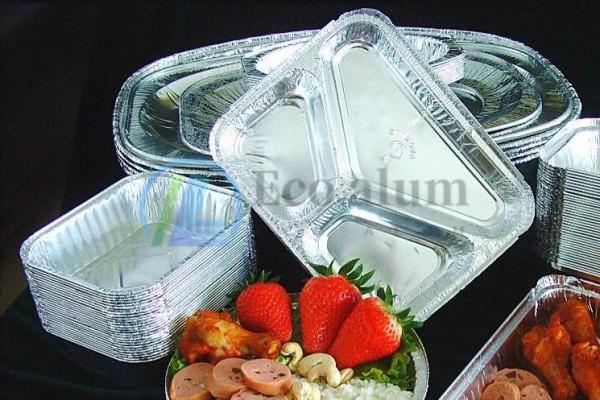
Disposable 3003 aluminum foil lunch boxes are mainstream for takeaway and prepared meals, thanks to their recyclability, high-temperature resistance (>200°C), and good formability (2024 market size >8 billion RMB).
Notably, lightweight thinning has emerged as a key strategy for cost reduction and sustainability. Thinning their aluminum foil from the traditional 0.08-0.10mm to below 0.07mm cuts material use by 12%-15%, lowers per-unit cost by 8%-10%, and reduces overall aluminum consumption—aligning with industry environmental goals.

ECO-B. Puncture Resistance Challenge After Thinning
Thinning to below 0.07mm sharply reduces the puncture resistance of disposable 3003 aluminum foil lunch boxes, creating a critical performance gap.
Specifically, when holding bone-in ingredients (e.g., spare ribs) or shell-on foods (e.g., shrimp), the sharp edges of these items easily pierce the thin foil. Industry data shows this increases the leakage rate from a negligible 0.5% (for 0.08mm foil) to 5%-8%—a level that fails to meet consumer and brand expectations.
ECO-C. Core Factor: Microstructure-Mechanical Property Link
Fundamentally, puncture resistance depends on two key capabilities of aluminum foil: “local deformation resistance” and “energy absorption capacity.” Both are directly determined by the foil’s microstructure (grain size, Al₆Mn second-phase distribution) and resulting mechanical properties (strength, elongation, hardness).
Consequently, the annealing process— which regulates microstructure by controlling recrystallization and second-phase precipitation—becomes critical to balancing lightweighting and puncture resistance for these lunch boxes. Without precise annealing, even thin 3003 foil cannot meet service requirements.
ECO-D. Microstructure’s Role in Puncture Resistance
For disposable 3003 aluminum foil lunch boxes, the microstructure of 3003 aluminum foil (an Al-Mn alloy with 1.0%-1.5% Mn) directly dictates puncture resistance—with two key aspects dominating this relationship:
(A) Grain Size Effect
First, grain size has a profound impact on both strength and toughness:
- Overly fine grains (<3μm): The foil exhibits high hardness (HV>60) but low elongation (<8%). During puncture, this leads to brittle fracture, significantly raising leakage risk.
- Overly coarse grains (>10μm): Strength drops below 130MPa, causing excessive plastic deformation that results in “penetrating damage” to the box.
- Optimal range: 5-8μm. This balance delivers 140-150MPa tensile strength and 10%-12% elongation—exactly what’s needed for reliable lunch box performance.
(B) Al₆Mn Second-Phase Effect
Second, the morphology and distribution of Al₆Mn (the primary second-phase in 3003 foil) — controlled by annealing — further influences puncture resistance:
- Cold-rolled state: Al₆Mn exists as a supersaturated solid solution, causing severe work hardening. Elongation falls below 6%, leading to poor puncture resistance.
- Inadequate annealing (<280°C): Al₆Mn precipitates as fine spheres (<0.5μm), but insufficient precipitation limits strength improvement.
- Excessive annealing (>350°C): Al₆Mn coarsens into flakes (>2μm), acting as stress concentration sources. This cuts puncture force by 20%-30%.

ECO-E. Mechanical Property Thresholds
To ensure reliable puncture resistance for 3003 aluminum foil thinner than 0.07mm, specific mechanical property thresholds must be met—each contributing uniquely to the lunch box’s ability to resist piercing:
| Mechanical Indicator | Threshold Range | Contribution to Lunch Box Puncture Resistance |
| Tensile Strength (MPa) | 140-150 | Resists local stretching, preventing box deformation |
| Yield Strength (MPa) | 110-120 | Improves initial puncture resistance |
| Elongation (%, L0=50mm) | 10%-12 | Absorbs puncture energy (>3J), reducing leakage |
| Vickers Hardness (HV) | 50-55 | Balances hardness and toughness, avoiding brittle fracture |
Notably, exceeding these thresholds undermines performance. For example, tests show that when elongation drops from 10% to 7%, the lunch box leakage rate rises from 1.2% to 4.5%—a fourfold increase.
ECO-F. Core Challenges of Thinning to Below 0.07mm
Thinning 3003 aluminum foil to below 0.07mm introduces three critical challenges for the annealing process, all rooted in the “thickness effect” of thin foils—these challenges directly hinder mass production and performance consistency:
(A) Annealing Uniformity Issue
First, thin foil (<0.07mm) suffers from uneven temperature gradients in traditional roller hearth furnaces:
- Contact areas with rollers are up to 5°C hotter than non-contact areas, causing a 4-6μm difference in grain size (vs. a normal tolerance of ≤2μm). This leads to ±15% fluctuations in puncture resistance.
- Thin foil also has 12.5% lower heat capacity than 0.08mm foil, increasing the risk of over-burning—which coarsens Al₆Mn and degrades performance.
(B) Performance Balance Dilemma
Second, achieving a balance between strength and elongation becomes a dilemma:
- Extending annealing time beyond 10h to boost strength coarsens grains to >10μm, reducing elongation below 8% and limiting energy absorption.
- Lowering annealing temperature below 280°C to preserve elongation cuts strength to <130MPa, making the foil prone to penetration.
(C) Forming-Annealing Conflict
Third, the stamping process (required for lunch box forming, with 5-8mm deep drawing) conflicts with annealing outcomes:
- Inadequate annealing leaves residual work hardening, causing the foil to crack during stamping—dropping forming qualification rates below 85%.
- Excessive annealing leads to coarse grains, which cause “necking” during forming. This results in uneven wall thickness (>0.01mm) and weaker puncture resistance at thin points.
ECO-G. Optimized Three-Stage Annealing Process
To address these challenges and meet the puncture resistance requirements of thin 3003 aluminum foil, an optimized three-stage annealing process was developed—targeting the ideal microstructure of “5-8μm grains + 0.5-1μm spherical Al₆Mn” through precise control:
(A) Stage 1: Preheating (250-280°C, 1-2h)
Stage 1 focuses on controlled heating to avoid premature phase changes:
- Purpose: Slow heating to 3003 foil’s recrystallization temperature (~250°C) prevents rapid Al₆Mn precipitation, which would disrupt subsequent microstructure formation.
- Key control: A 5-8°C/min heating rate ensures ≤2°C temperature variation across the foil’s thickness—critical for uniformity.
- Result: Mn atoms begin to diffuse, easing work hardening and raising elongation to 6%-7%.
(B) Stage 2: Holding Annealing (300-320°C, 3-5h)
Moving to Stage 2, the goal shifts to balancing recrystallization and second-phase precipitation:
- Temperature rationale: 300-320°C is the “recrystallization-precipitation balance zone”:
-
- Recrystallization: Deformed cold-rolled grains fully transform into equiaxed grains (5-8μm).
-
- Al₆Mn precipitation: Fine spherical particles (0.5-1μm) form, refining grains via pinning and strengthening via dispersion.
- Time adjustment: 3h for 0.06mm foil and 5h for 0.07mm foil—ensuring 80%-85% Al₆Mn precipitation (verified via DSC).
- Mechanical outcome: 145-150MPa tensile strength, 11%-12% elongation, and HV 52-55—exactly meeting the required thresholds.
(C) Stage 3: Medium-Speed Cooling (10-15°C/min to RT)
Stage 3 completes the process by fixing the optimal microstructure:
- Rate selection:
-
- Cooling faster than 20°C/min inhibits Al₆Mn precipitation, leading to age hardening and 1-2% elongation loss.
-
- Cooling slower than 5°C/min coarsens Al₆Mn to >1μm, creating stress sources.
- Advantage: 10-15°C/min cooling locks in the desired microstructure, keeping puncture resistance fluctuations ≤5%.
- Supplementary step: Injecting nitrogen during cooling prevents oxidation (oxide film ≤0.5μm), avoiding sealing issues during forming.

ECO-H. Experimental Verification
To empirically validate the optimized annealing process, a series of tests were conducted using 0.06mm 3003 aluminum foil to fabricate disposable lunch boxes—with three sample groups for comparison:
(A) Sample Groups
First, three distinct sample groups were prepared:
- Experimental: Foil treated with the optimized three-stage process.
- Control 1: Foil treated with traditional annealing (320°C×8h, 5°C/min cooling).
- Control 2: Foil treated with unoptimized annealing (280°C×3h, 20°C/min cooling).
(B) Testing Methods
Next, comprehensive tests were designed to evaluate performance:
- Microstructure: Grain size measured via 500× metallographic microscope; Al₆Mn morphology analyzed via TEM.
- Mechanical properties: Tensile strength/elongation tested via universal machine; hardness via Vickers tester.
- Puncture resistance:
-
- Lab test: GB/T 31985-2015 standard, using a 1mm steel needle (5mm/min speed) to measure force and energy.
-
- Actual service test: Simulated takeaway vibration (10Hz, 30min) with bone-in ribs, counting leakage.
(C) Key Results
Finally, test results confirmed the optimized process’s superiority:
| Sample Group | Grain Size (μm) | Puncture Force (N) | Leakage Rate (%) |
| Experimental | 6.2±1.0 | 16.2±0.8 | 1.1 |
| Control 1 | 11.5±2.3 | 12.3±0.6 | 5.8 |
| Control 2 | 4.8±0.8 | 17.5±0.7 | 4.2 |
(D) Conclusions
From these results:
- The experimental group met industry standards (leakage ≤2%) due to its ideal microstructure.
- Controls failed: Control 1 lacked puncture force (coarse grains), while Control 2 lacked energy absorption (low elongation).
ECO-I. Engineering Application Measures
For the optimized annealing process to be viable in mass production of disposable 3003 aluminum foil lunch boxes, three key engineering measures are essential—balancing performance, cost, and quality:
(A) Equipment Upgrade
First, upgrading annealing equipment ensures uniformity:
- Adopt “infrared heating + hot air circulation” furnaces: Infrared heating controls temperature to ±1°C; 0.5-1m/s air flow eliminates surface temperature differences (≤1°C), boosting grain uniformity to >90%.
- Add online thickness gauges (0.1μm accuracy) to detect fluctuations that cause uneven annealing.
(B) Cost Control
Second, optimizing process parameters reduces costs:
- Shorten preheating to 1-2h (vs. 3-4h traditionally) and holding time to 3-5h—cutting the total annealing cycle by 20%-30% and energy use by 15%-18%.
- Use waste heat recovery in cooling to preheat incoming foil, lowering unit energy from 80kWh/ton to 65kWh/ton.
(C) Quality Inspection
Third, implementing strict quality checks ensures consistency:
- Sample each foil roll 3 times (head/middle/tail), using a micro puncture tester (1mm needle, 5mm/min) to verify force ≥15N.
- Test 100 lunch boxes per batch with bone-in ingredients, requiring leakage ≤2%.
ECO-J. Conclusion and Outlook
In summary, the core logic behind ensuring puncture resistance for disposable 3003 aluminum foil lunch boxes thinned to below 0.07mm lies in the optimized three-stage annealing process (250-280°C preheat → 300-320°C hold → 10-15°C/min cool). This process balances microstructure and mechanics to meet key requirements (force ≥15N, leakage ≤2%).
Experimental proof confirms its value: 0.06mm foil lunch boxes achieved 16.2N puncture force, 1.1% leakage, and 15% energy savings—outperforming traditional methods.
Looking ahead, two directions will further improve performance:
- Explore “annealing-forming integration” to reduce performance fluctuations from room-temperature storage.
- Use microalloying (e.g., trace Zr) to refine grains, enabling even thinner foils (<0.05mm) with higher puncture resistance.