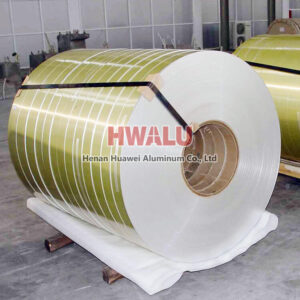
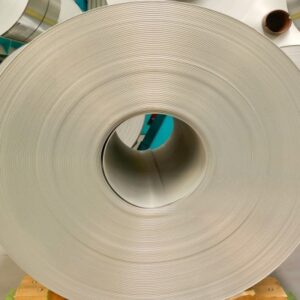


8079 O 0.010mm Laminated Packaging Foil
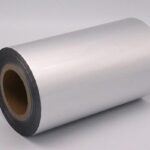

8079 O 0.010mm Laminated Packaging Foil
In the modern flexible packaging industry, aluminum foil has become an indispensable core substrate for high-end packaging due to its excellent barrier properties, flexibility, and processability. Among various options, 8079 O 0.010mm Laminated Packaging Foil stands out in demanding fields such as food, pharmaceuticals, and daily chemicals. It is an ideal choice that balances protective performance with lightweight requirements, thanks to its unique material characteristics and precise process adaptability.
1. What is 8079 O 0.010mm Laminated Packaging Foil?
8079 aluminum foil belongs to the 8xxx series of aluminum alloy foils. Based primarily on aluminum, it incorporates small amounts of alloying elements to optimize its properties. Through multiple rolling processes, its thickness is precisely controlled to an ultra-thin specification of 0.010mm (10μm).
The term “O Temper” indicates that the aluminum foil has undergone a full annealing and softening treatment. This process eliminates internal stresses and hardening caused by rolling, bringing the foil to a fully softened state. In this state, it possesses excellent ductility and formability, distinguishing it from hardened tempers (like H-state) and making it highly suitable for complex lamination and forming processes.
While this ultra-thin foil is inherently light and uniform, laminating it with various plastic films creates a composite packaging material that combines multiple functions. This structure retains the core advantages of aluminum foil while compensating for the shortcomings of single-layer foil, such as susceptibility to breakage and poor heat-sealing capability.
2. Chemical Composition and Material Properties of 8079 Aluminum Foil
(1) Main Chemical Composition of 8079 Aluminum Alloy
8079 aluminum alloy belongs to the Al-Fe-Si system. Its core chemical composition (mass fraction) strictly follows industry standards. As shown in the table below, it also contains trace impurities like Copper (Cu), Magnesium (Mg), and Manganese (Mn), which are tightly controlled to ensure material purity and performance stability.
| Chemical Component | Mass Fraction Range | Description |
|---|---|---|
| Aluminum (Al) | ≥99.0% | Base element, determines the fundamental properties of the foil |
| Iron (Fe) | 0.60% – 1.00% | Enhances foil strength and puncture resistance |
| Silicon (Si) | 0.20% – 0.50% | Optimizes ductility and processing performance |
| Impurities (Cu, Mg, etc.) | Trace amounts | Strictly controlled to prevent adverse effects |
- Compared to 8011 Aluminum Foil: 8079 has a slightly higher Iron content and lower Silicon content. This results in superior elongation, flexibility, and a lower pinhole rate, making it more suitable for ultra-thin specifications and deep-drawing processes.
- Compared to 1235 Aluminum Foil (Pure Aluminum): Thanks to its added Iron and Silicon elements, 8079 offers significantly higher strength and puncture resistance while maintaining excellent barrier properties. It avoids the issues of pure aluminum foil being too soft and easily damaged, thus fitting a wider range of packaging scenarios.
The chemical composition design of 8079 is the core foundation that allows it to balance flexibility, strength, and processability.
(2) Core Performance of 8079 Aluminum Foil
The core properties of 8079 O 0.010mm foil are optimized for packaging applications, directly addressing common industry pain points:
- High Elongation: After O softening, the elongation of 8079 foil can reach over 30% (far exceeding standard hardened foils). It is highly resistant to breaking or developing creases during lamination, stamping, and folding. This makes it perfect for complex forming processes and deep-drawing packaging, effectively reducing scrap rates.
- Excellent Flexibility: With a soft yet highly resilient texture, it can be folded repeatedly without breaking or developing pinholes. Even at 10μm, it can withstand the high-speed stretching and folding of automated packaging lines.
- Superior Barrier Performance: Aluminum foil inherently provides absolute barriers against oxygen, moisture, light, and odors. 8079 foil is precision-rolled to have a smooth surface, uniform thickness, and an extremely low pinhole rate. This effectively prevents the oxidation, moisture absorption, and spoilage of contents, extending shelf life—the primary reason for its widespread use in food and pharmaceutical packaging.
- Strong Puncture Resistance: Compared to pure aluminum and standard alloys, 8079 offers outstanding puncture resistance. It can withstand sharp or granular contents (e.g., coffee beans, nuts, pharmaceuticals), preventing package failure and contamination.
- Excellent Heat-Sealing Adaptability: After surface treatment, 8079 bonds perfectly with heat-seal layers like PE and CPP. It achieves high heat-sealing strength and airtight seals, preventing leaks and ensuring package integrity.
- Outstanding Lamination Processability: It features uniform surface tension, ensuring high bonding strength with films like PET, BOPP, and NY. It is compatible with dry lamination, solvent-free lamination, and other processes without delamination risks.
3. Structural Analysis of 8079 O Laminated Packaging Foil
Because a single layer of 0.010mm aluminum foil is fragile and cannot be heat-sealed directly, it must be laminated with plastic films to form a multi-layer structure (e.g., Film + Aluminum Foil + Film). Different structures cater to different packaging needs.
(1) Common Laminated Structures
- PET/AL/PE: The most common structure. PET (Polyester) provides outer strength and printability, AL (8079 foil) acts as the barrier, and PE (Polyethylene) serves as the heat-sealing inner layer. It offers a great balance of cost and performance, widely used for vacuum food packaging, condiments, and daily chemicals.
- BOPP/AL/CPP: BOPP (Biaxially Oriented Polypropylene) offers excellent printing gloss; CPP (Cast Polypropylene) provides a moderate heat-sealing temperature for high-speed production. Ideal for snacks, biscuits, and pet food.
- NY/AL/PE: NY (Nylon/Polyamide) offers superior puncture resistance and toughness. This structure is perfect for heavy-duty applications, vacuum packaging, and products with sharp edges (e.g., coffee, nuts, hardware).
- PET/AL/PA/CPP: A premium multi-layer structure. PET for printing/strength, AL for barrier, PA (Polyamide) for extreme puncture resistance, and CPP for sealing. Used for high-end electronics, medical devices, and precision instruments.
(2) Common Lamination Processes
- Dry Lamination: Adhesive is coated onto a film, dried to remove solvents, and then pressed onto the aluminum foil. It offers high bond strength and is suitable for high-end packaging, though solvent residue must be strictly controlled to meet food/medical safety standards.
- Solvent-Free Lamination: Uses 100% solid adhesives without solvents. It is environmentally friendly, energy-efficient, and leaves no toxic residue. This method is highly efficient and cost-effective for large-scale food and daily chemical packaging.
- Extrusion Lamination: Molten thermoplastic materials (like PE or CPP) are extruded directly onto the aluminum foil and cooled. This method requires no adhesive, reduces costs, and provides excellent heat-sealing properties, making it ideal for general food packaging and vacuum bags.
4. Core Advantages of 8079 Laminated Packaging Foil
Compared to traditional materials and other aluminum alloys, 8079 O 0.010mm laminated foil offers five distinct competitive advantages:
- All-in-One Barrier Protection: It completely blocks moisture, oxygen, and light while locking in aromas. This prevents spoilage, oxidation, and clumping, making it essential for sensitive products like milk powder, coffee, and pharmaceuticals.
- High Flexibility & Crease Resistance: The O treatment ensures the material can endure high-speed automated folding and stretching without breaking or leaving permanent creases, maintaining the package’s aesthetic appeal.
- Superior Puncture Resistance: The metallurgical properties of 8079, combined with the support of outer nylon layers, provide robust defense against sharp objects, significantly reducing damage during transport and storage.
- Excellent Printability & Processability: The outer plastic films (PET/BOPP) allow for high-definition, vibrant printing. Furthermore, its compatibility with high-speed automated lines boosts production efficiency.
- Food-Grade Safety: Manufactured from high-purity aluminum ingots with strictly controlled impurities, it complies with international standards (such as FDA and EU regulations). It is non-toxic and safe for direct contact with food, medicine, and cosmetics.
5. Main Application Fields
Thanks to its comprehensive properties, 8079 O 0.010mm laminated foil is widely used across multiple industries:
- Food Packaging: Coffee bags (preserving aroma and preventing oxidation), milk powder sachets (preventing clumping), condiment packets (leak-proof), pet food bags (puncture-resistant), and vacuum pouches for processed meats.

- Pharmaceutical Packaging: Blister packs and sachets for tablets/capsules/granules (protecting against humidity and light), sterile packaging for medical devices (syringes, dressings), and high-barrier films for biologics.
- Daily Chemical Packaging: Mask sachets (maintaining active ingredients), cosmetic samples (creams/serums), and wet wipe packaging (preventing drying out).
- Industrial Packaging: Moisture-proof shielding for electronic components (chips, resistors) and lightweight, flexible packaging for lithium-ion batteries (preventing leakage and oxidation).
6. 8079 vs. Other Packaging Aluminum Foils
Understanding the differences between 8079, 8011, and 1235 is crucial for material selection.
| Feature / Characteristic | 8079 Aluminum Foil | 8011 Aluminum Foil | 1235 Aluminum Foil |
|---|---|---|---|
| Material Type | Al-Fe-Si Alloy (8xxx Series) | Al-Fe-Si Alloy (8xxx Series) | Pure Aluminum (1xxx Series) |
| Key Chemical Difference | Higher Fe (0.60%-1.00%), Lower Si (0.20%-0.50%) | Standard Fe/Si ratio for general alloy foils | Minimum 99.35% Aluminum content |
| Elongation & Ductility | Highest (≥30%); Excellent for deep drawing and complex forming | Moderate (20%-25%); Suitable for standard lamination | High (Soft temper), but lacks structural memory |
| Strength & Puncture Resistance | Excellent; Highly resistant to tears and punctures | Good; General purpose durability | Poor; Very soft, easily pierced by sharp edges |
| Pinhole Rate (at 0.010mm) | Extremely Low; Stable and reliable barrier | Moderate; Quality can degrade in ultra-thin specs | Low to Moderate; Prone to micro-perforations |
| Ultra-Thin Processing | Superior; Stable production down to 0.008mm | Limited; Challenging below 0.012mm | Good; But structural integrity is compromised |
| Typical Applications | High-end pharma, coffee, lithium battery, cosmetic sachets | Household foil, yogurt lids, general food wrapping | Candy wrappers, chocolate foil, simple storage |
| Cost Efficiency | Higher Cost; Premium performance justifies the price | Cost-Effective; Best for high-volume, standard jobs | Lowest Cost; Economical for disposable uses |
7. How to Choose High-Quality 8079 Laminated Packaging Foil
Selecting the right foil directly impacts product safety and shelf life. Here are four key considerations:
- Raw Material Quality: Ensure the supplier uses high-purity aluminum ingots (≥99.0% Al) with strictly controlled impurity levels and stable Fe/Si ratios.
- Key Technical Indicators: Verify the thickness tolerance (±0.001mm for 0.010mm foil), pinhole rate (≤3 holes/m², diameter ≤0.03mm), bonding strength (≥1.5N/15mm), and surface wettability.
- Certifications: Look for ISO 9001 quality management certification, FDA food-grade compliance, EU RoHS directives (restricting hazardous substances), and SGS third-party test reports.
- Supplier Reliability: Partner with experienced manufacturers who possess advanced automated rolling/lamination equipment and rigorous quality control systems. For instance, suppliers like Henan Huawei Aluminum Co., Ltd. are highly regarded in the industry for their expertise in ultra-thin foil production, ensuring dimensional accuracy and batch-to-batch consistency.

8. FAQ (Frequently Asked Questions)
- Q1: Why is 8079 aluminum foil suitable for ultra-thin packaging?
- A: Its precise chemical composition (Fe/Si ratio) maintains strength and flexibility even at 10μm. The O annealing maximizes ductility, and its extremely low pinhole rate ensures a reliable barrier in ultra-thin gauges.
- Q2: Is 0.010mm aluminum foil easy to break?
- A: Not at all. The O treatment gives it exceptional flexibility and elongation. When laminated with plastic films, its structural integrity is highly enhanced, allowing it to withstand the mechanical stress of automated packaging lines and transportation.
- Q3: Which is better for laminated packaging, 8079 or 8011?
- A: It depends on the application. For high-end, high-performance packaging (pharma, coffee, liquids), 8079 is the clear winner. For standard, cost-sensitive applications (like basic food wraps), 8011 offers a better price-to-performance ratio.
- Q4: Is 8079 aluminum foil safe for direct food contact?
- A: Yes. It is manufactured from high-purity aluminum, uses non-toxic laminating adhesives, and complies with international food safety standards (e.g., FDA, EU), making it completely safe for direct food contact.
- Q5: What are the most common laminated foil structures?
- A: The top four are PET/AL/PE, BOPP/AL/CPP, NY/AL/PE, and PET/AL/PA/CPP. Each offers a different balance of printability, puncture resistance, and moisture barrier.
- Q6: What are the typical applications for 8079 O foil?
- A: It is typically used for coffee bags, pharmaceutical blister packs, facial mask sachets, electronic component shielding, and lithium battery packaging.
- Q7: How can the pinhole rate of 8079 foil be minimized?
- A: By using high-purity aluminum ingots, optimizing the rolling process parameters, and implementing strict quality control using professional detection equipment (like ZKD-01 foil pinhole testers) to filter out defective batches.
9. Conclusion
8079 O 0.010mm Laminated Packaging Foil is a cornerstone material in modern high-end flexible packaging.
Through its precise metallurgical formulation, superior ductility, and versatile lamination structures, it successfully bridges the gap between lightweight design and robust product protection.
As the packaging industry pivots towards sustainability, miniaturization, and premiumization, the demand for 8079 foil is set to rise. Whether you are in the food, pharmaceutical, cosmetic, or electronics sector, choosing high-quality 8079 laminated foil is a strategic decision that enhances product shelf life, elevates brand value, and meets the rigorous safety standards of the global market.