

1235 Tape Aluminum Foil Price: Gauges, Cost Factors and Buyer’s Guide

1235 Tape Aluminum Foil Price: Gauges, Cost Factors and Buyer’s Guide
Introduction
Buyers searching “1235 tape aluminum foil price” are usually after one of two products: soft 1235-O aluminum foil in jumbo or slit rolls sold to adhesive-tape and laminating converters, or finished self-adhesive aluminum foil tape used to seal HVAC ducts, pipe insulation and vapor-barrier joints.
The two are priced very differently—the first per ton of bare foil, the second per roll or per square meter of converted tape.
This guide covers what 1235 tape foil is, standard gauges, tempers and widths, how the price is built, the factors that move it, indicative market ranges (which track the daily ingot price), and what to send a factory for an accurate quote.
What Is 1235 Tape Aluminum Foil?
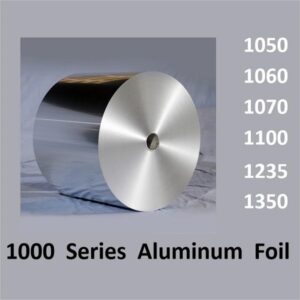
1235 is a commercially pure 1xxx-series aluminum alloy (minimum about 99.35% Al). In the soft annealed O temper it is highly ductile and dead-soft, so it conforms tightly to duct and pipe surfaces without spring-back
the reason it is the dominant backing for pressure-sensitive aluminum tape. It is also widely used for cable shielding, bottle caps, battery foil and flexible lamination. There are two supply forms:
- Bare converter foil—1235-O jumbo or slit foil (plain, single-bright) that a tape maker coats with acrylic, rubber or hot-melt adhesive and laminates to a release liner.
- Finished foil tape—foil plus adhesive and liner, sometimes reinforced with glass-fiber scrim (FSK: foil/scrim/kraft), supplied as branded or OEM rolls.
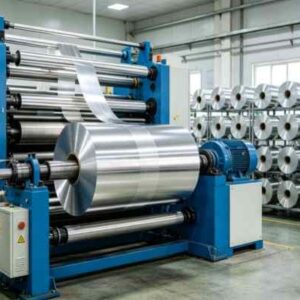
Mill range is roughly 0.018–0.20 mm thick and 100–1700 mm wide on 76 mm (3 in) or 152 mm (6 in) cores, in O or H18; finished HVAC tape most often uses 18–100 μm foil.
Common Specifications and Area Yield
| Parameter | Typical range for 1235 tape foil |
| Alloy / temper | 1235-O (soft, most common); 1235-H18 for stiffer web |
| Foil thickness | approx. 18–100 μm for tape; jumbo foil to 0.20 mm |
| Width | jumbo 100–1700 mm; slit tape 20–1500 mm to order |
| Surface | single-bright, dry, oil-free; width tolerance about ±1 mm |
| Core | 76 mm / 152 mm ID; paper or steel core |
| Adhesive (finished tape) | solvent acrylic, water acrylic or hot-melt; glassine/PE liner |
| Reinforced types | FSK (foil/scrim/kraft), glass-fiber mesh for tear strength |
At about 2.70 g/cm³, g/m² = thickness (μm) × 2.70, so thinner foil yields far more area per ton—key when comparing price per ton against price per m²:
| Foil gauge | g/m² | Approx. m² per ton |
| 18 μm | 48.6 | 20,600 |
| 30 μm | 81.0 | 12,300 |
| 40 μm | 108 | 9,260 |
| 50 μm | 135 | 7,410 |
| 75 μm | 202.5 | 4,940 |
| 100 μm | 270 | 3,700 |
How the 1235 Tape Foil Price Is Built
Bare 1235-O foil is quoted per metric ton as: price per ton = aluminum ingot base price + rolling/processing fee.
The ingot component (linked to LME, Shanghai/Changjiang or A00 spot aluminum) is the largest part and moves daily, so no mill can publish a fixed annual price.
The processing fee covers casting, rolling, O-temper annealing, slitting, inspection and packing and is relatively stable.
Finished tape is quoted per roll or per m², adding adhesive and its coating weight, release liner, optional scrim/kraft reinforcement, final slitting and winding, labeling, carton packing and converter margin.
The foil is only part of a finished-tape price, so cheaper foil does not automatically mean the cheapest converted roll.
Factors That Change the Price
- Gauge and width: very thin or very narrow foil needs more rolling and slitting passes, raising the processing fee per ton even though area yield is higher.
- Temper and surface: O-temper annealing and a clean, oil-free, low-pinhole surface add cost; shielding grades are tighter than general HVAC foil.
- Bare foil vs converted tape: adhesive, liner and FSK reinforcement add clear per-m² cost.
- Quantity: full-container and multi-ton orders get the lowest fee; small trial lots and custom widths carry a setup premium.
- Core and packaging: steel cores, export pallets, moisture-proof wrapping and private-label cartons affect the price.
- Market and logistics: the daily ingot price, USD/CNY rate and FOB/CFR/CIF freight all shift landed cost.
Indicative Price Ranges (Reference Only)
These are indicative ranges from B2B platforms and mill quotations, not a fixed offer; reconfirm them against today’s ingot price, gauge, width and quantity.
| Product form | Usually priced | Indicative reference range |
| 1235-O bare jumbo/slit foil | per metric ton (FOB) | roughly the ingot price plus a processing fee; B2B listings commonly sit in the low-thousands to about US$5,000+/MT, varying with gauge and market |
| Standard HVAC foil tape (small rolls) | per roll | about US$0.2–3/roll for common gauges/lengths at volume; thicker or longer rolls cost more |
| Engineering / FSK reinforced tape | per m² or roll | often about US$2–3+/m²; heat-resistant and scrim-reinforced grades are higher |
Compare quotations on the same gauge, tape width and roll length, adhesive, liner, reinforcement, core, quantity and Incoterm; a per-ton foil quote and a per-roll tape quote describe different products.
Main Applications
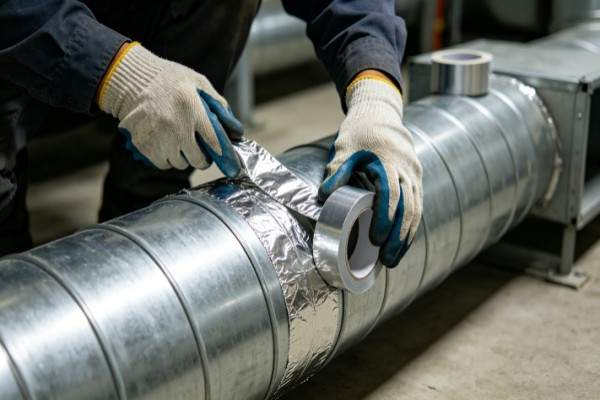
- Sealing joints and seams of galvanized HVAC duct, flexible duct and fiberglass duct board (UL 181A-P / 181B-FX type systems).
- Vapor-barrier sealing and jacketing seams on pipe, tank and duct insulation in HVAC, refrigeration and industrial plants.
- Refrigerator and appliance assembly, kitchen range hoods, metal repair, patching and heat reflection.
- Electromagnetic shielding of cables and electronics (often laminated AL/PET), and general moisture-proof, heat-resistant wrapping.
1235 vs 8011, and How to Order
1235-O is the economical, dead-soft, conformable choice that dominates general tape and shielding foil. 8011-O, with more iron and silicon, is slightly stronger with fewer pinholes in very thin gauges, suiting household/food foil and tougher webs.
For tear resistance in insulation, choose FSK or glass-scrim-reinforced tape rather than thicker plain foil.
For a precise price, send: alloy and temper (1235-O); gauge and tolerance; slit width and roll length/OD; bare foil or finished tape; adhesive type and coating weight;
liner and reinforcement (plain/FSK/mesh); core ID; quantity; application and standards (UL 181, food/electronic grade);
packaging and destination port. Reputable mills supply an MTC, gauge/pinhole and adhesion data, samples, ISO 9001 and SGS/BV inspection; common terms are 30% deposit with the balance against the bill of lading, FOB/CFR/CIF.
Frequently Asked Questions
Q: What is the price of 1235 tape aluminum foil?
A: Bare 1235-O foil is priced per ton as ingot price plus a processing fee and changes daily; finished HVAC tape is priced per roll or m² with adhesive and liner added. Treat the ranges above as reference and request a same-day quote.
Q: Why is there no fixed price?
A: Aluminum is most of the cost and tracks fluctuating LME/Shanghai spot ingot prices; gauge, width, quantity, adhesive and freight also move the number.
Q: Which gauge should I choose?
A: General HVAC seam tape commonly uses about 30–50 μm foil; light wrapping can use 18–30 μm, while heavy-duty, outdoor or reinforced jobs use 75–100 μm or FSK.
Q: 1235 or 8011 for tape foil?
A: 1235-O is the standard soft, economical, conformable tape backing; choose 8011 when you need slightly higher strength and toughness, and FSK/scrim when tear resistance matters most.
Q: Is it cheaper to buy bare foil or finished tape?
A: Converters buy bare jumbo per ton and add adhesive, liner and slitting; end users buy finished rolls. Bare foil is only cheaper if you run your own coating and laminating line.
Q: What is the MOQ and lead time?
A: Jumbo foil MOQ is commonly several tons per spec (trials negotiable); finished tape MOQ is often a few thousand rolls or hundreds of square meters, with lead time set by quantity and customization.
Conclusion
The 1235 tape foil “price” is really two: a per-ton ingot-plus-processing rate for soft 1235-O converter foil, and a per-roll or per-m² rate for finished, often reinforced HVAC tape.
Both move with the aluminum market, gauge, width, adhesive and quantity. Define the full spec and compare like-for-like on the same Incoterm.