
8011 Foglio di alluminio: Proprietà meccaniche, Qualità della superficie & Application Guide
Introduzione
8011 aluminum foil properties play a decisive role in determining the overall performance of packaging materials, household foil products, pharmaceutical sealing, and industrial laminates. As one of the most widely used alloys in the global aluminum foil market, 8011 is preferred by converters and brand manufacturers due to its strength-to-weight balance, resistenza alla corrosione, excellent barrier characteristics, and reliable forming behavior. In high-volume production environments, this alloy delivers consistent processing stability, making it ideal for applications requiring strict hygiene and mechanical precision.

1. Material Characteristics and Alloy Behavior
8011 aluminum foil belongs to the 8xxx series of Al-Fe-Si alloys. Its mechanical and corrosion-resistance characteristics are partly defined by the presence of iron and silicon which enhance strength and improve formability. Unlike pure aluminum grades such as 1050 O 1235, lega 8011 is engineered to withstand the demands of composite packaging lines, sealing technologies, and deep-forming operations.
Highlights of the Alloy Behavior
- Balanced strength for both thin and medium gauges
- Higher elongation compared with many 1-series foils
- Strong crack inhibition during repeated bending
- High-temperature tolerance for cooking and sterilization
- Excellent adhesion to coatings and adhesives used in composite materials
These attributes allow 8011 to outperform several conventional foil alloys in advanced packaging structures.
2. Proprietà meccaniche: Influence of Temper and Thickness
Mechanical performance is one of the most important quality indicators for industrial foil users. Resistenza alla trazione, allungamento, resistenza stenopeica, and yield consistency directly affect downstream forming, taglio, and sealing processes.
Mechanical Behavior Across Tempers
Different tempers (O, H14, H18) change the alloy’s microstructure. Per esempio:
- O temperamento offers high ductility suitable for heavy forming and household use.
- H14 provides moderate strength needed for blister foil and heat-sealing layers.
- H18 gives the highest strength but lowest elongation for high-rigidity films and insulation products.

Tavolo 1: Proprietà meccaniche di 8011 Aluminum Foil by Temper
| Temperare | Spessore tipico (mm) | Resistenza alla trazione (MPa) | Allungamento (%) | Applicazioni |
|---|---|---|---|---|
| O | 0.008–0.050 | 60–95 | 12–20 | Foglio per la casa, coperchi dei contenitori |
| H14 | 0.018–0.060 | 110–150 | 3–8 | Blister foil, pharmaceutical sealing |
| H18 | 0.010–0.040 | 150–185 | 1–4 | Industrial laminates, Schermatura EMI |
These values represent industry-standard ranges and may differ by manufacturer.
3. Surface Quality Requirements for High-Grade 8011 Sventare
Surface performance determines the material’s appearance, hygiene safety, composite adhesion, and conversion efficiency. For food and pharmaceutical applications, surface uniformity and cleanliness are critical.
Major Surface Quality Requirements
- Liscio, uniform gloss with no visible texture deviations
- Absence of roller marks, polvere, graffi, and black spots
- Low oil-residue levels to ensure compliance with food regulations
- Strict control of pinhole quantity for barrier-sensitive applications
- Consistent thickness tolerance across full coil width and length
High-end pharmaceutical and food converters often use automated vision inspection systems to ensure defect-free foil before lamination or coating.

4. Surface Defect Comparison: Standard vs Substandard Foil
Surface integrity not only impacts product quality but also affects sealing strength, printing adhesion, e aspetto estetico.
Tavolo 2: Surface Defect Comparison — Standard vs. Substandard 8011 Sventare
| Criteri | Standard 8011 Sventare | Substandard Foil Indicators |
|---|---|---|
| Densità del foro stenopeico | < 100 fori stenopeici/m² | Hundreds to thousands per m² |
| Oil Residue | < 3 mg/m² | Visible smudges or staining |
| Lucentezza & Colore | Uniform metallic tone | Patchy brightness or dull zones |
| Planarità | < 2 mm deviation | Onde di bordo, rughe, buckling |
| Pulizia della superficie | No dust, nessun graffio | Embedded particles, streak lines |
This comparison highlights the gap between premium-grade foil and inexpensive, quality-inconsistent materials.
5. Campi di applicazione di 8011 Foglio di alluminio
Because of its performance advantages, 8011 aluminum foil serves as a core material in numerous industries. Its adaptability to various manufacturing systems—slitting, laminazione, Rivestimento, formando, and sealing—makes it one of the most commercially successful foil alloys worldwide.
5.1 Foglio di alluminio per uso domestico
Household aluminum foil must be flexible yet tear-resistant, capable of wrapping uneven food shapes while withstanding oven and stovetop temperatures. 8011 alloy offers:
- Eccellente conducibilità termica
- Stable performance during folding and bending
- Safe barrier for food storage and cooking
5.2 Pellicola per imballaggio alimentare
Many food packaging structures rely on multilayer films incorporating 8011 Foglio. I suoi vantaggi includono:
- High oxygen and moisture barrier
- Flavor and aroma retention
- Excellent light protection for sensitive products
- Strong compatibility with coatings and heat-seal layers
Typical applications include yogurt lids, food container lids, buste di storta, and laminated snack packaging.
5.3 Pharmaceutical Packaging Foil
8011 is widely used in:
- PTP blister foil
- Cold-form base foil
- Sealing lid foil for medicine jars and bottles
Key performance requirements:
- High sealing strength
- Zero-contamination surface
- High-temperature stability
- Controlled thickness and hardness
The alloy’s reliability ensures that pharmaceutical packaging meets strict global regulatory standards.
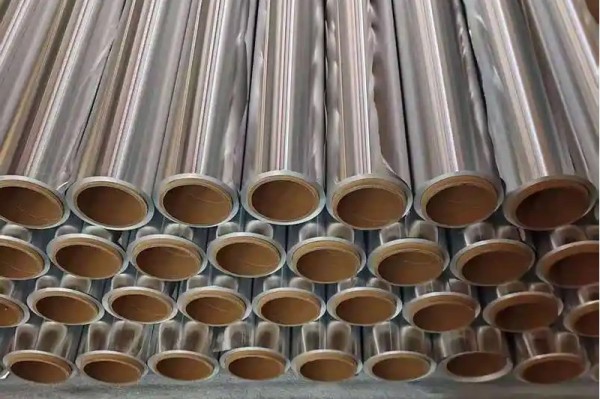
5.4 Industrial and Electrical Applications
Beyond food and pharmaceuticals, 8011 foil is preferred in multiple industrial sectors:
- Cable shielding for electromagnetic protection
- HVAC foil for insulation and reflective surfaces
- Industrial laminates for chemical-resistant structures
Its high strength-to-thickness ratio makes it suitable for lightweight engineering materials.
6. Quality Control Considerations for Manufacturers
To ensure stable mass production, companies typically monitor:
- Rolling tension consistency
- Annealing temperature and duration
- Cleanliness of rolling oil
- Online pinhole detection
- Edge trimming and slitting stability
These factors determine whether the finished foil meets the stringent quality demands of international buyers.
7. Common Questions (FAQ)
1. What makes 8011 more popular than 1235 in the packaging industry?
8011 provides higher strength, better elongation, and superior crack resistance, making it suitable for forming and sealing applications where 1235 may be too soft.
2. È 8011 safe for food and pharmaceutical contact?
SÌ. When produced under food-grade or pharma-grade standards, it is non-toxic, resistente alla corrosione, and compliant with global safety regulations such as FDA and EU standards.
3. How can surface quality be evaluated during inspection?
Key evaluation metrics include pinhole count, uniformità del colore, oil residue measurement, and roller mark inspection.
4. Why does temper selection matter?
Different tempers provide different strengths and flexibility. Per esempio, O temper is softer for wrapping and forming, while H18 is stronger for rigid laminates.
5. Potere 8011 foil resist high cooking temperatures?
SÌ. It can withstand typical oven, cottura al forno, sterilizzazione, and retort conditions used in modern food processing.
6. What are the most common causes of pinholes?
Pinholes originate from impurities in cast ingots, rolling defects, or incorrect annealing processes.
7. Does thickness affect barrier performance?
Generalmente, thinner foil increases the risk of pinholes, while thicker foil offers better mechanical strength and barrier reliability.
Conclusione
A deep understanding of 8011 foglio di alluminio proprietà is essential for selecting the right material for household foil, high-barrier packaging, pharmaceutical blister film, and industrial laminates. With excellent mechanical performance, stable surface quality, and broad processing adaptability, 8011 remains a cornerstone alloy in global foil manufacturing. By controlling surface defects, optimizing temper selection, and maintaining strict production standards, manufacturers can achieve superior product performance and higher yield in downstream applications.