
Key Technical Points in the Preparation of 8079 Aluminum Foil Composite Soft Package on High-Cleanliness Production Lines
1. Introduction
In recent years, the global demand for advanced flexible packaging materials has increased rapidly, particularly in the pharmaceutical, food, and high-end electronics industries. These industries require materials that offer not only excellent barrier properties but also high cleanliness, mechanical strength, and chemical stability. Among the various aluminum-based materials available, the 8079 aluminum foil composite soft package has gained significant attention for its superior performance in hermetic sealing, ductility, and resistance to environmental stress.
Unlike traditional aluminum foil, the 8079 alloy is specifically engineered for applications requiring extreme purity and precision. High-cleanliness production lines are therefore essential to maintain the foil’s physical and chemical integrity during manufacturing. This paper provides a comprehensive technical analysis of the production process, from alloy melting to composite lamination and final inspection, focusing on key parameters, process optimization, and quality control systems for achieving top-grade cleanliness and consistency.

2. Material Characteristics of 8079 Aluminum Alloy
2.1 Alloy Composition and Metallurgical Features
The 8079 alloy belongs to the Al–Fe–Si series, combining high strength and flexibility. Its chemical composition and metallurgical functions are summarized below:
| Element | Content (%) | Function |
|---|---|---|
| Al | ≥99.3 | Provides ductility, thermal stability, and corrosion resistance |
| Fe | 0.6–1.0 | Increases tensile strength and resistance to tearing |
| Si | 0.05–0.3 | Enhances oxidation resistance and rolling performance |
| Mn | ≤0.05 | Improves corrosion resistance and structural integrity |
| Cu | ≤0.05 | Strengthens thermal conductivity |
| Zn | ≤0.10 | Boosts anti-corrosion and surface brightness |
The optimized balance of iron and silicon in the 8079 alloy ensures uniform grain distribution, better elongation properties, and excellent performance during cold rolling and lamination.
2.2 Physical and Mechanical Properties
8079 aluminum foil demonstrates a combination of high tensile strength, exceptional elongation, and superior barrier performance:
- Tensile strength: ≥100 MPa
- Elongation: ≥2.0%
- Water vapor transmission rate: ≤0.01 g/m²·24h
- Oxygen transmission rate: ≤0.1 cm³/m²·24h
- Surface oil residue: ≤30 mg/m²
These properties make the 8079 aluminum foil composite soft package ideal for pharmaceutical blister packs, retort pouches, and electronic moisture-proof films.
3. High-Cleanliness Production Line Design
3.1 Cleanroom Classification and Zoning
A high-cleanliness production line is divided into melting, casting, rolling, annealing, laminating, and slitting zones. Each must comply with ISO cleanroom standards:
| Process Area | ISO Class | Air Exchange Rate | Particle Limit (≥0.5μm) | Temperature | Humidity |
|---|---|---|---|---|---|
| Melting | ISO 9 | ≥10 times/hour | ≤3,500,000 particles/m³ | 25±2°C | 50±5% |
| Casting & Rolling | ISO 8 | ≥20 times/hour | ≤350,000 particles/m³ | 23±2°C | 45±5% |
| Annealing & Laminating | ISO 7 | ≥30 times/hour | ≤35,000 particles/m³ | 22±2°C | 45±3% |
| Slitting & Packaging | ISO 7 | ≥35 times/hour | ≤20,000 particles/m³ | 22±2°C | 40±3% |
The entire air system uses multi-stage filtration (G4, F7, and HEPA H14) and maintains a constant positive pressure gradient to prevent contamination transfer.
3.2 Environmental Control
- Temperature stability: ±2°C across production areas
- Relative humidity: maintained between 40–50%
- Airflow direction: laminar downward flow to reduce particle accumulation
- Noise and vibration control: under 60 dB and 0.01 mm amplitude
Regular calibration of sensors, differential pressure monitors, and HEPA filters ensures sustained compliance with ISO standards.
3.3 Personnel and Material Flow Management
Personnel must pass through multi-stage air showers and disinfection chambers before entry. Raw materials are vacuum-sealed and opened only in buffer zones equipped with negative pressure exhausts. The Manufacturing Execution System (MES) tracks every operation, including operator ID, batch number, and real-time cleanliness data.

4. Melting and Casting Technology
4.1 Controlled Melting
The purity of molten aluminum determines the cleanliness of the final foil.
- Melting temperature: 740–760°C
- Degassing method: online rotary argon degassing; hydrogen content ≤0.15 mL/100g Al
- Filtration: ceramic foam filters (40–60 PPI) to remove inclusions
- Stirring: electromagnetic stirring to prevent mechanical contamination
4.2 Continuous Casting
The molten alloy is cast into 6–8 mm thick slabs using a twin-roll caster:
- Casting speed: 900±50 mm/s
- Exit temperature: 580–620°C
- Surface roughness (Ra): ≤0.3 μm
- Lubrication oil filtration: ≤5 μm
The cooling water system operates in a closed loop, maintaining a conductivity below 2 μS/cm to eliminate ionic impurities.
5. Cold Rolling and Annealing
5.1 Multi-Stage Rolling
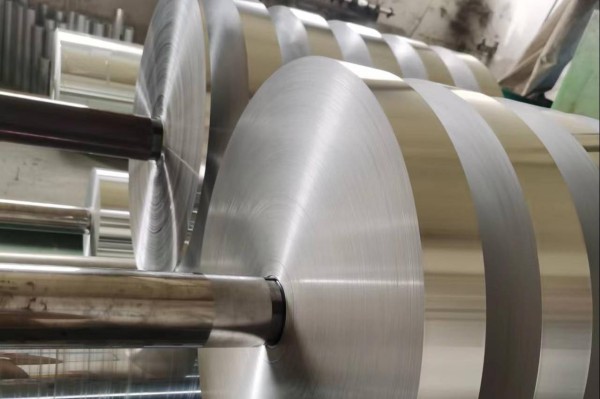
The casting slabs are cold rolled through 4–5 passes to reach a final thickness of 7–15 μm. Each pass reduction is limited to 35% to avoid excessive grain elongation. The process utilizes Automatic Gauge Control (AGC) and Automatic Flatness Control (AFC) systems to maintain a uniform thickness tolerance of ±2 μm.
5.2 Vacuum Annealing
Annealing enhances ductility and surface cleanliness:
- Temperature: 320–380°C
- Duration: 6–12 hours
- Vacuum level: ≤1×10⁻³ Pa
This process removes rolling oil residues and relieves internal stress. The resulting aluminum foil exhibits high surface brightness and excellent composite adhesion strength.
6. Surface Cleaning and Static Control
After annealing, foil surfaces undergo neutral detergent ultrasonic cleaning at 45°C. The filtration precision of the cleaning liquid is ≤1 μm, and the cycle frequency is less than 24 hours. To prevent static-induced dust attraction, ionizing air bars are installed along slitting and winding sections, maintaining a surface potential below 50 V.
All cleaned foil rolls are vacuum-sealed within 24 hours and stored under controlled temperature (<20°C) and humidity (<40%) before lamination.
7. Lamination and Slitting Technology
7.1 Lamination Parameters
The 8079 aluminum foil composite soft package is typically laminated with PET, PE, or CPP films using solvent-based or solvent-free polyurethane adhesives.
- Adhesive coating: 1.5–2.0 g/m²
- Lamination temperature: 85–95°C
- Line tension: 15–25 N
- Curing: 40°C for 48 hours
Proper lamination ensures strong adhesion, uniform tension, and excellent barrier stability.
7.2 Slitting and Rewinding
Precision slitting requires blade sharpness and tension uniformity.
- Width tolerance: ±0.3 mm
- Burr height: <3 μm
- Tension control deviation: <1.5 N
After slitting, each roll is vacuum-packed in anti-static bags with a digital QR tracking code for full traceability.
8. Quality Control and Performance Evaluation
Table 1. Key Physical Properties of 8079 Foil
| Parameter | Standard | Method | Description |
|---|---|---|---|
| Thickness deviation | ±2 μm | Laser gauge | Dimensional uniformity |
| Tensile strength | ≥100 MPa | GB/T 228.1-2010 | Structural stability |
| Elongation | ≥2% | Tensile tester | Ductility |
| Surface cleanliness | Oil residue < 30 mg/m² | Infrared analysis | Purity |
| Pinholes | ≤0.3/m² | Electrolytic method | Barrier reliability |
Table 2. Lamination Performance
| Property | Standard | Test Method |
|---|---|---|
| Peel strength | ≥3.0 N/15 mm | GB/T 8808-2017 |
| Heat seal strength | ≥25 N/15 mm | ASTM F88 |
| WVTR | ≤0.01 g/m²·24h | ASTM F1249 |
| OTR | ≤0.1 cm³/m²·24h | ASTM D3985 |
Table 3. Cleanliness Monitoring Frequency
| Parameter | Control Standard | Frequency |
|---|---|---|
| Airborne particles | ≤35,000/m³ | Per shift |
| Oil mist concentration | ≤0.2 mg/m³ | Daily |
| Surface dust residue | ≤10 mg/m² | Per roll |
| Machine vibration | ≤0.01 mm | Weekly |
| Pressure differential | 250–300 Pa | Continuous |

9. Application Fields and Case Studies
9.1 Pharmaceutical Packaging
In pharmaceutical blister packs, the 8079 aluminum foil composite soft package acts as a superior barrier layer, protecting capsules and tablets from oxidation and moisture. It also maintains drug stability over extended shelf lives.
Case Example: A European pharmaceutical manufacturer reported a 30% increase in shelf life after replacing conventional 8011 foil with 8079 alloy foil in its PVC/AL laminate structure.
9.2 Food Packaging
Used in coffee, chocolate, and powdered milk pouches, 8079 aluminum foil offers outstanding aroma preservation and oxygen isolation. Its excellent heat-sealing properties enhance product integrity during long-distance transport.
9.3 Electronic Component Protection
The foil’s anti-static surface treatment and moisture resistance make it suitable for packaging integrated circuits, sensors, and optical components. When laminated with conductive polymer films, it meets ESD standards (surface resistance ≤10⁹ Ω).
10. Smart Manufacturing and Sustainability
10.1 Intelligent Production Systems
High-cleanliness production lines increasingly integrate AI-driven inspection and predictive analytics:
- Machine vision detects micro-defects such as pinholes, scratches, or oil stains.
- MES and ERP integration ensures full product traceability.
- Adaptive Process Control (APC) automatically adjusts rolling force, temperature, and speed based on real-time sensor feedback.
10.2 Green and Circular Manufacturing
To meet global sustainability standards, manufacturers are implementing:
- Solvent-free lamination adhesives to reduce VOC emissions;
- Cooling oil filtration and recycling systems;
- Waste heat recovery from annealing furnaces;
- 98% aluminum scrap recycling efficiency.
These initiatives reduce carbon emissions and enhance environmental compliance across the entire 8079 aluminum foil composite soft package lifecycle.
11. Conclusion
The preparation of the 8079 aluminum foil composite soft package on high-cleanliness production lines represents a sophisticated integration of material science, environmental control, and precision engineering. From alloy purity to digitalized process management, every stage affects product performance and consistency.
As the global market continues to prioritize clean, safe, and sustainable packaging, this technology will play an increasingly vital role in pharmaceuticals, food safety, and electronics protection. The trend toward intelligent and green manufacturing ensures that 8079 aluminum foil will remain a cornerstone material in the future of high-performance flexible packagin