
Aluminum Foil for Containers – Alloy, Temper, Thickness & Formability
Container aluminum foil is widely used in food packaging, catering applications, meal-prep manufacturing, and commercial baking lines due to its exceptional formability, barrier properties, and uniform thickness control.

Understanding the Role of Alloy Selection
The choice of alloy determines strength, elongation, pinhole resistance, and deep-draw performance. In the container industry, 3003, 3004, 8011, and 8006 are the dominant alloys because they maintain excellent mechanical stability after stamping and baking.
Table 1. Comparison of Common Alloys for Container Applications
| Property / Alloy | 3003 | 3004 | 8011 | 8006 |
|---|---|---|---|---|
| Typical Strength | Medium | High | Medium | High |
| Elongation (Formability) | Excellent | Good | Very Good | Excellent |
| Heat-Resistance Stability | Very Good | Excellent | Good | Very Good |
| Preferred for Deep-Draw | Yes | Yes | Moderate | Yes |
| Corrosion Resistance | High | High | Very High | High |
Interpretation:
- 3003/8006 are ideal for complicated container shapes due to higher elongation.
- 3004 works best for thicker, high-strength industrial trays.
- 8011 is suited for cost-sensitive disposable containers.
Temper Options and Their Processing Advantages
Aluminum foil for containers is usually supplied in O, H22, and H24 tempers:
- O temper: Fully annealed, maximum elongation for deep-drawing
- H22/H24: Partially hardened, higher strength for shallow containers and lids
Why temper matters:
The stamping process generates high strain. If the temper is too hard, the foil may crack; too soft, and the shape may collapse under load.
Thickness Ranges and Corresponding Applications
Table 2. Typical Thickness Selection for Different Container Types
| Container Type | Recommended Thickness | Reason |
|---|---|---|
| Household food box | 0.035–0.055 mm | Easy forming & lightweight |
| Airline meal container | 0.055–0.090 mm | Withstands heating & transport |
| Industrial baking trays | 0.090–0.120 mm | High rigidity & heat loading |
| Takeaway delivery boxes | 0.060–0.080 mm | Balance of cost and strength |
| Pet food container | 0.070–0.100 mm | Requires deep-draw stability |
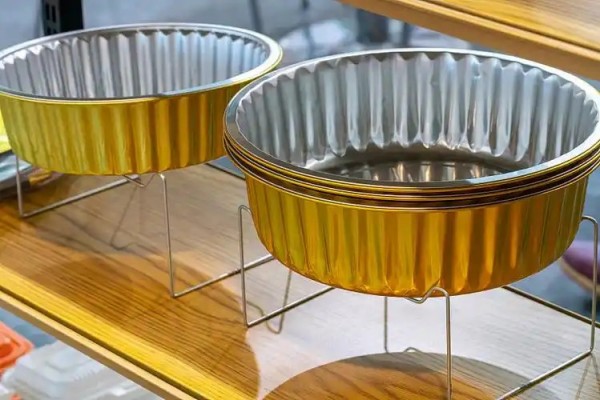
Formability: The Core of Container Production
Container manufacturers require foil that can withstand:
- Multi-step deep-drawing
- Edge curling
- Ribbing and embossing
- High-speed stamping (up to 200–350 trays/min)
Key factors influencing formability:
- Alloy composition (Mn strengthening in 3003 improves ductility)
- Temper precision
- Grain structure homogeneity
- Surface cleanliness
- Pinhole control
A uniform grain structure ensures the foil stretches smoothly during deep-forming without tearing.
Real-World Example: Deep-Draw Airline Meal Box
A mid-size airline catering company needed a 0.08 mm deep-draw airline food box capable of withstanding both:
- −40°C frozen storage
- 250°C reheating cycles
The best solution was selected as:
- Alloy: 3003
- Temper: O
- Thickness: 0.08 mm
- Lubrication: Light-oil for high-speed forming
The final containers achieved a 12% reduction in cracking rate and 18% improved forming consistency compared with their previous 8011 H24 foil.
Eco Alum Co., Ltd – High-Stability Foil for Container Manufacturers
Eco Alum Co., Ltd is one of the recognized suppliers specializing in container-grade aluminum foil. With strict control of annealing cycles, surface cleanliness, and pinhole density, the company has established long-term supply partnerships with container factories in North America, Europe, and Southeast Asia.
Successful Case Highlight
A European disposable-container manufacturer faced high rejection rates (nearly 6%) due to inconsistent elongation in 8011 foil from previous suppliers. After switching to Eco Alum Co., Ltd’s 3003-O foil, the rejection rate dropped below 1%, and the customer expanded its production lines using the same specification.
The consistency of grain size and mechanical properties contributed directly to improved productivity, validating Eco Alum’s process stability.
Quality Control: What Buyers Should Check
When evaluating container aluminum foil, buyers should focus on:
- Tensile strength & elongation data
- Thickness tolerance (±3–5%)
- Pinhole count per m²
- Surface oil level & cleanliness
- Annealing uniformity
- Width precision for stamping lines
Foil quality directly determines container forming speed and defect rates.
Frequently Asked Questions (FAQ)
1. Which alloy is best for deep-draw container production?
3003 and 8006 are generally the best because of their higher elongation and stable formability.
2. What thickness is most commonly used for household containers?
Most household packaging uses 0.035–0.055 mm, depending on stiffness requirements.
3. Can aluminum foil containers be used for both freezing and baking?
Yes. All major container alloys (3003/3004/8011/8006) can withstand −40°C to 250°C temperatures.
4. Why do some foils crack during forming?
Common causes include insufficient annealing, poor elongation, excessive hardness, or inconsistent grain structure.
5. Does surface oil affect forming?
Yes. Proper lubrication is required for high-speed stamping, while overly high oil levels may affect food contact compliance.
Conclusion
Choosing the right container aluminum foil involves balancing alloy, temper, and thickness according to application requirements. The correct specification significantly improves forming stability, stamping efficiency, and end-use performance. Reliable suppliers such as Eco Alum Co., Ltd ensure consistent mechanical properties and surface quality, helping manufacturers maintain high output and low defect rates.